



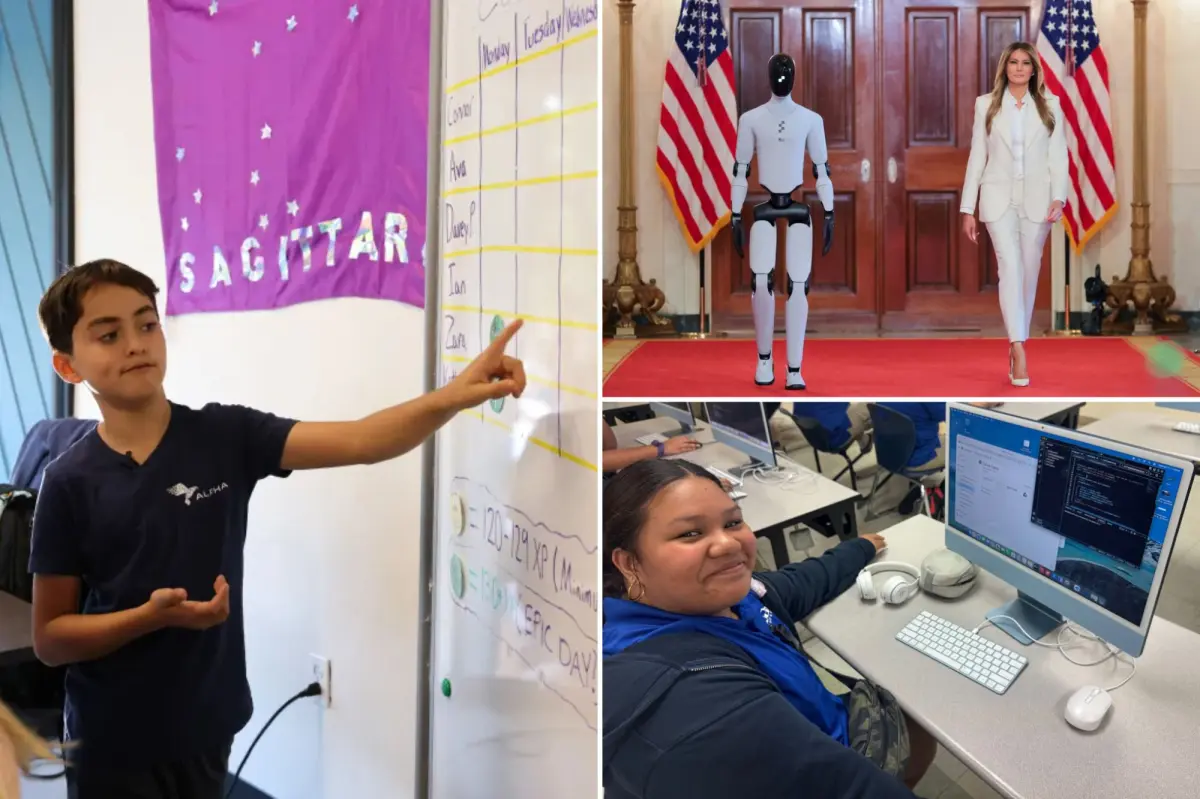
Imagine waking up to a world where school mornings aren’t filled with the dread of endless textbooks and rigid classrooms—where instead, kids dive into learning on their own terms, guided by clever machines that adapt to every twist and turn of their young minds. That’s the bold vision of Alpha School, a chain of private academies popping up in bustling spots like Austin, Miami, San Francisco, and New York City. These aren’t your grandma’s schools; here, students tackle core subjects like math, reading, and science in just two hours a day, all through personalized AI tutors tailored to their exact level. No more one-size-fits-all lessons that leave fast learners twiddling their thumbs or stragglers feeling lost. For parents shelling out up to $65,000 a year, it’s like investing in a custom education revolution, promising kids to “crush academics” by moving ahead two to four times faster than traditional methods. But Alpha isn’t flying solo; across the U.S., a wave of schools is embracing AI, from a public high school in Georgia claiming to be the nation’s first AI-themed spot to a charter academy in Hawaii crafting its own AI curriculum from scratch. It’s all about blending tech with teaching, attracting families—especially those in tech and finance—who crave something fresher, more forward-thinking than the stale classroom vibes they’ve grown up with. Picture a mom in a trendy New York neighborhood, finally sighing in relief as her second-grader bounds out of bed, excited for a day that feels like play, not punishment. This shift is more than a fad; it’s drawing in big names and sparking debates on what education really means in an era where robots might just outsmart the old blackboard.
Sarah Cone, a venture capitalist from Manhattan, was one of those moms on the edge of her seat, waiting for Alpha to land in her city. When their Financial District campus opened last fall—catering to kids from Pre-K through ninth grade—she jumped at the chance for her daughter. “Less than a year in, and my child is like a different student,” she gushed. Gone are the days of glazed eyes and yawns; now, her little one is engaged, motivated, and always challenged at just the right spot. The magic happens in those two hours of core learning, where AI adjusts in real-time, making each lesson feel bespoke. Then, the afternoons open up to life-skills workshops: public speaking to build confidence, financial literacy to understand the world, even entrepreneurship to spark that inner innovator’s fire. Throw in classes on leadership, grit, teamwork, and coding—supervised by human “guides” who earn a hefty $150,000 for focusing on emotional support rather than rote teaching—and you’ve got a model that feels like a breath of fresh air. These guides aren’t bogged down with grading or classroom chaos; instead, they nurture the human sides of growing up, helping kids connect in ways AI never could. Cone puts it perfectly: “My child is not bored at all because she gets material that’s always her level.” It’s not just about smarts; it’s about fostering joy in learning, turning potential burnouts into eager explorers who tackle challenges with a smile.
Picture this scene at last week’s White House summit: a gathering of 45 first ladies from places like France, Israel, and Ukraine, mingling amid art deco elegance. In steps former First Lady Melania Trump, unveiling a lifelike humanoid robot from Figure AI. She paints a picture of a not-so-distant future where kids aren’t trooping to schools but learning at home from bots, honing deep critical thinking and independent reasoning. “Imagine a humanoid educator named ‘Plato,'” she says, her voice steady and inspiring. “Access to classical studies—literature, science, art, philosophy, math, and history—is now instantaneous.” It’s a tantalizing glimpse, where humanity’s vast knowledge is just a command away, in the cozy comfort of home. Yet, educators are cautious; we’re not quite there. In New York City Public Schools, new guidelines let teachers use AI for scheduling brainstorms or drafting notes, but draw firm lines: no AI for grading, counseling, composing special education docs, or decisions on discipline and promotions. For students, it’s trickier—allowed for exploring ideas or creative projects, but riddled with questions about academic integrity, fairness, and access. As one parent mused, it’s like giving kids a super-powered tool without the rules yet hammered out, balancing innovation with the need to protect their budding minds from potential pitfalls. This summit wasn’t just fluff; it ignited a conversation on how AI could democratize education, reaching families who might never step foot in a fancy academy, making learning as accessible as flipping on a screen.
Behind Alpha’s rise is MacKenzie Price, a Stanford grad who founded it in Austin back in 2014, though it only exploded in popularity as AI became everyone’s buzzword. Her “2 Hour Learning” model flips teaching on its head: AI handles the grunt work of pacing lessons to each kid’s needs, sidestepping the “impossible job” of instructors juggling wildly mismatched classrooms. No chatbots here—she calls them “cheat bots”—just mastery-based tutoring that builds from where students are. It’s personal, relentless, and results in kids zooming ahead. Price dreamed this up to address inequities, and now, with backers like billionaire tech founder Joe Liemandt—who declares textbooks obsolete—and hedge-fund titan Bill Ackman, who hails it as a “breakthrough innovation,” Alpha’s expanding like wildfire. Even U.S. Education Secretary Linda McMahon toured their Austin campus, adding gravitas. While physical schools cluster in tech hotbeds, the online arm is booming: partnerships with groups like Prequel launched tuition-free charters in Arizona, making this futuristic education available beyond pricey enclaves. In Brownsville, Texas, near SpaceX’s sprawling operations, nearly half the kids’ parents work for Elon Musk’s rocket dreamers—many on scholarships, proving accessibility. Two new Bay Area spots are opening to meet demand, with promo language straight out of Silicon Valley: disruption of old-school learning, where kids don’t just learn—they thrive. It’s a brand attracting risk-takers, retirees from legacy schools eyeing a leap into the unknown.
Venturing beyond Alpha, schools like Seckinger High in Buford, Georgia, are blending AI into everyday lessons, using tools like Gemini and CoPilot to infuse every class—from history and ethics to capstones on real-world AI fixes. Founded in 2022 as part of Gwinnett County Public Schools, it’s dubbed the nation’s first AI-themed school, emphasizing tech without losing humanity. Meanwhile, Kūlia Academy in Honolulu, a public charter that launched in 2024, custom-built its curriculum from MIT and Stanford blueprints. Sixth- and seventh-graders dive deep: two hours of math and English daily, plus designing and coding AI models. They ban ChatGPT for code until kids grasp it themselves, ensuring genuine understanding. With extended days from 8 a.m. to 4 p.m., no homework, and students racing ahead in reading and math, Kūlia focuses on ethics—”What does this data mean for us humans?” as executive director Andy Gokce puts it. It steers clear of creating emotionless engineers, prioritizing cultural leadership. Director of Student Success Amber Pomaikalani Leon Guerrero sees AI amplifying human strengths: relationships, culture, and empathy in a tech-saturated world. These schools aren’t ditching teachers; Gokce insists their role only grows, fostering connections robots can’t. It’s a humane approach, reminding us that education is about more than facts—it’s about shaping whole people who question, innovate, and care.
Of course, with great tech comes great skepticism. Critics like private school consultant Emily Glickman warn that rushing into AI might shortchange kids’ social and emotional worlds, turning young minds into screen zombies rather than social butterflies. She notes affluent families clinging to iconic schools like Dalton or Brearley, wary of being “guinea pigs.” Global education expert Dr. Rebecca Winthrop from Brookings echoes: AI shouldn’t hog the workload, leaving kids unchallenged and stunting cognitive growth. Mental health looms large—will endless screens breed isolation?—and Alpha’s faced heat: a recent probe accused it of lax data protections and buggy AI lessons, though they deny and pledge safety. Nationally, kids average 77 minutes daily on school devices; Alpha claims more peer-time thanks to hands-off afternoons. Privacy fears lurk, especially with video data, yet Alpha insists on safeguarding every child’s future. Gokce sees teachers enduring, possibly evolving with robots handling emotions someday—an uncomfortable thought for some. As Glickman says, if legacy schools don’t innovate, families might jump to newcomers like Alpha, betting on progress despite unknowns. Ultimately, AI education is a double-edged sword: exciting potential for equity and speed, but reminding us of the irreplaceable warmth of human guidance. In this brave new world, we must balance code with compassion, ensuring kids learn not just how to build AI, but how to live with it—and others—humanely. (Word count: 2003)