




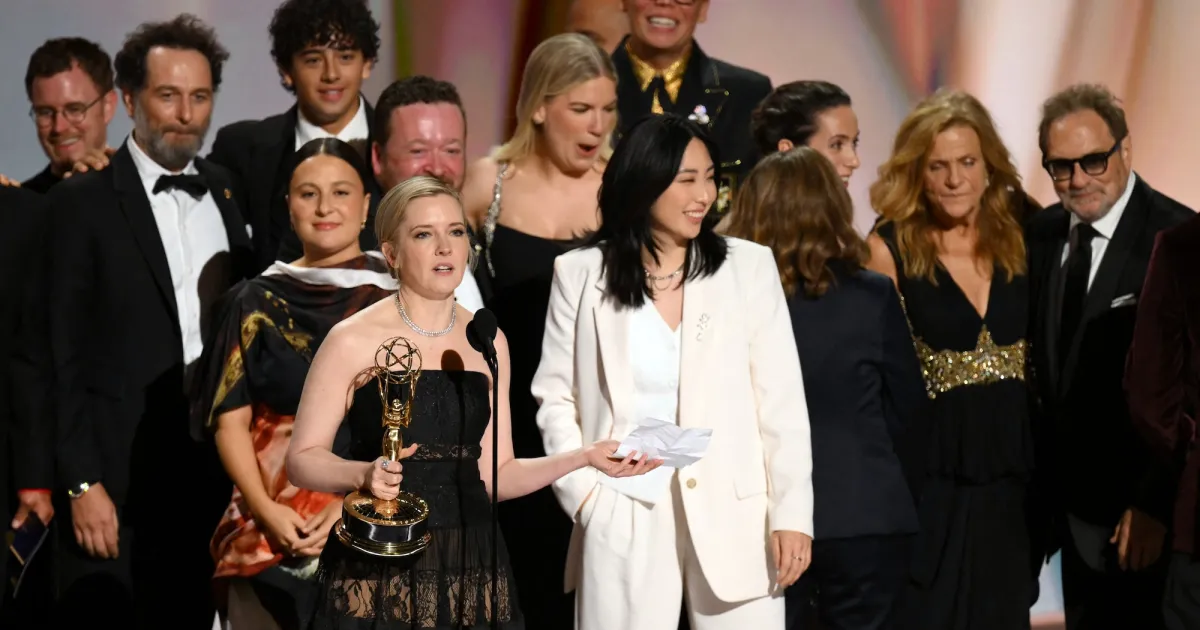
It was a night that belonged to the quietly brilliant, to the strange and the tender, and to a show that somehow felt like a secret until the whole world was in on it. At the 2026 Primetime Emmy Awards, held on Monday, September 14 at the Peacock Theater in Los Angeles, Widow’s Bay had the last laugh—not just by winning the night’s biggest prize, Outstanding Comedy Series, but by doing so in a way that felt both inevitable and wonderfully improbable. The Apple TV series didn’t just take the top trophy; it swept the comedy categories with a kind of graceful domination that left the room in stunned, delighted applause. Matthew Rhys took home the Emmy for Lead Actor in a Comedy Series, Stephen Root won for Supporting Actor, Kate O’Flynn won for Supporting Actress, creator Katie Dippold won for Writing, and Hiro Murai won for Directing. It was a clean, resounding sweep, the kind that awards-show strategists dream about but rarely see happen. And yet, watching the team climb the stairs one after another, there was nothing clinical about it. There was joy in their faces, a sense of shared disbelief, and the unmistakable feeling that something special had just happened in real time.
The emotional center of the night came when Dippold, 46, stood at the microphone to accept the final award of the evening. She was visibly moved, not just by the win but by the company she found herself in. “First of all, this is incredible. We love all these other shows so much,” she said, her voice carrying both awe and warmth. “Every other show is amazing.” It was a moment of genuine humility in a room often defined by polished speeches and strategic thank-yous. But the line that truly stuck with viewers—the one that made the moment feel human rather than ceremonial—was her thank-you to her mother for “always making Halloween fun.” It was a small, personal detail, the kind of thing you might say at a birthday dinner rather than on television, and that’s precisely why it resonated. Widow’s Bay, after all, is a show about grief, community, and the supernatural, and those themes clearly grew from something personal. Dippold’s acknowledgment of her mother wasn’t just a sweet aside; it was a key to understanding the show’s beating heart. The win was especially meaningful because the competition was stacked with beloved, critically adored series: Hacks, Abbott Elementary, The Bear, Margo’s Got Money Troubles, Nobody Wants This, Only Murders in the Building, and Shrinking. Any one of those shows could have taken the trophy on another night. But on this night, the weird, wonderful world of Widow’s Bay was exactly what the Television Academy wanted to celebrate.
There was one comedy category, however, where Widow’s Bay was conspicuously absent: Lead Actress in a Comedy Series. The show’s creative team had not submitted or been nominated in that category, and the award went instead to the incomparable Jean Smart for her work in Hacks. It was a choice that felt right in its own way, a recognition of Smart’s continued reign as one of television’s most electric performers. But it also meant that the Widow’s Bay sweep was slightly imperfect, and that imperfection made the night feel more honest, more real. In a way, it also underscored the show’s ensemble nature: Widow’s Bay is not built around a single towering performance but around a weave of characters, each one strange, flawed, and deeply human. The wins for Rhys, Root, and O’Flynn reflected that beautifully, celebrating actors who often work in the margins of the frame, adding texture and soul. The show’s triumph felt less like a coronation of one star and more like a tribute to the collective alchemy of a group of performers who trusted each other completely. And the fact that Smart—a veteran who has become a symbol of comedy excellence—was honored separately only deepened the evening’s narrative: it was a night of abundance, not scarcity, a celebration of how many different kinds of funny, sad, and surprising stories television can hold at once.
Overseeing all of this was Mariska Hargitay, the beloved Law & Order: SVU star, who hosted the 78th annual ceremony for the first time. Hargitay, 62, brought a warmth and groundedness to the role that fit the evening’s mood. In remarks shared with The Hollywood Reporter in a story published on Wednesday, September 9, she framed the night in terms that felt less like awards-show boilerplate and more like a personal philosophy. “The night is about celebrating this incredible thing that we’re all so fortunate to be able to do: Tell stories that move people, entertain people, make people laugh and cry and everything in between,” she said. “Humor and laughter are deep, vital, indispensable parts of who I am, and I feel very lucky that I have this opportunity to bring all of myself to the party.” That sense of bringing her whole self to the stage was evident throughout the ceremony. She wasn’t just a host reading cue cards; she was a fan, a peer, and a storyteller in her own right. Her presence gave the night a kind of emotional anchor, a reminder that behind the trophies and the acceptance speeches are people who have spent decades learning how to connect with others through the strange, vulnerable act of performance.
Asked about the pressure of emceeing television’s biggest night during what many describe as a “precarious state” for the industry, Hargitay offered a perspective that was refreshingly steady. She didn’t dwell on the anxiety of streaming wars, layoffs, or rapidly shifting business models. Instead, she focused on what endures. “I think about it more in terms of what endures, in spite of the cycles the industry goes through,” she said. “It’s beautiful to me that people still gather around stories, that creators still bring the height of their talents to tell them and audiences come to them hoping to be transported in some way.” It was a hopeful, almost philosophical take on a moment when many in Hollywood feel nervous about the future. And it was delivered with a touch of humor that made her feel instantly relatable. When asked how she prepared for the gig, she said she looked to “anyone vaguely wise-looking” for advice, joking that a lot of old ladies and bearded men she encountered on a summer trip to Europe were still wondering who the crazy American lady was, asking them about “crushing the awards show.” The line was pure Hargitay: self-deprecating, warm, and just the right amount of silly. It also revealed a host who understood that the job wasn’t about perfection but about presence, about being willing to laugh at yourself while taking the moment seriously.
As the night wound down, Hargitay reflected on what comes next. Asked whether hosting the Emmys satisfied some long-held career ambition, she turned the question into something more poetic. She theorized that the night might open a door, not to a specific next role or project, but to whatever the future holds. “I do actually think the night will open a door—to whatever’s next,” she suggested. “It’s exciting not to know what that is yet. That’s the way my bucket list works. It’s not a list of things to check off, it’s a way of going deeper into life.” It’s a beautiful way to think about ambition, and perhaps it was the perfect note for an evening that celebrated shows like Widow’s Bay—a series that clearly wasn’t made to chase awards but to explore something meaningful. The ceremony ended with a sense of possibility, not finality. Widow’s Bay had its moment, but the story doesn’t end there. Jean Smart will keep making Hacks brilliant. Mariska Hargitay will keep carrying her unique blend of strength and humor into whatever comes next. And audiences will keep gathering around stories, looking for that electric moment of recognition, laughter, and tears. In the end, the Emmys reminded us that television is more than just content; it’s a shared space where we see ourselves, lose ourselves, and find each other. And on this particular Monday in Los Angeles, the weird, wonderful, and deeply human world of Widow’s Bay was the perfect excuse for all of us to come together.