


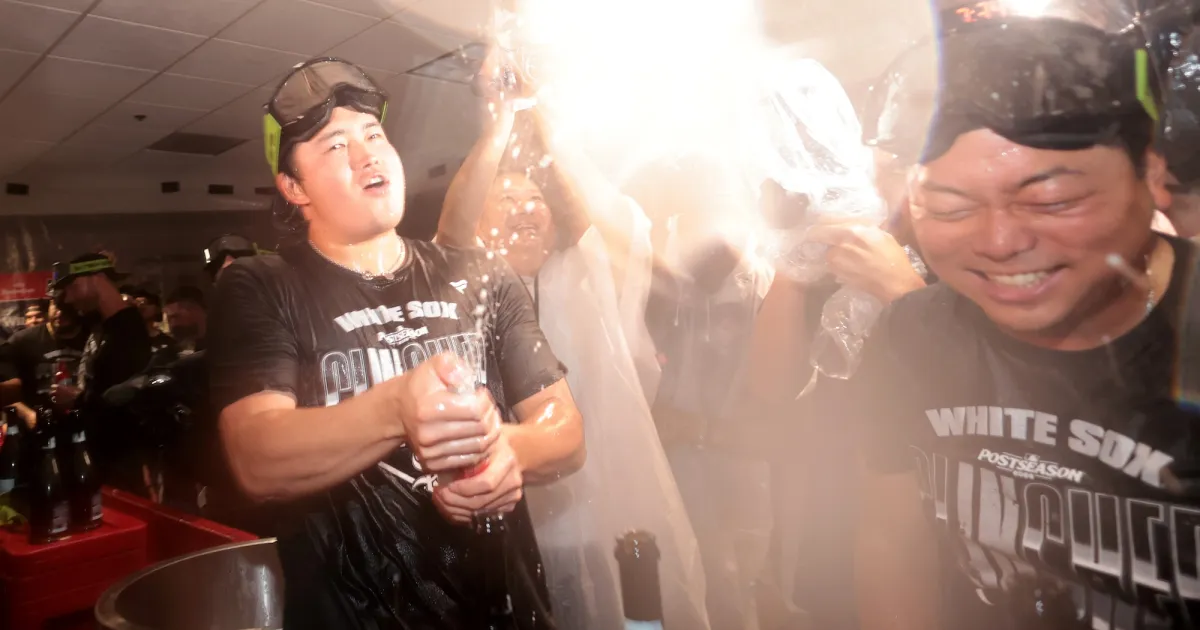
No one is having more fun in the 2026 MLB Postseason than Chicago White Sox first baseman Munetaka Murakami. Minutes after the White Sox defeated the Houston Astros on Wednesday, September 30, 7-3, to win their American League Wild Card Series, the clubhouse dissolved into a joyful hurricane of champagne, beer, screaming teammates, and television cameras trying to capture it all. Reporters were jostled, players were drenched, and the music was so loud that every interview became a shouted conversation. Murakami, 26, was at the center of it, a grinning, soaked figure moving through the chaos like a man who could not believe where he was. When NBC Sports’ Britney Eurton managed to get close enough to ask how he felt, he did not offer a polished sound bite. He simply yelled, “I’m drunk. I’m drunk.” Eurton laughed, but Murakami wasn’t finished. With the sincerity of someone who was trying very hard to be understood, he shouted, “Yesterday, maybe hungover… No, not yesterday, tomorrow. Sorry, I don’t speak English!” It was nonsensical, lovable, and entirely human. Here was one of the most important players in a franchise’s long-awaited postseason return, not reciting talking points or thanking his teammates in careful, rehearsed phrases, but celebrating the way fans dream of celebrating: with absolutely no filter. In that moment, Murakami wasn’t a superstar. He was just a kid who had worked his whole life for something and couldn’t believe it was finally happening.
That kind of raw joy makes a little more sense once you understand where Murakami came from. He arrived in the United States in December 2025 after a stellar career in Japan, where he had built a reputation as a four-time Nippon Professional Baseball Organization All-Star and one of the most dangerous hitters in the sport. He came to Chicago with expectations attached to him like weights. The White Sox did not bring him across the ocean to be a nice story; they brought him to be a cornerstone, a middle-of-the-order force capable of changing the direction of a franchise that had lost its way. For months, he handled the transition with the calm professionalism you might expect from someone who learned baseball in a culture that prizes discipline and composure. He typically uses a translator when conducting interviews with White Sox media, and he does so with patience and care. But all that measured, careful Murakami tends to disappear the moment champagne starts spraying. In the clubhouse, with the music thumping and his teammates howling, he is unguarded, impulsive, and completely himself. The contrast is part of what makes him so magnetic. Off the field, he is thoughtful. In the middle of a celebration, he is pure instinct. That duality has made him one of the most beloved figures in Chicago sports, because fans can see that his happiness is genuine. He isn’t performing for cameras. He is simply too overwhelmed by the moment to remember that he should be composed.
The Wild Card Series celebration was not Murakami’s first viral moment of the season, and it probably won’t be his last. Just a few days earlier, when the White Sox clinched a postseason berth on September 24, he treated the world to a scene that immediately spread across social media. CHSN’s Brooke Fletcher asked him, reasonably enough, to rate how he felt on a scale of one to ten. Most players would say ten. Murakami grabbed the microphone and screamed, “No 10! 100!” Fletcher, clearly delighted, asked how many bottles of champagne he had opened so far during the celebration. Without missing a beat, he shouted, “100!” Then she asked what it meant to be able to celebrate with his teammates, and Murakami, still holding the microphone, looked directly into it and roared, “I’m Japanese!” The answer did not answer the question. It did not need to. In that strange, wonderful moment, Murakami had found the only words that could possibly express the enormity of what he was feeling. He was proud. He was overwhelmed. He was grateful. And somehow, in his broken English, he made all of that clear. The moment was funny, of course, but it was also deeply endearing. Murakami wasn’t trying to be a character. He was just so happy that his joy spilled out in fragments — numbers, exclamations, declarations of identity. His teammates loved it. Fans loved it. Even reporters who had been soaked in champagne and trying to do their jobs couldn’t help but laugh. In a postseason full of high-stakes drama and carefully manufactured narratives, Murakami offered something refreshingly real.
The White Sox’s journey to this point makes his celebration feel even more meaningful. Chicago is just two years removed from losing an American League record 121 games in a single season. That was a year so painful that it seemed to define the franchise’s future more than any single player could. Then, last season, the White Sox lost another 100 games, missing the postseason for a fourth straight year. They were not just bad; they were a punchline. People joked about them the way people joke about teams that exist only to lose. It would have been easy for the organization to sink into despair, to accept that this was simply who they were. Instead, they rebuilt, retooled, and somehow found a way to flip the script. Now they stand as one of the final teams standing in the American League, preparing to face the division rival Cleveland Guardians in the American League Division Series beginning Saturday, October 3. The turnaround is nothing short of remarkable. For a team that had become synonymous with losing, every single celebration this October carries extra weight. Murakami seems to understand this in a way that goes beyond language. He knows he is not just playing for a team; he is playing for a city that has been starved for baseball joy. That is why his celebrations feel so cathartic. When he screams “100!” into a microphone, he is speaking for White Sox fans everywhere who have spent years watching their team stumble through one miserable season after another. He is celebrating not only the win in front of him, but the distance traveled from the wreckage of 121 losses.
Murakami addressed that distance in his own way before the Wild Card Series even began. Speaking through his interpreter, he reflected on what it meant to be part of a team that had transformed its identity. “Obviously I don’t really know what kind of team atmosphere was here the last two years when we did lose 100 games,” he admitted, “but I’m right here at this moment in time, so this is our culture. It’s a winning culture, as you can see, and that’s how we have been proceeding. This is not the end. This is just the start of our, let’s say, postseason run.” Those words, quiet and deliberate, stand in stark contrast to the champagne-soaked Murakami who screamed about being drunk and Japanese. But both versions of him are real. One is the thoughtful professional who understands the weight of his role and the history of the franchise. The other is the impulsive kid who can’t help but celebrate the fact that all the work has paid off. Together, they make him exactly the kind of player a team wants to carry into October. He refuses to be weighed down by the ghosts of the White Sox’s past. He is not interested in hearing about 121 losses or 100 losses or all the reasons this team shouldn’t be here. In his mind, that history belongs to somebody else. This team is different. This team is winning. This is his culture now, and he is determined to enjoy every second of it.
Manager Will Venable, who has guided the White Sox through this improbable season with calm and steady leadership, was quick to point out that Murakami’s joy is only part of the story. Yes, Murakami has produced the most memorable celebrations and the most quoted lines. But the White Sox advanced past the Astros because they received contributions from throughout the roster. After the Wild Card Series clinching win, Venable described the game as “emblematic” of the way his team had won all season. “Contributions from everywhere,” he said. “Sammy [Antonacci] setting the tone, great job down the lineup with everyone behind him. Guys pitching in different spots, going out whenever and getting the job done, and they did it.” That is the kind of baseball that wins in October. It is not one superstar carrying a team. It is a collection of players who trust one another, who take turns being the hero, and who celebrate each other’s success as if it were their own. Murakami may be the face of the fun, but he is also part of a larger organism, a team that has learned how to win together. And that is perhaps the most exciting thing of all. The White Sox are not just happy to be here. They are dangerous. They are loose. They are having the time of their lives. As they turn their attention to the Guardians, they carry with them the memory of two miserable losing seasons, the sting of a record nobody wants to hold, and the unshakable belief that the culture has changed. Murakami, meanwhile, will keep celebrating, keep yelling, and keep reminding everyone why baseball is the greatest game in the world. The champagne may dry. The microphone may go quiet. But the feeling, for this team and this city, is still a perfect 100 out of 10.