



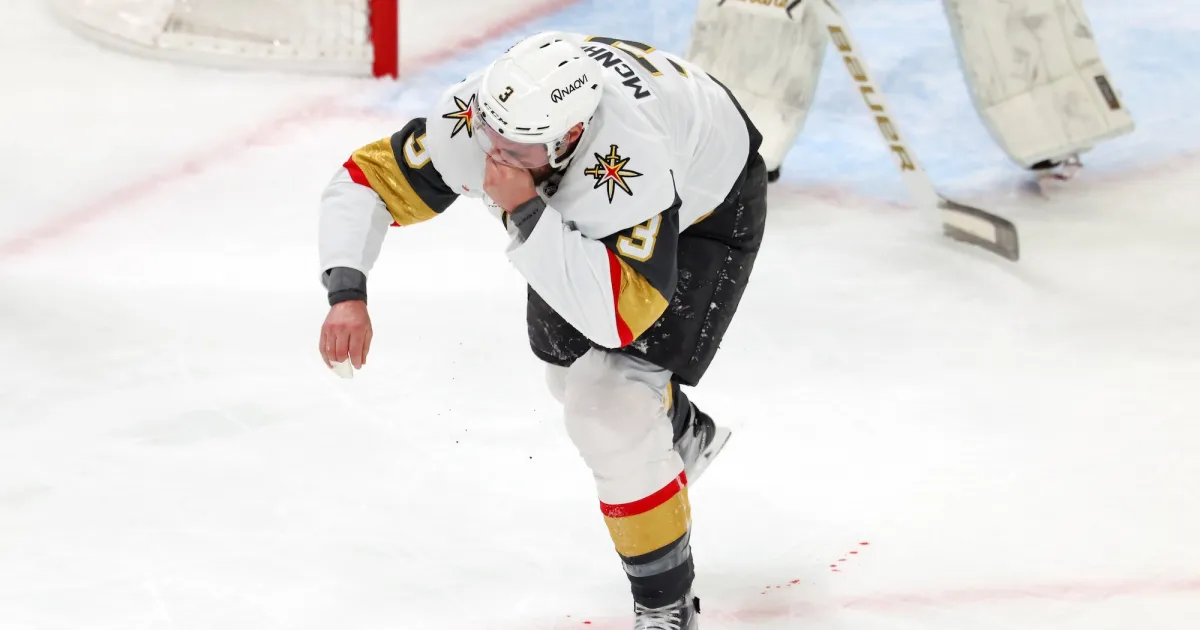
In the high-octane theater of the Stanley Cup Finals, the margin between ultimate triumph and sudden tragedy is razor-thin, measured not in periods or minutes, but in terrifying fractions of a second. During Game 2 of the 2026 championship series, this harrowing reality crystallized in a single, heart-stopping moment that instantly silenced a raucous arena and sent shockwaves rippling through the global hockey community. Vegas Golden Knights defenseman Brayden McNabb, a veteran revered for his stoic defensive play and selfless willingness to put his body in harm’s way, was anchoring the zone directly in front of goaltender Carter Hart. As the Carolina Hurricanes mounted a furious, sustained attack, winger Nikolaj Ehlers unleashed a blistering, eighty-seven-mile-per-hour slap shot from the point. In a desperate bid to defend his net, the thirty-five-year-old McNabb squared his body to the oncoming puck, a routine act of bravery that players perform dozens of times in any given game. But this time, the physics of the play turned tragic. The puck, traveling at a lethal velocity, bypassed his stick and struck him directly in the face, apparently catching him just beneath the protective visor of his helmet. The sheer force of the impact drove the plastic visor upward, causing it to make violent contact with his skin and rendering his facial protection essentially useless against such concentrated momentum. McNabb collapsed immediately to the frozen surface, clutching his face as the arena’s atmosphere shifted from competitive ferocity to a profound, bone-chilling dread. When he finally struggled to his feet, assisted by medical trainers, a trail of dark crimson blood painted the white ice, a stark, visceral reminder of the immense physical toll demanded by this beautiful but brutal sport. As McNabb slowly made his way to the dressing room, holding a towel to his shattered face, the news soon filtered down from ESPN’s Emily Kaplan that he was being rushed to a local hospital for urgent evaluation, leaving an air of heavy anxiety hanging over the game.
Behind the helmets, visors, and heavily padded armor of professional hockey players lie deeply human vulnerabilities, a truth that is too often or easily obscured by the hyper-masculine narratives of modern sports. The immediate aftermath of McNabb’s departure left the Golden Knights’ bench draped in a somber, anxious pall, as his teammates struggled to compartmentalize their raw fear while continuing to play the most important game of their lives. In the post-game press conference, the emotion of the locker room was palpable, transcending the typical, scripted clichés of sports journalism to reveal genuine, unvarnished heartache. Star forward Mitch Marner, visibly shaken and speaking with quiet intensity, described the play as nothing short of terrifying, expressing an immediate, deeply personal concern for his teammate’s long-term well-being that far outweighed any tactical analysis of the game’s outcome. Marner’s words painted a vivid picture of a tight-knit brotherhood, labeling McNabb a “warrior” who has long served as the heartbeat and defensive anchor of the roster, whose absence leaves a massive emotional and physical void in the lineup. Forward Brett Howden echoed this sentiment of helplessness and worry, admitting the sheer terror of watching a close friend and teammate fall in such a violent, unexpected fashion. Howden noted that the team had not yet been able to see or speak to McNabb since his emergency hospitalization, illustrating the agonizing silence that players must endure while waiting for medical updates. This collective anxiety highlights the difficult emotional tightrope these athletes must walk; they are not just pieces moving on a scoreboard, but human beings linked by years of shared sacrifice, late-night flights, and the collective pursuit of a childhood dream, making McNabb’s sudden, bloody absence felt deep within their souls. To look at the ice and see a teammate’s blood is to confront one’s own mortality in a game that usually demands complete and total psychological bulletproofing.
As the wider hockey community awaited concrete news from the hospital, prominent sports physician Dr. Harjas Grewal offered a sobering preliminary analysis, suggesting that the devastating force of an eighty-seven-mile-per-hour puck making direct contact below the visor almost certainly resulted in severe facial fractures. Such injuries are excruciatingly painful and highly complex, often requiring intricate reconstructive surgery to repair nasal passages, cheekbones, or orbital sockets shattered by the dense, vulcanized rubber puck. Yet, in discussing the medical outlook, Dr. Grewal also touched upon the legendary, almost mythological toughness associated with hockey culture, referencing former Boston Bruins captain Zdeno Chara as a historical precedent. During the 2019 Stanley Cup Finals, Chara famously suffered a broken jaw from a stray puck, underwent emergency surgery to have plates and screws inserted, and returned to play with his jaw wired shut, refusing to miss a single game. While this legendary comparison offers a glimmer of hope to Golden Knights fans praying for McNabb’s miraculous return, it also highlights a complex, sometimes controversial ethic within elite sports: the immense pressure on athletes to sacrifice their long-term health for the sake of championship glory. McNabb’s identity as a hard-nosed, old-school defenseman means he would undoubtedly crawl back onto the ice if given the slightest medical clearance, but the human cost of such stoicism is immensely high. In a league where injuries are often shrouded in secrecy and classified as simple “upper-body” ailments, the visible reality of a fractured face forces everyone to stop and think about the limits of human endurance. We marvel at the modern gladiators who play through broken bones, but we must also acknowledge the terrifying physical toll that remains long after the cheering stops and the ice has been melted. This debate between heroic perseverance and basic human safety is a constant undercurrent in modern sports, and McNabb’s impending diagnosis will once again force the Golden Knights’ medical staff to balance the desperate competitive needs of a championship run against the fundamental duty of care owed to a human soul.
On the ice, the sudden loss of Brayden McNabb created a massive, gaping chasm in the Golden Knights’ defensive schemes, forcing veteran head coach John Tortorella to completely restructure his game plan on the fly. McNabb is not easily replaced; he is a player who logs heavy, grueling minutes against the opponent’s top forward lines, playing a physical, shutdown style that anchors the entire defensive unit and provides stability during high-pressure shifts. In his absence, the remaining five defensemen were pushed to their physical absolute limits, enduring exhausting shifts and extended periods of zone pressure without the luxury of regular rest or line rotations. Vegas captain Mark Stone was quick to praise the monumental efforts of Jeremy Lauzon, who was thrust into the spotlight alongside Shea Theodore on the top defensive pairing to absorb the heavy burden. This sudden elevation required Lauzon to play far beyond his usual role, absorbing the physical matchups and high-pressure PK situations that McNabb typically handled with veteran ease and poise. Stone, thirty-four, lauded the sheer guts shown by his remaining blueliners, recognizing that they battled as hard as they humanly could under extremely adverse circumstances, emptying their tanks for their hospitalized teammate. Mitch Marner also emphasized the incredible work ethic of the five remaining defensemen, noting how they continuously battled through grueling, extended shifts where they simply could not get off the ice to change, showcasing an inspiring level of dedication. When a top-pairing defenseman goes down, the domino effect is catastrophic, forcing coaches to overplay others who are already running on empty. Every shift becomes a grueling test of aerobic capacity and sheer mental willpower, where defensemen must endure the suffocating forecheck of a relentless opponent while their lungs burn and their legs turn to lead. Yet, Lauzon and his peers did not complain; they simply strapped on their helmets tighter, stepped over the boards, and fought for every square inch of ice in honor of their fallen brother.
The emotional and physical fallout of McNabb’s injury undoubtedly played a critical, defining role in the frantic conclusion of Game 2, which ultimately saw the Carolina Hurricanes seize the moment to tie the best-of-seven series at one game apiece. Hockey is a game of momentum, and the sudden, violent nature of the injury disrupted the Golden Knights’ rhythm, allowing the relentless Hurricanes to capitalize on the inevitable defensive fatigue of their opponents. Scoring a thrilling 4-3 victory in overtime, Carolina proved that they are a relentless force, demonstrating a clinical, opportunistic ability to exploit the slightest defensive vulnerability and winded transitions. For John Tortorella, a coach known for his demanding and emotionally charged style, the post-game press conference was understandably subdued, as he had no concrete medical updates to share regarding McNabb’s condition, opting instead to focus on the immediate challenge lying ahead. The Hurricanes’ victory was a stark reminder of the unforgiving nature of the Stanley Cup Playoffs, where sympathy is nonexistent and opponents will relentlessly attack any perceived weakness, regardless of the tragic circumstances that created it. The Hurricanes did what championship teams do: they focused on the net, pushed the tempo, and let the physical weariness of a five-man defense do the rest of the work. The series has now transformed from a tactical chess match into a grueling war of physical and mental attrition, where depth of character is tested to its absolute limit. In the quiet moments after the final whistle blew in overtime, the silence in the Vegas dressing room was deafening. The disappointment of the loss was completely overshadowed by the empty locker stalls and the lingering image of a teammate being carted off to an emergency room. Yet, the Cup finals wait for no one, and Tortorella knows his squad must find a way to convert their profound heartbreak into a focused, unyielding competitive drive if they hope to survive this formidable onslaught. This emotional swing of losing a beloved teammate while simultaneously losing a critical game in overtime is a double blow that could easily fracture a lesser team, making the leadership of veteran players like Mark Stone and the coaching of Tortorella more vital than ever.
As the series shifts to the neon-drenched desert of Las Vegas for a pivotal Game 3 on Saturday, June 6, the Golden Knights must find a way to summon their collective resolve and rebuild their defensive identity without their fallen protector. Under the bright lights of the Vegas Strip, the roar of the crowd will serve as a sonic embrace for a team carrying a heavy heart. The T-Mobile Arena will undoubtedly be charged with an electric, highly emotional atmosphere, as the home crowd rallies behind a team that has shown immense courage in the face of sudden, violent adversity. They will look at the empty space on the blue line and remember the sheer will it took to reach this pinnacle of athletic achievement. The pursuit of the Stanley Cup is often romanticized, but moments like McNabb’s injury remind us of the harsh, cold reality of that pursuit—it is an endeavor that demands every ounce of physical, mental, and emotional strength a person has to offer. In a world where sports are often treated as mere entertainment, this series has reminded us that the athletes are flesh and blood, enduring unimaginable pain for the glory of their city and the love of their brothers. Whether McNabb is able to make a miraculous, Chara-like return to the lineup or is forced to watch from the press box with a wired-shut jaw, his spirit and sacrifice will serve as a powerful rallying cry for the Golden Knights. In the end, the human story of the Stanley Cup is not just about who hoists the trophy at the end of June, but about how a group of men comes together to support each other through physical pain, emotional exhaustion, and the terrifying realities of the game they love. As the puck drops for Game 3, the Golden Knights will not just be playing for a championship; they will be playing for Brayden McNabb, carrying his warrior spirit onto the ice in hopes of turning a moment of profound tragedy into a triumphant chapter of franchise history.