



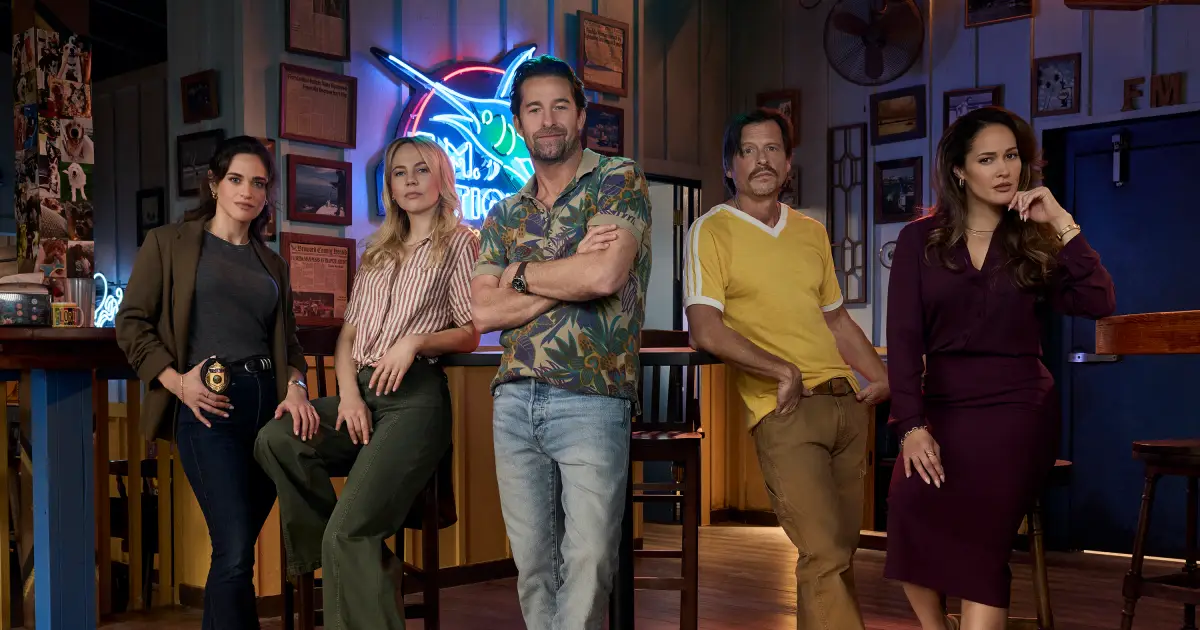
Scott Speedman’s journey through television has been one of quiet evolution, marked by characters who carry weight, history, and a certain bruised vulnerability. For years, viewers knew him best as Dr. Nick Marsh on Grey’s Anatomy, a guest appearance in season 14 that bloomed into a main cast role by seasons 18 and 19, and then a recurring presence in season 20 that kept him close to the Grey Sloan family. But now, Speedman is stepping into a very different kind of world with RJ Decker, a series born from Carl Hiaasen’s novel Double Whammy. The show relocates the action to the sun-soaked, morally tangled landscape of South Florida, where the title character—a disgraced newspaper photographer and ex-con—tries to rebuild his life as a private investigator. It’s a premise that thrives on contradiction: a man who once captured truth through a lens, but lost his own credibility, now navigating cases that are by turns eccentric, dangerous, and deeply human. There is a sense of reinvention in this role, not just for the character but for Speedman himself, who has managed to balance his ongoing commitment to Grey’s Anatomy with being the leading man on a brand-new show. It speaks to his range as a performer, and to the way he chooses roles that feel textured rather than predictable. With RJ Decker, Speedman isn’t just playing a hero—he’s playing someone who has fallen, learned from the fall, and is still learning who he wants to become on the other side.
The energy on set seems to match the complexity of the story, and the cast has been vocal about what it’s like to work with Speedman at the center of it all. Jaina Lee Ortiz, who stars alongside him, didn’t hold back when sharing her admiration for his craft. She described him as a true professional, someone who arrives fully prepared, knows every line, and remains completely present in every moment. What stood out to her most, though, was the unpredictability of his performances. Each take brings something new, something unanticipated, and that kind of spontaneity is a gift on a set where the material itself is so quirky and ever-shifting. There’s a playfulness in that approach, a willingness to let the scene breathe and evolve organically, which can only come from an actor who trusts both himself and the people around him. Adelaide Clemens, who plays R.J.’s ex-wife, echoed that sentiment in her own way, speaking about the unspoken connection that develops between actors who share as much history as their characters do. She talked about the fun of their dynamic, the little involuntary things that happen between two people who know each other deeply—the micro-expressions, the eyebrow twitches, the small irritations that somehow become endearing. It’s clear that the chemistry on set isn’t just professional, it’s genuinely human. When a cast feels that connected, it translates to the screen, making the relationships feel lived-in and real, even when the circumstances are wildly unusual. That interplay of trust, surprise, and affection is likely what gives RJ Decker its heartbeat, grounding the crime-filled chaos in something emotionally authentic.
At the core of the show is Speedman’s portrayal of R.J. Decker himself, a man whose past defines him but doesn’t necessarily have to confine him. As a former newspaper photographer, R.J. once had the kind of career that depended on seeing the world clearly, catching moments that others missed, and telling stories with a single frame. But a fall from grace sent him to prison, and now he’s left to piece together a semblance of a life on the other side of that disgrace. There’s something deeply American about that narrative arc—the idea of a second act, the belief that even after public ruin, a person can find a way to be useful, to matter, to solve problems that others can’t. As a private investigator in South Florida, R.J. doesn’t have the luxury of working in a clean, orderly environment. The cases that come to him are strange, even surreal, mirroring the distinctive tonal blend of Hiaasen’s writing, which has always mixed sharp satire with genuine suspense. But what makes R.J. compelling isn’t just the weirdness of the cases—it’s his own moral complexity. He’s not a perfect detective, and he’s certainly not a perfect person. He’s still carrying the scars of his choices, the guilt and the resentment, the lingering questions about who was really at fault and what justice even means. Speedman brings a kind of quiet intensity to that role, a brooding energy that makes you believe R.J. is always thinking three steps ahead, even while he’s clearly working through his own unresolved demons. It’s a performance that feels lived-in, raw, and refreshingly unpolished, the kind that makes you want to keep watching simply to see what he’ll do next.
One of the most intriguing relationships in the series is the one between R.J. and Emilia “Emi” Ochoa, played by Jaina Lee Ortiz. On the surface, Emi is a character with a heavy burden: she’s the one who sent R.J. to prison, and that choice wasn’t entirely her own. She was acting at the order of her corrupt father, a state senator whose influence and secrets cast a long shadow over her life. That setup creates a complicated web of guilt, duty, and resistance. Emi isn’t simply a villain or a regretful ally—she’s a woman caught between loyalty to family and the growing realization that her father’s actions have caused real damage, not just to R.J. but to everyone around them. Ortiz has a knack for playing characters with backbone and vulnerability in equal measure, and Emi seems like a perfect vehicle for that strength. There’s an undeniable tension between Emi and R.J., one that likely stems from the history they share and the circumstances that brought them together. Every scene between them carries an undercurrent of unfinished business, of questions that still need answering, of wounds that haven’t fully healed. But there’s also the possibility of redemption, not just for R.J. but for Emi too. She has a chance to reclaim her own agency, to decide who she wants to be apart from her father’s influence. That arc is compelling because it’s tender and messy, and it suggests that the path to forgiveness is rarely straight. Their relationship complicates everything, forcing both characters to confront not only what was done, but what could still be done to move forward.
Surrounding the central duo is a cast of characters who add depth, humor, and a sense of community to R.J.’s strange new world. Kevin Rankin plays Aloysius “Wish” Aiken, R.J.’s former cellmate who has since traded prison walls for the life of a bar owner. There’s a certain loyalty that comes from having survived something together, and Wish embodies that kind of friendship—rough around the edges, perhaps, but fiercely dependable. A bar owner in South Florida is inevitably someone who hears stories, who knows the secrets of the neighborhood, who can point a curious investigator in the right direction while pouring a drink. Wish is likely that kind of character, a grounding presence who offers R.J. a place to belong, even when the rest of the world isn’t so welcoming. Then there’s Adelaide Clemens’s Catherine Delacroix, R.J.’s ex-wife and a journalist. The relationship between a reporter and a former photographer-turned-sleuth is naturally complicated—they were once partners in more ways than one, and their professional instincts probably still align, even if their personal lives have taken separate paths. Catherine represents a connection to R.J.’s old life, to the person he was before everything went wrong, and that makes her both a comfort and a challenge. She still understands him in ways few others can, which is exactly why their interactions feel so layered with history and unspoken understanding.
Rounding out the core cast is Bevin Bru as Melody “Mel” Abreu, Catherine’s current wife and a detective at the Fort Lauderdale Police Department. Mel’s role is particularly interesting because she exists at the intersection of multiple worlds: she’s law enforcement, which means she operates with a certain authority and institutional perspective, but she’s also personally connected to Catherine, which pulls her into R.J.’s orbit in ways that must feel complicated. As a detective, Mel has the skills and resources that R.J. lacks, but she’s also bound by rules and protocols that he doesn’t have to follow. That contrast makes their dynamic rich with potential—there’s room for mutual respect, jealousy, suspicion, and eventually, maybe, trust. Together, this ensemble creates a portrait of an unconventional family of sorts, bound by love, loss, and a shared commitment to uncovering the truth, no matter how bizarre the journey gets. Ultimately, RJ Decker feels like a show about second chances, not just in the romantic sense, but in the broader sense of people finding purpose after failure. It’s a story set in a world that’s colorful and dangerous, funny and heartbreaking, and at its center is a man learning that redemption isn’t a destination—it’s a daily choice. With a talented cast, a source novel full of quirky crime, and Speedman’s steady, soulful presence, the series offers something for viewers who want their procedurals with a little more heart and a lot more personality.