

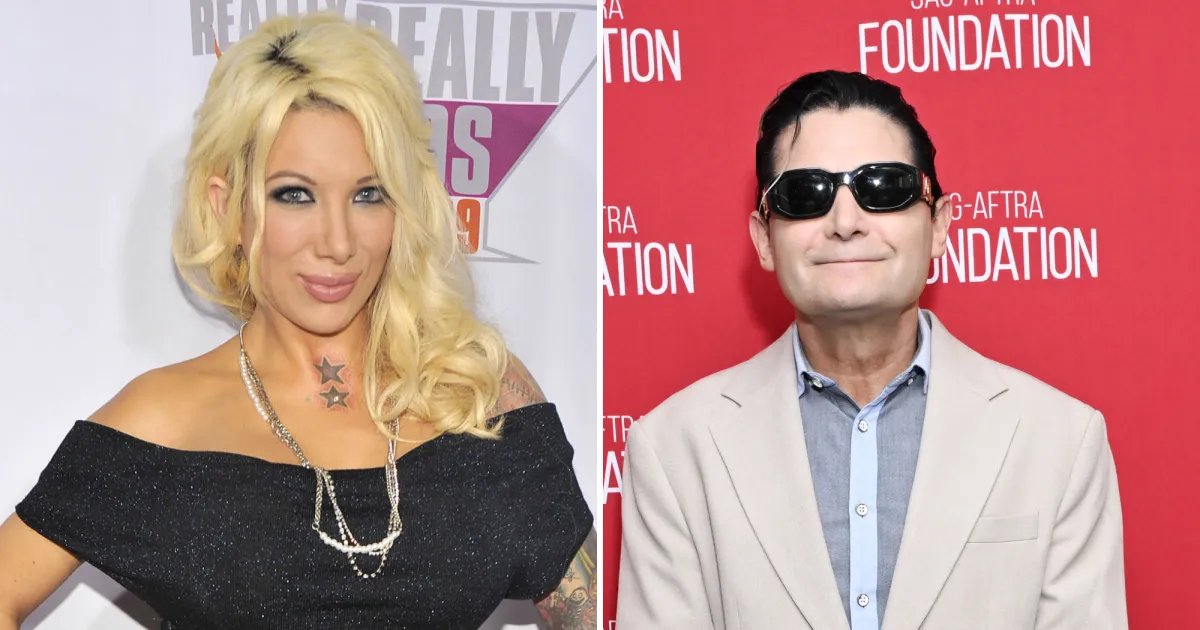
She was once the woman with the peroxide hair and the fearless personality that made reality television viewers fall in love with her. But when Daisy De La Hoya sat down for a recent interview, she wasn’t there to talk about old glory days or notorious rock-star romances. She was there to talk about something far more fragile and far more real: survival. For years, the former Rock of Love star has been fighting a private war against addiction, one that ultimately stripped her of a home, a relationship, and even her sense of self. Now, she says, the person most responsible for her being alive is not a producer or a doctor, but a dear friend who refused to let her disappear into the dark. Corey Feldman, the former child actor and lifelong friend, stepped in when she had nowhere left to turn. “He saved my life,” she said, and those words were not dramatic embellishment. They were the plain truth of a woman who had been evicted from her Las Vegas apartment and was, by her own admission, in the grip of an addiction that had become dangerously out of control.
The story she tells is one that unfolds like a rescue mission, not a Hollywood storyline. She was living in Las Vegas, trying to hold on to something that was already slipping away, when Feldman arrived and simply picked her up. He did not lecture her. He did not judge her. He took her dog, packed up her belongings, and placed her back in California, specifically in Oceanside, where she could begin the slow, agonizing process of recovery. That act of friendship, as simple as it sounds, was the hinge on which her entire life turned. Since February 29, 2024, De La Hoya has been clean. That date matters to her not as a badge of triumph but as a reminder of how close she came to losing everything. “I love him to death,” she said of Feldman, and the love in her voice is not casual. It is the gratitude of someone who knows that without that intervention, she may not have lived to tell the story at all. She spent the months after that shedding the weight of her addiction, doing the unglamorous work of sitting with her pain, her past, and her mistakes.
But recovery did not come with a safety net. It came, instead, with a kind of brutal clarity that forced her to face the wreckage of the life she had left behind. “I lost everything,” she admitted. That includes the relationship she was in and the apartment she had been trying to hold on to. What followed was a descent into literal homelessness. She did not just feel homeless in a poetic sense; she was sleeping in shelters, moving through the gray limbo of the unhoused, clinging to the idea that she could somehow find her way back. And while she was in that vulnerable state, she was assaulted. She does not dwell on the details, but she acknowledges it with a heaviness that suggests the wound is still tender. “I’m not happy or proud of myself for what happened,” she said. Yet even in that shadow, she manages to find a sliver of light. She is grateful to be here. She is grateful to be sober. She is grateful that the drugs no longer own her. For someone who has lost so much, that gratitude is not performative; it is the quiet foundation upon which she is trying to rebuild her life.
It is hard to reconcile the Daisy De La Hoya of reality television with the woman who, in August, told the Daily Mail that she is “poor and homeless.” That stark admission, stripped of any glamour, shocked many fans who assumed that a familiar face from hit shows would always land on her feet. But De La Hoya has never been shy about telling the truth, even when that truth is embarrassing. She is staying with a friend, she said, but it is temporary. She is enrolled in school. She is looking for a job, any job. In her own words, she would work at McDonald’s or Starbucks if given the chance. “Maybe I’m overqualified or maybe I’m underqualified,” she laughed, though the laugh is tinged with sadness. She wonders aloud why God will not let her catch a break, why every door seems to close just as she reaches for the handle. There is something deeply human about that confusion, that sense of having done everything right and still getting nowhere. She has traded the rock-and-roll excess of her past for the humbling reality of counting down the days until she can find some steady, ordinary work.
Part of her financial hardship stems from a system that leaves reality stars behind. De La Hoya first came into the public eye in 2008 on season 2 of Rock of Love With Bret Michaels, where she competed for the heart of the Poison frontman and came in second place. She went on to headline her own spinoff, Daisy of Love, which gave her a platform and a fandom that has lasted nearly two decades. But that fame has not translated into financial security. She says she does not receive residuals from those shows, even though they continue to stream and attract new viewers. “I don’t get any of that money,” she said plainly. It is a strange and familiar story in reality television, where participants become icons yet are often left out of the profits. In addition to her sobriety, De La Hoya is also managing her mental health through medication for anxiety and a diagnosed bipolar disorder. Those diagnoses add another layer of complexity to an already difficult journey, but she addresses them with a kind of weary honesty that is both heartbreaking and admirable. She does not present herself as a victim; she presents herself as someone who is trying to get well, one day at a time.
The most striking part of De La Hoya’s story is not the tragedy of her fall but the tenacity of her climb. “You have a different perspective after hitting rock bottom and losing everything,” she said, and that perspective is evident in her words. She no longer thinks of herself as famous, or as somebody who deserves special treatment. She is simply a person who did a thing once, who wants to be part of the entertainment industry again, but who now understands that sometimes survival is more important than stardom. She admits that she sometimes thinks about giving up on entertainment entirely. Right now, she says, she just needs a job. That is a sentence that could come from anyone, famous or not, and it is that universality that makes her story resonate so deeply. She is not asking for pity. She is asking for a chance. Her journey is still unfolding, and she knows that recovery is not a destination but a lifelong path. For anyone struggling with substance abuse, her message is one of hope and honesty: that it is possible to come back, even when everything is lost. The Substance Abuse and Mental Health Services Administration National Helpline remains available at 1-800-662-HELP for those in need, a resource that can be a lifeline for someone else like Daisy, waiting for a friend or a stranger to help them find their way home again.