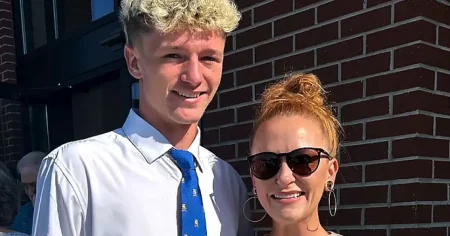



Amanda Kloots and Justin Gimelstob have quietly closed the chapter on their romance, but the way she talks about it says less about endings and more about the kind of woman she has become. The 44-year-old mother, former dancer, fitness instructor, and one-time cohost of The Talk confirmed in a recent Page Six interview that she and the 49-year-old former tennis player are no longer together after more than a year of dating. There was no scandal, no bitter accusations, no dramatic public unraveling — just a gentle, honest update delivered by a woman who seems to have learned that some relationships are not failures just because they don’t last forever. “No, not currently [together], but we’re still very good friends,” she said. And then, almost as if to assure anyone who might be worried about her, she added: “I believe in love. I definitely want that in my life.” There is something quietly brave about that admission. After losing her husband in the most public and devastating way imaginable, after grieving in front of the world while raising a little boy, and after now navigating another relationship that didn’t end in forever, she still refuses to close herself off to the possibility of love. That is not naïveté. That is resilience wearing the softest possible mask.
For Kloots, believing in love has never been a simple, fairy-tale kind of faith. Her love story with Broadway actor Nick Cordero was one of those rare, radiant partnerships that seemed to glow from the inside out. They met, married, welcomed their son Elvis, and then were plunged into a nightmare when Cordero contracted COVID-19 in 2020. For months, Kloots documented her husband’s agonizing hospitalization, urging the world to pray for him, holding onto hope with both hands even as the odds stacked against them. When Cordero died at just 41 years old, Kloots became a widow and a single mother in the span of a single breath. She has spent the years since learning how to carry that grief while also carrying a child, a career, and her own fragile heart. So when she says she still believes in love, she is not speaking from a place of sheltered innocence. She is speaking from the wreckage of real life, from the ashes of a marriage that ended far too soon, and from the quiet wisdom that comes when you realize love is not a reward for getting things right. Love is something we choose to remain open to, even when it hurts, even when it doesn’t work out the way we hoped. That is why her recent words land with such weight. She is not pretending the split from Gimelstob didn’t sting. She is simply refusing to let that sting become a scar that blocks her from the future.
Right now, though, Kloots is not rushing to fill that space with someone new. Instead, she is pouring herself into the two loves that have never left her: her seven-year-old son Elvis and the work she does to rebuild herself from the inside out. In her own words, “Right now I’ve really just been focused on work and Elvis and myself and just making sure I’m the best version of me. It’s been very good and healing and rewarding, so that’s where I’m at right now.” There is something deeply human about this confession. After the chaos of grief, after the intensity of a new relationship, after the exhaustion of public scrutiny, she is choosing to come home to herself. And that is not always the most glamorous choice, but it is often the most necessary one. Elvis is, of course, at the center of it all. He is her late husband’s son, a living reminder of the love she shared with Cordero, a little boy who will grow up knowing his father through stories, photographs, and the mother who loved his father so fiercely. Every milestone Elvis reaches is both a joy and a pang of sorrow, because the person who should be there to celebrate it is missing. Kloots has spoken openly about the complicated ache of single parenting while grieving, the way joy and sadness can live in the same moment, the way a child’s laughter can coexist with a mother’s tears. By focusing on Elvis now, she is not just keeping herself busy; she is making sure that her son grows up feeling safe, loved, and whole, even in a family that looks different than she once imagined.
When Kloots and Gimelstob first went public in April 2025 at a cancer awareness event at the Beverly Hilton in Beverly Hills, California, it felt like a new beginning. There she was, stepping onto a red carpet with someone new, smiling, dressed up, holding hands with a man who clearly admired her. Gimelstob, for his part, did not shy away from expressing just how much he cared for her. In an exclusive interview, he called her “a special lady” and praised the way she prioritizes the people she loves. “I think it’s cliche, but just how she prioritizes her people and obviously all this and everything she’s been through — how much grace and kindness [and generosity] she shows,” he said. That quote is revealing. It shows that Gimelstob saw her clearly, not just as a public figure or a survivor, but as a woman who loves deeply and gives generously even when she herself is carrying pain. He recognized that Kloots is someone who shows up for the people in her life, who holds space for others even when her own heart is heavy. That kind of recognition is not something you fake. It suggests that their relationship was built on a foundation of mutual respect and genuine affection, which makes the news of their split feel less like a failure and more like a gentle, mutual release. Sometimes two good people meet at the right time, love each other in a way that matters, and then realize that their paths are heading in different directions. That doesn’t erase the value of what they shared. It just means the story changes course.
One of the most touching parts of Gimelstob’s comments about Kloots was the way he honored Nick Cordero’s memory. Rather than acting threatened by the love Kloots still carries for her late husband, Gimelstob spoke about it with tenderness and admiration. “They had such a beautiful relationship, and I only have admiration for the relationship they had. I just support [Amanda] and obviously the baby is such a sweet boy,” he said. For anyone who has ever loved someone who has loved deeply before, this is exactly the kind of grace that is needed. Kloots does not have to hide her past or dim the memory of Nick in order to make room for someone else. The love she shares with her late husband is not a rival to any future love; it is a foundation. It shaped her, softened her in some places and strengthened her in others. Gimelstob seemed to understand that, and his willingness to acknowledge the beauty of Kloots’s marriage to Cordero speaks to the kind of man he is. It also offers a glimpse into why their relationship, even if it didn’t last, was meaningful. In a world that often treats grief as something to get over and past partners as something to erase, their dynamic was refreshingly mature. Kloots is a woman who has learned that you don’t have to choose between honoring what was and remaining open to what could be. The heart is expansive enough to hold both a profound loss and a new connection, sometimes at the same time.
Kloots has always been honest about how difficult that emotional juggling act can be. In an interview in 2021, just over a year after Cordero’s death, she spoke openly about the ongoing nature of grief. “A lot of people have said to me, ‘It gets easier [and] time helps,’ and I don’t know if I found that yet,” she admitted. “I still pretty much cry every day. It’s growing pains.” She described the way grief can ambush you in ordinary moments, how her son would do something, or she would experience a milestone, and all she wanted was for her person to be there to share it with her. “You miss your person so much,” she said. Even then, she was determined to keep living. She said she was doing everything she possibly could to stay healthy, active, and happy, understanding that grief is a process and that everyone does it differently. Those words, spoken years ago, now feel like a thread connecting her past to her present. She is still that woman — the one who cries, who misses, who wishes, but who also keeps moving forward. The end of her relationship with Gimelstob is not the beginning of a tragic narrative. It is simply another chapter in a life that has already shown extraordinary courage. Kloots believes in love, and that belief is not fragile. It is a promise she keeps making to herself. It means she has not given up, not on the world, not on herself, and not on the possibility that somewhere down the road, love will find its way back to her. Until then, she will keep doing the quiet, beautiful work of raising her son, healing her heart, and becoming the best version of herself — one day, one tear, one smile, and one hopeful breath at a time.