







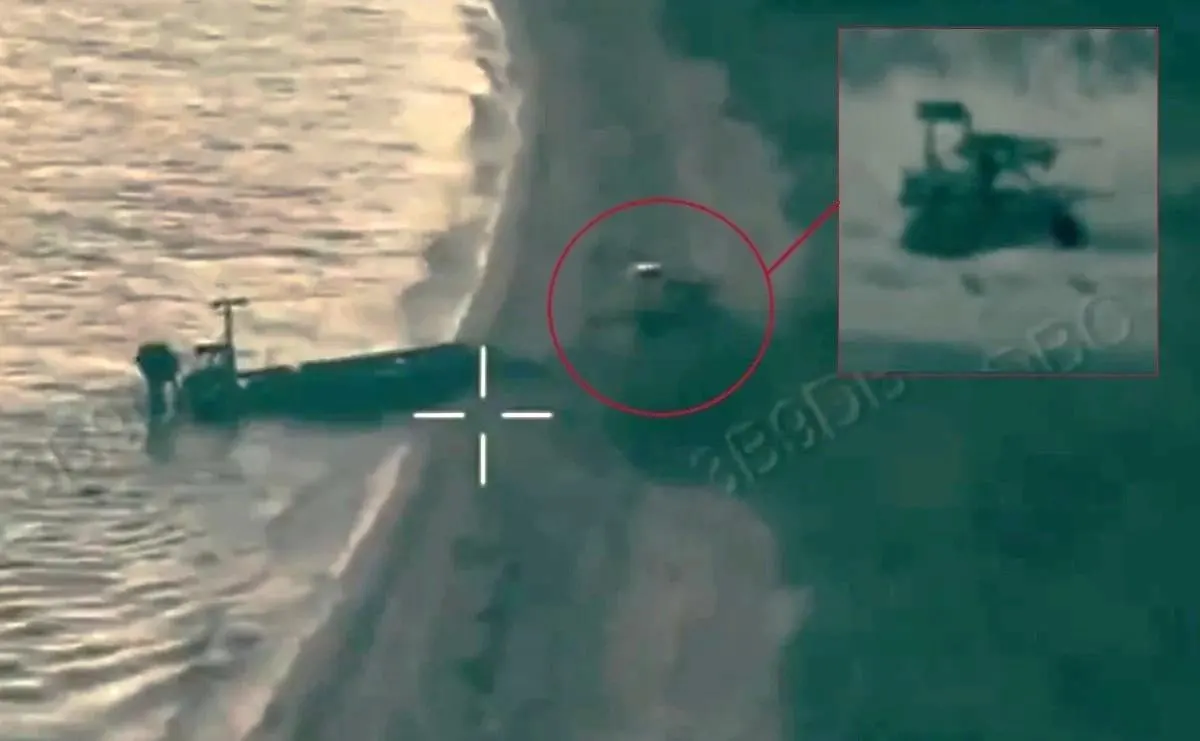
On July 13th, the Ukrainian military quietly made history on a windswept beach. In a video released by the 123rd Separate Territorial Defense Brigade, a sleek, uncrewed maritime vessel nudged its hull onto the shore of an enemy-held territory, lowered its front ramp, and deployed a small, tracked ground robot. Within moments, the remote-controlled machine trundled onto the sand, swiveled its turret, and opened fire with a heavy machine gun. While this conflict has introduced an astonishing array of robotic milestones—including the first major warship sunk by maritime drones and the first aerial dogfights between quadcopters—this hybrid amphibious operation represents an entirely new chapter in the theater of war. It is the first known combat mission where an unmanned sea vessel successfully transported, landed, and deployed an unmanned ground vehicle directly onto hostile shores, executing a complex mission without a single human setting foot on the beach.
The stage for this historic trial was the strategically critical Kinburn Spit, a narrow, twenty-five-mile-long peninsula that tapers down to a mere hundred yards at its tip. Part of the pristine Black Sea Biosphere Reserve, this strip of sand, pine forests, and oak groves guards the mouth of the Dnipro–Bug estuary, controlling maritime access to the vital ports of Mykolaiv and Kherson. Russian forces occupied the spit in June 2022, securing it as a heavily fortified stronghold from which to launch artillery strikes, deploy radar networks, and direct electronic warfare operations. Over the last two years, this isolated strip of land has been the site of fierce, bloody skirmishes. Ukrainian Special Forces have staged daring, high-stakes amphibious raids to destroy equipment and temporarily raise the blue-and-yellow flag, only to withdraw under intense enemy fire. Because the spit is heavily fortified and can only be reached by water, a traditional frontal assault would normally mirror the tragic, high-casualty undertakings of military history.
To understand the sheer magnitude of this technological shift, one only has to look back eighty years to the Allied preparations for D-Day in 1944. To breach occupied Europe, the Allies had to orchestrate the largest amphibious armada in human history, relying on overwhelming naval bombardments, specialized engineering vehicles, airborne insertions, and immense human sacrifice. Despite meticulous planning, the storming of Normandy cost over ten thousand Allied casualties on the first day alone, and the success of the invasion hung in the balance for a tense week. Fast-forward to the present day in Ukraine, and the terrifying calculus of storming a fortified beach is being rewritten. By swapping vulnerable flesh-and-blood troops for expendable steel and silicon, the immense psychological and physical toll of amphibious invasions can be dramatically mitigated, shifting the burden of the opening assault entirely onto machines.
This amphibious breakthrough is powered by Ukraine’s rapidly consolidating domestic robotics industry. Production of Uncrewed Ground Vehicles (UGVs)—the wheeled or tracked counterparts to flying aerial drones—has scaled dramatically, jumping from ten thousand units last year to an ambitious target of fifty thousand by 2026. While early models were primarily used to evacuate wounded troops or haul heavy ammunition crates to isolated outposts, combat-oriented variants are now taking center stage on the frontlines. A prime example is the DevDroid TW 12.7, a rugged, low-profile machine roughly the size of a quad bike, armed with a powerful .50 caliber machine gun mounted in a remote turret. Costing around $30,000, these machines rely heavily on aerial drone escorts to scout paths and spot obstacles, preventing them from flipping over or getting stuck in craters. Already, commanders report these sturdy robots holding defensive positions entirely on their own for weeks at a time, withdrawing only to reload or swap rechargeable batteries, proving that the infantry of tomorrow will be increasingly mechanical.
The innovative coordination of these systems has also birthed the “marsupial drone” concept, wherein a larger, mother-ship vehicle carries and deploys smaller tactical platforms. This approach solves a major vulnerability of remote warfare: the limited battery life and range of offensive drones. By utilizing an unmanned surface vessel as a mini-aircraft carrier or landing craft, Ukraine can bypass miles of hostile water, deliver a combat-ready ground robot directly to the water’s edge, and maintain a safe operating distance for human controllers. This tactic leverages Ukraine’s highly creative “mosquito fleet” of more than twenty distinct unmanned naval drone models, turning what was once a largely defensive tool into a highly offensive, multi-domain projection of force. When the ground robot rolls off the ramp, it works in tandem with overhead reconnaissance and kamikaze drones, flushing out hidden defenders and coordinating instantly with artillery units.
Ultimately, this beachhead trial on the Kinburn Spit serves as a powerful proof of concept for the future of global warfare. By sending an expendable, low-cost machine to probe enemy defenses, military commanders no longer have to risk precious human lives to gather intelligence or secure a hostile foothold. If a robot is destroyed by a hidden landmine or caught in a mortar barrage, there is no tragic loss of life, no mourning family, and no blow to national morale; it is simply a line item in an economic ledger. Looking forward, amphibious operations will likely transform from high-stakes, all-or-nothing spectacles into highly frequent, highly decentralized robotic raids designed to harass, distract, and exhaust adversaries. We have crossed a profound threshold in the evolution of conflict: a future where the terrifying first wave of any beach invasion will not be met by young soldiers jumping into the surf, but by silent, mechanical advance guards clearing the way for humanity to follow later in safety.