

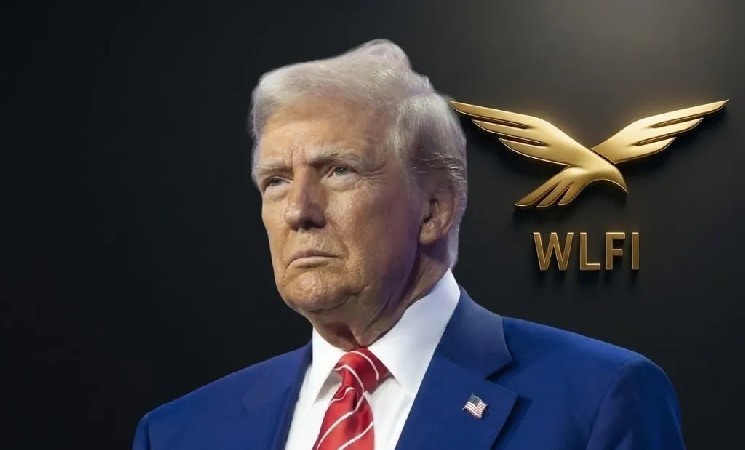
World Liberty Financial’s Controversial Proposal: Striking Gold or Siding with Speculators?
In the swirling vortex of cryptocurrency, where innovation often clashes with investor trust, World Liberty Financial ($WLFI) has ignited fresh debates that echo far beyond the digital ledger. This blockchain project, inextricably tied to the Trump family’s political and entrepreneurial ventures, has proposed a governance overhaul that could fundamentally reshape the landscape for its holders. At its core, the move aims to recalibrate voting power, potentially diluting the influence of early adopters while bolstering the voices of those willing to commit longer-term. As the crypto market grapples with themes of decentralization and equity, $WLFI’s latest gambit raises pointed questions about transparency, fairness, and the delicate balance between project control and community input.
The proposal, unveiled amid growing scrutiny, zeroes in on the roughly 20% of $WLFI tokens that are currently unlocked and freely tradable. To maintain their governance rights, holders of these tokens must stake them for a minimum of 180 days, effectively locking them up in a bid to foster stability and long-term vision. In return, participants receive a modest 2% annual return, paid out in additional $WLFI tokens—a carrot dangled to incentivize loyalty. However, this reward isn’t set in stone; the project team reserves the right to adjust it, adding a layer of unpredictability that critics argue undermines trust. Staking itself isn’t novel in the crypto universe; it’s a staple mechanism designed to align incentives and reduce volatility. Yet, $WLFI’s iteration introduces a peculiar wrinkle: governance votes—those very decisions about when locked tokens might be unleashed—could paradoxically require voters to surrender their liquid assets further. Investors, suddenly faced with a choice between liquidity and influence, find themselves navigating a labyrinth where short-term freedom collides with the promise of collective stewardship.
Investor sentiments, as voiced in the project’s governance forums, reveal a fractured community torn between skepticism and strategic acceptance. Take Morten Christensen, a vocal $WLFI holder who attended a high-profile event for memecoin enthusiasts hosted by Donald Trump himself. Christensen has pledged to vote against the proposal, articulating his concerns in stark terms: “We’re investing with a great deal of uncertainty here. It’s like betting on a horse that’s halfway through the race without knowing the track.” His apprehension underscores broader anxieties among the community, where the proposal’s logic—prioritizing entrenched participants over fleeting speculators—rings hollow for those wary of hidden agendas. This dynamic pits immediate financial flexibility against the elusive reward of amplified voice, creating a scenario where not participating means ceding ground, while engaging demands sacrificing readily accessible capital. As discussions unfold, the project’s forum buzzes with threads dissecting the mechanics, from the staking minimums to the mutable return rates, painting a picture of a crypto ecosystem in flux.
Delving into the backdrop, World Liberty Financial’s ties to the Trump family have long fueled controversy, amplifying the stakes of this governance shift. Linked to former President Donald Trump’s second inaugural term, the project’s memecoin predecessor reportedly delivered outsized returns to initial backers but left later entrants nursing devastating losses, sparking accusations of inequity. Even related ventures, such as a proposed stablecoin, have drawn congressional ire over potential conflicts of interest, igniting debates about the ethical boundaries between political power and private enterprise. Against this political tapestry, $WLFI’s opacity on token unlocking schedules—over a year since its inception, with 80% of original investor tokens still confined—feels like a deliberate veil. Traditional crypto norms dictate clear unlock timelines, outlining release quantities and milestones to empower investors, yet $WLFI deviates from this practice, fostering an environment ripe for speculation and distrust.
Expert voices in the field lend credence to these worries, highlighting the unusual nature of $WLFI’s approach. Lex Sokolin, a respected token economist and managing partner at Generative Ventures, weighs in with measured critique: “Transparency around token release schedules is paramount—it’s the bedrock of investor confidence. Without it, projects risk eroding trust, and in a sector already fraught with volatility, this oversight is glaring.” Sokolin’s perspective draws on broader tokenomics lessons, where opaque governance can lead to imbalances that favor insiders. He elaborates on how staking mechanisms, while useful for price stabilization, can inadvertently centralize power if not handled equitably, echoing the community’s divided opinions. As $WLFI navigates these waters, Sokolin’s insights serve as a reminder that in cryptocurrency, where innovation thrives on openness, secrecy can be a harbinger of turmoil.
The real-time fallout is evident in the token’s market performance and the ongoing vote, which commenced on March 5th and concludes on March 12th. Having shed over 50% of its value since trading began last year, $WLFI’s price trajectory mirrors the broader skepticism, with critics contending that the staking proposal is a veiled attempt to curb sell-offs and prop up the market—a notion the team rigorously disputes. In their official statement, they emphasize a preference for long-term voices over short-term opportunists, framing the regulation as a safeguard for sustainable growth. Voting data tells a compelling story of factionalism: out of the approximately 100 billion total tokens, only 1.4 billion have participated, but among those, a staggering 99% support the proposal. This landslide, however, masks underlying tensions, as forums reveal pockets of resistance rallying around themes of governance transparency and fair play. As the deadline looms, $WLFI stands at a crossroads, its fate hinging on whether this proposal cultivates loyalty or sparks exodus. For investors, the message is clear: in the high-stakes arena of cryptocurrency, where fortunes can pivot on a single vote, vigilance remains the ultimate asset. This is not investment advice, and as always, thorough due diligence is advised in navigating these volatile waters.