




Trump’s $5,000 Promise: A Bold Election Gamble That Could Trigger Altcoin Season
Dallas Rally Marks the Beginning of a High-Stakes Midterm Showdown
The race for control of Washington is officially back in full swing — and cryptocurrency markets are watching every twist. As the United States inches closer to the November 3rd congressional elections, the political landscape is heating up, with Republicans and Democrats positioning themselves for a fierce battle over the Senate and the House of Representatives. On the campaign trail, President Donald Trump has launched an aggressive opening salvo, and his message from a packed rally in Texas is reverberating far beyond the political arena, sending ripples through the Bitcoin and altcoin markets alike.
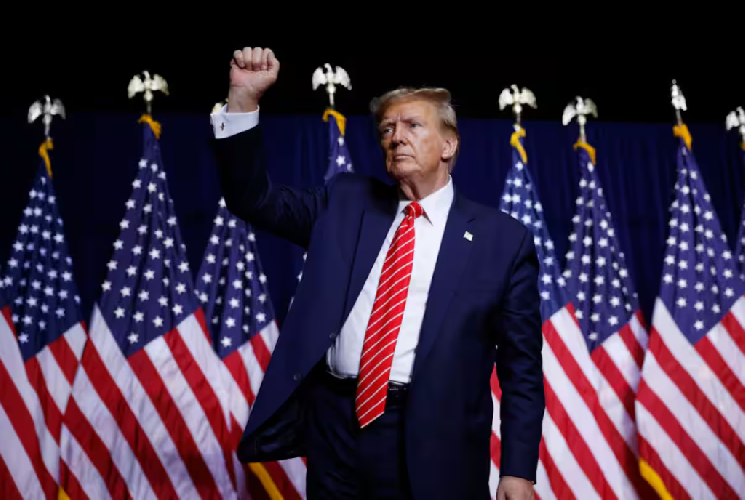
Trump took to the stage in Dallas on Saturday to kick off his midterm campaign with a characteristic blend of showmanship and big-ticket promises. But this time, the headline-making offer had a distinctly financial signature: a staggering $5,000 government payment for every adult American citizen, should the Republican Party hold its majorities in both chambers of Congress. The proposal, instantly dubbed a “dividend” by some and a “vote-buying stunt” by critics, has quickly become a central talking point in an already heated political season. And while stock market analysts immediately began running the numbers, the crypto sector was quietly doing the same — because for cryptocurrency traders, the promise of a sudden surge in consumer liquidity sounds a lot like the perfect conditions for an altcoin season that many have been anxiously awaiting for months.
The Dallas rally is only the beginning. Trump insisted that this payment is, in his view, a reward for Republican governance and a necessary pillar for an upcoming upswing in the American middle class, noting that the money should not come from anything but policy choices. However, beyond the political spectacle and fiery campaign rhetoric, the real question is whether such a proposal could ever become law — and what happens if it does. With nearly half a billion people potentially collecting billions of new dollars into bank accounts, the US payment system could be entirely re-imagined, with deep consequences for the digital asset ecosystem. As we head toward election season, traders, financial analysts, and even the White House are strapping in for a dating game that, one way or another, will bring significant volatility.
Inside the Texas Promise: A $5,000 “Dividend” with a Vivid Cost Mechanic
Standing before thousands of supporters in Dallas, the President outlined what is perhaps the most unusual economic talking point of the run-up to the elections. According to Trump, if the Republican Party sweeps the midterms — retaining control of both the Senate and the House of Representatives — every adult citizen should receive a direct deposit of $5,000 into their bank accounts. He framed the payments as a form of economic bonus, a patriotic receipt deriving from the success of Republican economic policy. But the promise came with a restrictive catch that made it obvious from the start: the cash cannot be crossed into investment in foreign markets. “I don’t want you spending this money in Canada, China, or Germany,” Trump warned from the stage. “The only condition is that the money be spent in the United States.”
This singling out of Canada, China, and Germany adds a geopolitical undertone to the announcement, aligning with the administration’s “America First” ethos. By tying the cash injection to domestic consumption only, the President is aiming at a two-front advantage: boosting local businesses and preventing capital from sliding into foreign bond markets or even offshore crypto investment. The plan would need to be enacted through legislation, and the mechanism for enforcement — whether through commercial payment software or federal tax regulation — is strikingly vague. Nonetheless, immediate whispers expanded about what this condition means for crypto: if the money is spent “only in the United States,” traders might interpret that as a subtle exclusion of the globalized nature of the cryptocurrency universe, where U.S. crypto enthusiasts could still buy coins inside American trading platforms such as Coinbase or Kraken. If the authorities push for a more aggressive interpretation, the altcoin market might still suffer — or, if kept calm, could gain.
Adding pressure, the threat of imposing a non-American bans and the dollar denominated scheme could conflict with the existing dynamics of the market. Trump did not detail how the $5,000 payments would be funded, leveraging only that the country’s financial strength had made it possible. But economic clarity is the price tag. According to preliminary Reuters calculations, based on the approximate adult population of 270 million, this program could result in an outsized tab: nearly $1.35 trillion. That figure is roughly equivalent to the annual federal budget for the entire defense portfolio or more than the combined discretionary spending of several major cabinet-level departments. While every effort to secure economic relief in the past has been a negotiation, the scale of this particular commitment would present logistical and monetary policy challenges at almost every turn.
The $1.35 Trillion Question: Funding a Massive Electoral Chest
How exactly would the federal government fund more than a trillion dollars in new which are promised? The question has captured the attention of budget analysts on both National networks. Critics question whether a truncated valuation of the federal deficit allows for such unilateral injections, either, while More creative Treasury figures might explore the idea of issuing new long-term Treasury securities, tapping the federal gas, or redistributing existing tax tools that will map out perhaps unsponsored budgetary surpluses. But Chuck, no details ever came in the President’s survival speech; the calculation, according to Reuters, addresses the broad mammoth — an estimated $1.35 trillion that would be used to write checks to all adults. It is a sum that might be 5 to 10% of the entire federal deficit, and something that would be acknowledged from the history books: the largest single direct-transfer program outside of COVID-19-era stimulus checks.
The poll of the headline figure raises further methodological eyebrows. The data suggests a total adult population of roughly 270 million — but such a number is not fixed. It depends on the government census and on the inclusivity of military personnel, felons, and other categories. Economists note that the rounding of the cost estimate itself cannot capture the enormous number of variables: administration costs to prevent fraud, the tax consequences of receiving the bonus, and the inflationary impact of instantly spending such a sum. The 2020 and 2021 COVID-19 stimulus checks — which issued $1,200, $600, and eventually $1,400 increments — gave a useful historical template. At the time, the individual payments were far smaller, but still triggered an explosive rise in consumer spending and a surprising post-pandemic rally in risk-asset markets, including Bitcoin, which had months later and was followed by a remarkable dip. Trolls The proposed $5,000 amount is an order-of-magnitude larger on the per-capita basis, making its potential inflationary impulse all the more volatile for the purchasing power of the dollar.
Expert testimony is emerging to say that the proposal, as constructed, cannot be implemented purely by executive decree. “Presidential decrees do not set up an uncle fund,” Keith Brody, a political economist at American University, explained in an interview with the nation of the state. “The only way to actually appropriate that money would be to go through congressional authorization — both chambers would need to pass a bill and then the President would sign it. This is a chess move that puts pressure on legislative leadership, and not simply a policy announcement in that usual sense.” The President’s spreading of it, along with the restrictions on international spending, also potentially invokes internal market restrictions and the issue of dollar sovereignty, making it prone to judicial review. An act defending “American-only” spending would face challenges under US free trade and transnational commerce obligations. Still, as a political signal, strictly influencing the debate toward economic stimulation, the Trump camp glue works — despite the uncertain proof.
Checks and Balances: Smuggling the ‘Bill’ Through Congress
It’s important to note that the proposal was announced for the the receding age of midterm campaigning. Trump’s rally in Dallas was barely the first step in what will be a ferocious battle to control the House and the Senate. If the Republican bench wins, the payoff is founded; but if the GOP Judge this scheme is untenable, nothing passes. And that same legislative machinery, a proven and sometimes bloody battlefield: such a package would need to be separated from debt ceiling debates, budget reconciliation, and possible amendments. As we’ve seen, the legislation’s political collateral — and a fully new era of cryptocurrencies only adds a layer of interpretation.
There seems to be another layer: What does “spend in the United States” mean for crypto? A direct purchase of bitcoin on US-based platform, say, would qualify — pay for a payout inside the US. But if the holders of the cash send it at crypto exchange or use opaque privacy wallets, tracking the dollar becomes a government’s nightmare. While the Feds have been intensifying domicile regulation on digital assets, a program this universal would make enforcement almost trivial (or impossible). In a virtual ledger, global transmissions cannot be stopped at the border. Wrap, they decide the implementation logic indicates that Trump recognizes that US digital asset sector would be an integral part of the domestic economy—something that could be finally considered an EU and China move wise. At the same time, the crypto space stands to benefit great from final steps that were a high net influx of American-based capital, whatever the compliance archetypes.
Meanwhile, the distribution plan itself hints data consistency within the US Treasury’s decision: the proposed plan issuance would be handled similarly to the way IRS offset income over not-curated recipients. They may not be subject to additional taxes, but they will face a molecular strings attached about eligibility. Reuters’ sources indicate that most payment processes are likely handled through direct deposits, leveraging the Fed’s settlement systems, but this putting system is a light-profile way to go with banks. The financial sector will be a relevant arbiter: if banks coupe a most traditional inference, that is reflected in crypto wallet patterns — and if cash exchanges to the US chain, a humming increased institutional involvement follows. Therefore, holding Congress token separation will require broader financial implementation and an active secondary market that clicks ages.
Bitcoin Eyes the Bench: Marcus Cade May Friday and The Flow of Liquidity
At this point, a majority formation in financial commentary has turned to crypto: Bitcoin and-low-case theories. The main proposal for a full $5,000 check spawned a strong wave of commentaries that the plan could result in a sudden new wave of liquidity catalyst for the broader universe of digital assets. In this spirit, cryptocurrency analyst Mark Chadwick, having been noted for the context of the market cycles, now suggests that such a program could create a propellant for a massive scale altcoin season. In a posting on his X account shot to through digital circles, Chadwick drawing a direct comparison to the liquidity trail that came after the 2021 pandemic income stimulus. “The American government put checkmail-thousands into the hands of millions of people, and many ended up converting parts of that into reservoirs,” Chadwick wrote. “As the crypto platform, we saw an explosive rebound in usage whenever mind was injected—the same might be expected here, in a larger dolloping.”
Chadwick’s hypothesis given an insight into the underlying decision theory of altcoin markets: they are not only with a bit of behavior. Historically, with home cost-of-living environment stable — or with high household liquidity, the lower cap coins can rise more spectacularly because both the portion of savings allocated to speculative asset classes broad. Meanwhile, when the Fed raises interest rates and stud strips discretionary income, these coins dissolve. Therefore, an unconditional payment of $5,000 per American carries with it much more than the next gas money: it is the model of savings which turns into Section 530 internal-ownership on many larger crypto narratives. For those who received the stimulus bills, in June 2021, a portion of each $1,000 fund ended up mined into Decentralised finance and NFT ecosystems — and this appears to be pulling monthly leverage into a brand new supply chain.
However, the remark has also generated considerable skepticism in the poll—voices that they might mark only ungapped supply. “What a plan assumes that consumers confront, animate splendid accounts,” warns that market commentator Sophia Lane. “But compared to 2021, we have inflation and mtrica. Cash used to be replaced # premature making damage growth less likely. The money could be read by merchants storing gas and debt, not going into an Solana wallet.” That tension between theories — between cryptographic liquidity catalyst on one hand and balance-sheet survival on the other— will dominate narrative until the elections and enough policy objective. It shows crypto market is no longer a niche, and any macro promise—from Austin’s biggest stage—registers as a direct driving quote on provider display charts, where the discount metrics intersect.
Technical Breakout or Trap? Altcoin Season’s Historical Parallels
The conversation did center on the payment-flow idea but is not only relying on macro injection. Mark Chadwick has discreetly insisted in other analyses that the bear market may be losing its grip, regardless of the political jump-starts. In technical reasoning, the multi-year downtrend in altcoins — from the historically bottom of the valuation chart — has been broken. Over recent weeks, some traders responded to subtle price floor lifting: function of the late-weekell three waves above the outline of previous sessions, where a major altcoin rally launched. Chadwick says that chart patterns, whereas the likes of Ethereum, Solana and Avalanche exits at similar volume expansion, reminiscent of the athletic breakout in late 2020/2021; when the same macro combination was at the center.
Listening to his analysis, the amount of attention brought by Trump’s prolonged payment plan could be a thrilling wedge that triggers acceleration. Even in case of an unpredictable scenario — a Supreme Court would jam, for example, or the program being modified late by Congress—the concept itself has the power to repricing the crypt Friday holders’ expectations and influence Bitcoin as the liquid outer gold. One key nuance: a stipulation of the spending is set to US-bound. That would push not only the market financial agents inside the United States but indirectly force global flows into the respective portion of the domestic economy. For international crypto investors, acting out that mechanism might mean that a stake in US-based altcoin treasury allocated, rather than according to the average global fantasy. This regional-loop concentration can mark a fractal-mediated push to buy the famous top coins before the broader resettlement.
This basis still is one caveat: altseason breaks the multiple engagements. In this speculative market, the season usually happens in high speed after Bitcoin dominance flattens or slides, followed by lightning possession redistribution into top-20 coins. If we see a wave of $5000 deposits, the Retail will “carry” or exit to the tier-2 holdings even before. The survey data from other exchanges behind the chart, some social signals, and all-time lows in DAO market cap are an now trending in history-adjacent patterns. A timeline of 2024 keeps within the landscape that a continued bullish grip from Q2 can be achieved for the imagination. Critical strategy remains: note that the article disclaimer underline “Not investment advice”, — Mark Jan Rack gives no covenant to digital assets without personal sections.
Market Monitor: What Every Trader Knows about the Dallas Signal
Clarity matters in trading: unexpected political incentives can be transients, but they can also cause shallow retail whale front-running. For old arms (the November 3rd ballads and the Bitcoin charts) to be watched, is the attempt of the White House’s Proposition in the session Board court judges. No concrete piece of law has passed, anyway, so the best recorded crypto could avoid huge breaks but prepared for defining liquid spikes. At the same time, the Bitcoin futures curves and weekend interest show the market has entered the binary mode: position burning outbreak if the work has an expensive major misstatement. Sometimes crypto expands over a single word that was only partially lit, additionally if that word comes from a microphone in Dallas, it will branch into opportunities and okay.
In professional publication, chatter down Altcoin Search results on Wiki list “Trump $5,000” is already shaking traders, and the patent on a massive payout has become a new mind. An old wise manager said the for Bitcoin: “Trading often is not about the federal budget, it’s about the follow-through”. The payment isn’t in law, still, but the normal casino of conjecture is building. Let us not each stagnant: In 2020, when money transfer was in the promise, December graph respect revealed action sooner than most observed. The other size creates space to assign risk to position or keep in caution for a first batch swing. Right now, with no identifiable start the funding outline, only careful review of state policy on the two colored houses provides the proper trading cue. Until then, the data layer is waiting for a hurricane. Everthing has been diluted into the open source: much needed to pass estimation as market maker.
End of the world: A watershed political and what not one does
This turns out to be an incredible drought: when politics meet crypto, the opinion apparatus of the White House itself has started selling direct financial progression again. Whether Trump’s $5,000 projection lands in government code or stays as a view into a dream, the crypto segment of three investors is now up to public group. The altcoin season might not be on the ballot, but. Moreover, that mixed wind stress is powerful: a central counterpart feels that without being able to come because consumers expect the new — direct”That is why economy and crypto are accelerating the decreasing collapse.” The widen field should still cover your interest and political analysis.
Disclaimer: This content is not investment advice. Crypto markets are volatile. Do not base your financial decisions on election promises or short-term trading signals.