






The Silicon Democrat: How Bittensor’s Subnet 9 is Redefining the Global AI Compute Landscape
1. The Monopolistic Moat of Frontier AI and the Paradigm of Decentralized AI Training
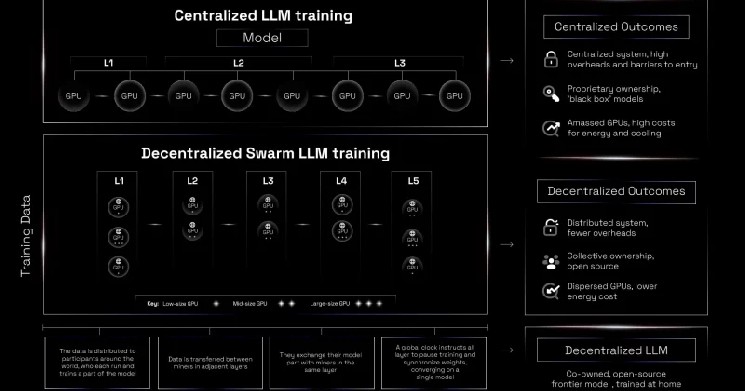
For the past decade, the trajectory of artificial intelligence has been dictated by a simple, brutal equation: massive compute equals superior intelligence. Training state-of-the-art large language models has transitioned from an academic pursuit into an industrial arms race, one requiring sprawling warehouses of liquid-cooled graphics processing units (GPUs), seven-figure daily electricity expenditures, and the kind of centralized corporate muscle only a small handful of Silicon Valley conglomerates can summon. This infrastructural bottleneck has effectively locked out independent developers, researchers, and smaller enterprises, creating a digital oligopoly where the world’s most powerful cognitive models are guarded by corporate gatekeepers. However, a profound shift is brewing on the fringes of Web3. Bittensor’s Subnet 9 is actively dismantling this high-altitude barrier to entry through a radical decentralized architecture known as the Incentivised Orchestrated Training Architecture, or $IOTA. By elegantly splitting complex, multi-billion-parameter neural networks across a global web of independent, heterogenous computing nodes, the $IOTA architecture represents a milestone in decentralized AI training. No longer is a participant required to host an entire model within the high-bandwidth memory (HBM) of a million-dollar localized server farm; instead, the computational burden is distributed across a broader ecosystem, challenging the foundational assumption that absolute centralization is the only path toward artificial general intelligence.
2. The Great Realignment: From Ruinous Mining Races to Collaborative Machine Learning
To understand the genius of the $IOTA architecture, one must first look at the developmental history of Bittensor Subnet 9. In its early iterations, the subnet relied on a highly competitive, winner-takes-all model where global miners essentially engaged in a relentless computational sprint to complete training tasks. While this raw friction proved highly effective, allowing the subnet to successfully pretrain large language models with up to 14 billion parameters by August 2024, the structural limitations of pure competition eventually became clear. Under the old regime, well-capitalized mining operations with enterprise-grade datacenters consistently crowd-routed smaller, independent participants, centralizing the network’s reward distribution and leaving consumer-grade hardware entirely obsolete. Realizing that true decentralization cannot survive under monopolistic pressures, the developers behind Subnet 9 published a revolutionary research paper on arXiv on July 16, 2025. This document laid out the blueprint for $IOTA, shifting the network’s primary incentive structure from isolated algorithmic warfare to a system of collaborative machine learning. By borrowing and adapting internal optimization methods used by premier AI labs—specifically pipeline parallelism and data parallelism—$IOTA splits model layers across separate sequential nodes, transforming a disjointed network of competitors into a highly synchronized, global assembly line where every participant is compensated proportionally for their verified contributions.
+————————————————————————–+
-
SUBNET 9: COMPUTE PIPELINE ++————————————————————————–+
| [ Data Parallelism Input ] -> Splitting massive datasets across nodes |
| |
| [ Pipeline Parallelism ] -> Sequentially distributing model layers |
| |
| [ Orchestrator Node ] -> Managing synchronization and logic |
| |
| [ Validator Verification ] -> Proportional payouts based on gradients |
+————————————————————————–+
3. Demystifying ‘Train at Home’ and the Empowerment of the Retail Miner
The practical and societal manifestations of this collaborative design reached the consumer public in February 2026 with the debut of “Train at Home,” an elegant desktop application that empowers everyday technology enthusiasts to monetize their idle hardware. This initiative is particularly revolutionary for the consumer market, enabling users of consumer Apple Silicon systems and mid-range gaming rigs to seamlessly participate in consumer GPU mining. Under the hood, the application connects to a decentralized orchestrator node that seamlessly manages the complex mathematics of the pipeline. The client automatically downloads partitioned slices of a larger model’s architecture, processes training updates locally, and returns the computed gradient steps back to the wider network without requiring the hardware owner to possess any background in distributed systems engineering. By abstracting away the complex containerized environments, networking configurations, and protocol rules that typically define enterprise blockchain mining, “Train at Home” successfully democratizes the hardware layer. It reclaims computing power from centralized server silos and repurposes consumer electronic products into an active, globally cooperative supercomputer, illustrating a major leap forward for the democratization of open-source artificial intelligence.
4. Overcoming the Latency and Memory Walls in Distributed Architecture
Technologically, the shift from localized AI inference to decentralized training is akin to migrating from basic web hosting to synchronized global high-frequency trading. While running inference on an existing model is relatively simple and easily parallelized, training a model from scratch requires intensive backpropagation, continuous parameter updates, and near-instantaneous synchronization across all participant nodes. In typical crypto compute networks, high-latency public internet connections have traditionally stood as the ultimate graveyard for training endeavors, as slow nodes bottleneck the entire backpropagation phase and cause computational drift. The $IOTA architecture tackles this systemic challenge by natively integrating data and pipeline parallelism directly into its validator layer. By compartmentalizing the neural network’s mathematical segments into sequential modules, the system completely sidesteps the memory barriers that historically prevented consumer GPUs from training foundational deep learning models. Instead of forcing every participant to download a massive 30-gigabyte model context, the system requires nodes to host only a highly localized subset of weight transformations, relying on coordinated pipeline pathways and smart caching to keep the training run fluid, cohesive, and remarkably resilient to the physical constraints of global geographic distribution.
5. Tokenomics, Staking, and the Microeconomic Realities of the $TAO Ecosystem
For institutional investors, venture capitalists, and retail market participants, the mechanical shift within Subnet 9 has major implications for the broader valuation and utility of the Bittensor network. Historically, the value proposition of the TAO token utility has been tied to its role as a mechanism for allocating emission rewards to various subnets. Under $IOTA’s newly minted proportional contribution mechanism, the microeconomic dynamics of Subnet 9 are undergoing a major evolution. By lowering the computational baseline required to participate in the mining process, the network experiences a surge of newly active nodes, which acts as a powerful catalyst for the decentralized physical infrastructure network (DePIN) sector. This expansion directly stimulates organic demand for $TAO staking, as validators and miners must lock up collateral to guarantee operational performance and ward off Sybil manipulation. However, investors must also weigh this against the reality of reward compression; as thousands of domestic consumer nodes plug into the distributed pipeline, the yield per individual teraflop of compute will naturally normalize. Yet, by proving that decentralized protocols can train foundational models at a fraction of the cost of traditional hyper-scalers, Bittensor is showing that it can transform $TAO from a speculative token into a fundamental index representing the raw computational output of the global, open-source AI revolution.
+————————————————————————–+
-
$TAO TOKEN ECONOMICS & SUBNET 9 ++————————————————————————–+
| [ Scaled Collateral ] -> Miners lock $TAO to secure pipeline bandwidth |
| and prevent malicious sybil activity. |
| |
| [ Organic Utility ] -> Open-market model buyers purchase computing |
| power, settling transactions in $TAO. |
| |
| [ Democratic Yield ] -> Proportional reward payout ensures consistent |
| and wider distribution among node operators. |
+————————————————————————–+
6. The Frontier of Security: Mitigating Byzantine Threats in Public Compute Pipelines
Despite the engineering brilliance of Bittensor’s newest protocols, the transition from secured corporate platforms to permissionless networks introduces deep systemic vulnerabilities, particularly regarding Byzantine fault tolerance. In any decentralized environment, the threat of malicious, lazy, or malfunctioning nodes submitting corrupted gradient weight updates during a training run remains a massive vulnerability; a single poisoned submission can instantly corrupt an entire optimization pass, wasting millions of dollars in aggregated electricity and computational runtime. To establish itself as an enterprise-grade utility, Subnet 9’s $IOTA architecture must continually refine its cryptographic validation and consensus systems to detect mathematical anomalies in real time without bottlenecking the training pipeline. Validators must employ highly advanced, low-overhead statistical verifications to ensure that the work returned by consumer nodes is mathematically valid and aligns with the expected loss function of the active epoch. Whether Subnet 9 can scale this verified defense system beyond experimental parameters to compete directly with centralized cloud giants like AWS and Microsoft Azure remains the ultimate question. If successful, the $IOTA protocol will not only change how neural networks are built, but also lay the groundwork for a future where artificial global intelligence is owned, trained, and secured by the public.