



Bitcoin’s Price Plunge: Retail Investors Lead the Sell-Off as Whale Holdings Waver
In the volatile world of cryptocurrency, where Bitcoin’s price swings can evoke everything from euphoric rallies to gut-wrenching plunges, recent data from analytics firm Glassnode offers a stark glimpse into investor sentiment. As Bitcoin slips below the $67,000 mark, a key metric called the Accumulation Trend Score—segmented by wallet cohorts—reveals a wave of broad-based selling, predominantly driven by retail participants who seem to be capitulating amid the downturn. This isn’t just another dip; it’s a revealing snapshot of market psychology, where the little guy feels the heat, while bigger players hold back, cautiously observing. For seasoned traders and newcomers alike, understanding these on-chain signals can illuminate paths through the digital asset maze, especially as global economic pressures and regulatory scrutiny intensify. Drawing from Glassnode’s meticulous on-chain insights, this trend underscores a potential shift in Bitcoin’s holder landscape, one that echoes past market corrections but carries unique implications for the coin’s long-term trajectory.
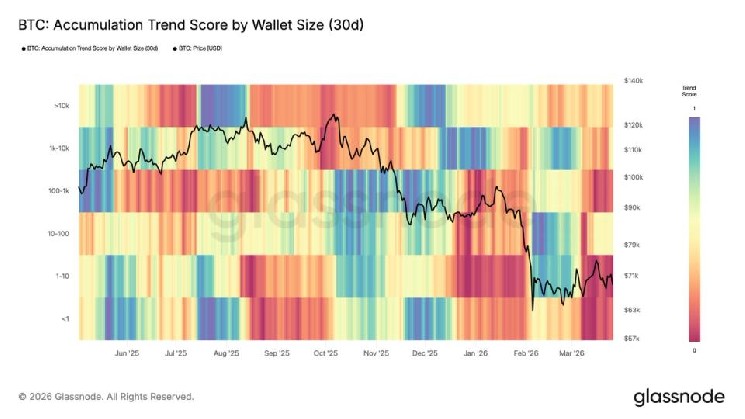
Glassnode’s 30-day Accumulation Trend Score, a sophisticated tool that dissects the behavior of various entity groups based on their on-chain activities, provides an objective lens into accumulation versus distribution patterns. By evaluating both the scale of holdings and the net changes in balances over the last month, the score ranges from 0 to 1—where a figure approaching 1 signals robust accumulation, often by heavyweight entities, and a score nearing 0 points to aggressive distribution or outright offloading. This metric isn’t merely a number; it’s a narrative device that unfurls the stories of daily transactions, unearthing hidden motivations in a market notorious for its opacity. In essence, it quantifies who’s buying the dip—those bold enough to scoop up Bitcoin at perceived lows—and who’s fleeing, potentially exacerbating sell-offs. Experts like those at Glassnode emphasize that this score transcends surface-level price charts, offering a deeper dive into cohort-specific strategies. For instance, during bullish phases, we might see scores clustering toward accumulation across the board, building a foundation for sustainable growth. Conversely, the current readings suggest a fragmentation, with smaller holders bearing the brunt of emotional selling, while larger wallets adopt a wait-and-watch posture. This analytical framework has become indispensable for analysts deciphering Bitcoin’s market dynamics, aligning with broader crypto trends where on-chain data increasingly guides investment decisions.
Zooming in on the retail end of the spectrum, the retail cohort—comprising wallets with holdings under 10 BTC—is exhibiting unprecedented distribution, painting a picture of panic and discontent. Wallets clutching less than 1 BTC score a mere 0.11, while those in the 1 to 10 BTC bracket dip even lower to 0.05, indicating a fierce inclination to liquidate positions rather than hold through the volatility. This behavior contrasts sharply with historical precedents, such as the 2021 bull run, where retail enthusiasm fueled soaring prices through collectives like WallStreetBets. Now, as Bitcoin falters below $67,000, these smaller investors are often the first to sell, propelled by fear of further losses, mounting inflation, or simply external market pressures like rising interest rates. Anecdotal evidence from social media platforms and trading forums amplifies this; users recount stories of hastily converting Bitcoin to stablecoins or fiat currencies to lock in diminished gains. Analysts note that retail driven sell-offs can create cascading effects, pressuring prices downward and prompting broader market corrections. Yet, this isn’t isolated—it’s a symptom of macroeconomic unease, from looming recessions to geopolitical tensions that rattle investor confidence. Understanding retail’s role here highlights a fundamental asymmetry in crypto: while institutional adoption grows, the average person’s involvement remains fraught with higher risks and emotional responses.
As we shift our focus to the bigger players in this on-chain saga, the trend reveals a markedly different narrative for larger wallet cohorts, where selling pressure eases and strategic patience emerges. Whales—those commanding 1,000 to 10,000 BTC—sit at a neutral score of around 0.5, neither aggressively accumulating nor distributing, instead biding their time in a bid to gauge market direction. This tepid stance speaks volumes about calculated restraint, especially when compared to late 2021’s all-time highs above $90,000, where massive distributions by these entities preceded a prolonged bear phase. The colossals, holders of over 10,000 BTC, show mild distribution but nothing akin to the frenzied unloading seen during Bitcoin’s peak euphorias. Meanwhile, mid-tier holders with 100 to 1,000 BTC are also leaning toward notable distribution, though tempered by their vested interests in long-term appreciation. This coalition of larger investors, often representing exchanges, institutions, and seasoned hodlers, contrasts retail’s capitulation, embodying institutional maturity that has matured over the years. Glassnode’s data suggests these entities might be poised for a comeback, waiting for tangible signs of a bottom before re-entering, much like the savvy maneuvers that defined Bitcoin’s recovery in 2019 post-halving. Such dynamics underscore the crypto ecosystem’s evolution, where whales no longer dictate unbridled dominance but operate in a more nuanced, data-driven landscape.
Delving into the broader zeitgeist, the paucity of significant accumulation since early February, when Bitcoin hovered near $60,000, paints a cautionary tale of subdued investor optimism. That brief spike soured quickly, and the current trend—substantiated by Glassnode’s metrics—implies a market in limbo, with retail capitulating while larger actors linger on the sidelines, reluctant to commit capital amid uncertainty. This mirrors patterns from previous cycles, like the 2018 crypto winter, where distribution outweighed accumulation for months, fostering resilience in the survivors. Economists point to intersecting factors: inflationary headwinds that erode purchasing power, regulatory clampdowns in key jurisdictions like the US and EU, and tech sector downturns that bleed into crypto valuations. Yet, amidst this, Bitcoin’s intrinsic value—its scarcity, decentralization, and role as digital gold—remains a beacon for contrarians. The juxtaposition of retail exodus and whale caution could herald a cleansing process, shaking out weak hands and paving the way for a more robust, institutional-driven bull phase. Analysts predict that if stability returns, perhaps through favorable policy shifts or macroeconomic stabilization, we might witness a resurgence of accumulation, turning today’s distributions into tomorrow’s opportunities.
In wrapping up this examination of Bitcoin’s current undercurrents through Glassnode’s lens, it’s clear that the Accumulation Trend Score offers not just data, but a roadmap for navigating turbulent waters. Experts in the field, including seasoned crypto journalists and on-chain researchers, stress the importance of these insights for informed decision-making. For instance, a balanced view from Glassnode co-founder Rafael Schultze-Kraft highlights that while retail selling might prolong volatility, the neutral-to-mild actions of larger cohorts signal an underlying strength—a network effect that has weathered storms before. As Bitcoin hovers below $67,000, the market’s maturation is evident: no longer a wild west of speculators, but a complex interplay of cohorts vying for leverage. Looking ahead, potential catalysts like the next Bitcoin halving in 2024 or global adoption milestones could tip the scales back toward accumulation. Ultimately, for investors sifting through the noise, these on-chain signals remind us that Bitcoin’s journey is as much about human behavior as it is about technological innovation, urging prudence, patience, and a keen eye on emerging trends. In the ever-shifting tapestry of digital assets, adaptability isn’t optional—it’s essential for those aiming to thrive in this lucrative yet unpredictable arena.