



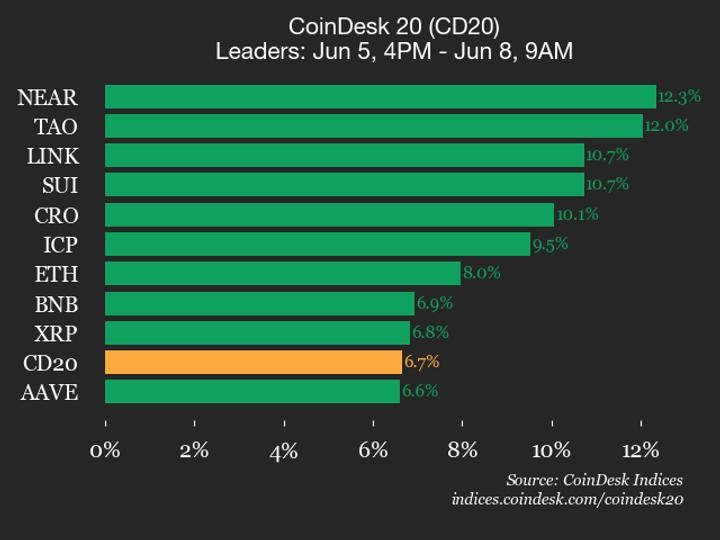
The Resurgence of Digital Assets: CoinDesk 20 Breaches Key Milestones Amid Broad-Based Market Optimism
Global financial markets are witnessing a profound structural realignment as digital assets break out of their recent consolidation ranges, fueled by a renewed wave of institutional interest and favorable macroeconomic data. At the center of this momentum is the CoinDesk 20 Index, the premier standard for measuring the performance of the market’s largest and most liquid cryptocurrencies. In its latest market update, the index surged to 1715.91, marking a robust 6.7% gain—an absolute increase of 107.11 points—since Friday’s 4 p.m. Eastern Time close. This swift upward movement underscores a broader narrative of capital re-entry into digital markets, indicating that investors are shaking off previous quarters of regulatory uncertainty and high-interest-rate anxieties. As traditional equities face headwinds from shifting fiscal policies, the cryptocurrency sector is carving out an independent trajectory of growth, signaling a maturation of the asset class from high-risk speculative vehicles to essential components of diversified global investment portfolios.
Decoding the Breadth of the Rally: Why a Multi-Asset Ascent Signifies Paradigm Shifts in Liquidity
                  COINDESK 20 INDEX PERFORMANCE
                     (Weekend Return: +6.7%)
19 of 20 Assets Higher [========================================] 95%
Top Gainers:
- NEAR Protocol (NEAR) [===========>] +12.3%
- Bittensor (TAO) [===========>] +12.0%
Laggards/Underperformers:
- Avalanche (AVAX) [=>] +1.1%
- Bitcoin Cash (BCH) [-=>] -3.2%
Perhaps the most compelling metric of this latest market cycle is the remarkable breadth of the recovery, with nineteen out of twenty representative index assets trading significantly higher. Historically, crypto market rallies have been highly top-heavy, dominated almost exclusively by Bitcoin and Ethereum, while the broader altcoin ecosystem struggled to find independent liquidity. The current market structure, however, suggests a healthy, decentralized distribution of capital across multiple ecosystems, layer-1 networks, and utility tokens. This widespread green wave indicates that market participants are actively seeking beta yields outside of the primary market bellwethers, allocation strategies that are increasingly characterized by sector-specific diversification rather than panic-driven speculation. As global liquidity conditions ease and capital flows from traditional debt instruments back into risk assets, the unified surge across nearly the entire CoinDesk 20 index illustrates a systemic return of buy-side pressure that is liftings all boats simultaneously.
The AI and Scalability Vanguard: How NEAR and Bittensor Led the Charge in the Latest Cycle
At the forefront of this market expansion are NEAR Protocol (NEAR) and Bittensor (TAO), posturing gains of 12.3% and 12.0% respectively. This double-digit outperformance is not an accident of the charts; rather, it reflects a deeply rooted fundamental narrative that intersects decentralized ledger technology with next-generation artificial intelligence and highly scalable web3 infrastructure. NEAR Protocol’s climb highlights the market’s growing appreciation for “chain abstraction,” dynamic sharding, and user-friendly Web2-to-Web3 onboarding experiences that aim to make blockchain utility invisible to the end user. Simultaneously, Bittensor’s remarkable rise demonstrates the massive investor appetite for decentralized machine learning networks, where computational power and algorithms are incentivized through native blockchain tokenomics. By rewarding decentralized nodes for producing high-quality machine intelligence, Bittensor (TAO) has successfully captured the imagination of institutional investors who view decentralized AI as the primary counterweight to centralized Big Tech monopoly, driving immense demand to its ecosystem.
Divergent Paths in Decentralization: The Story Behind BCH and AVAX’s Relative Underperformance
Market Leaders (High Beta/AI-Driven) Laggards (Legacy/Consolidating)
┌──────────────────────────────────┐ ┌──────────────────────────────────┐
│ NEAR Protocol (NEAR) +12.3% │ │ Avalanche (AVAX) +1.1% │
│ Bittensor (TAO) +12.0% │ │ Bitcoin Cash (BCH) -3.2% │
└──────────────────────────────────┘ └──────────────────────────────────┘
Conversely, the market update highlights a clear divergence in investor sentiment, as evidenced by the day’s laggards: Bitcoin Cash (BCH), which fell 3.2%, and Avalanche (AVAX), which managed a modest 1.1% increase. Bitcoin Cash’s descent into negative territory represents an ongoing market reassessment of legacy proof-of-work payment networks. While BCH historically benefits from short-term speculative volatility during payment-narrative cycles, its utility is increasingly overshadowed by layer-2 scaling solutions built directly on top of Bitcoin’s mainnet. Meanwhile, Avalanche’s modest gain, although positive, points to temporary capital rotation dynamics. Despite Avalanche’s robust institutional partnerships with traditional finance giants for asset tokenization, its slower upward momentum reflects a brief period of consolidation as speculative capital migrates toward higher-beta, AI-integrated computational assets. This divergence in price action signals a highly sophisticated class of market participants who are no longer treating all alternative coins as a singular asset class, but are instead discriminating based on technological trend, network utility, and structural updates.
The Rise of Index-Based Digital Asset Portfolios: Standardizing a Global Class of Commodities
The institutionalization of the cryptocurrency space has long required a robust infrastructure of indices, and the CoinDesk 20 Index has rapidly emerged as a globally recognized standard for asset managers. Traded on multiple platforms and across various financial jurisdictions globally, the index allows professional managers to gain exposure to the digital economy without having to manage the unique administrative burdens, custodial risks, or idiosyncratic volatility of choosing individual tokens. Similar to how the S&P 500 or the Euro Stoxx 50 revolutionized equity investment by offering diversified, single-vehicle exposure to entire economic sectors, index trading in crypto allows capital allocator systems to manage risk structurally. This maturity in market structure is crucial for the entry of sovereign wealth funds, pension systems, and massive asset management entities. As perpetual swap contracts, exchange-traded products, and structured derivatives based on the CoinDesk 20 continue to proliferate around the world, the index serves as a foundational bridge helping to normalize digital assets within the framework of global macro finance.
Forward Outlook: Navigating Volatility and Macroeconomic Winds in the Next Market Phase
MACRO FACTORS INFLUENCING FORECAST[Monetary Policy] ───► Interest rate cuts increase risk-on capital supply
[Regulation] ───► Stablecoin and index-product frameworks mature globally
[Infrastructure] ───► Institutional demand shifts focus to real-world utility
Looking ahead, the digital asset ecosystem appears poised for a sustained period of price discovery, though not without the volatility that characterizes young financial markets. Market participants will likely keep a close eye on upcoming macroeconomic prints, including inflation data, central bank interest rate decisions, and stablecoin regulatory frameworks advancing through legislative halls in both the United States and Europe. The current 6.7% leap in the CoinDesk 20 indicates that the market has built a resilient floor, supported by strong fundamentals and real-world utility cases rather than paper-thin speculative derivatives. As decentralized finance protocols continue to integrate with traditional business operations, and as AI and Web3 technologies continue their long-term convergence, the benchmarks that track these assets will become indispensable indicators of the globally integrated digital economy. For observers and market actors alike, the broad-based performance of the CoinDesk 20 is a powerful reminder that the tokenization of global value is no longer a futuristic hypothesis, but an active, compounding reality.