


The High-Stakes Battle for America’s Digital Future: Lummis Vows to Push Forward Despite Senate Delays
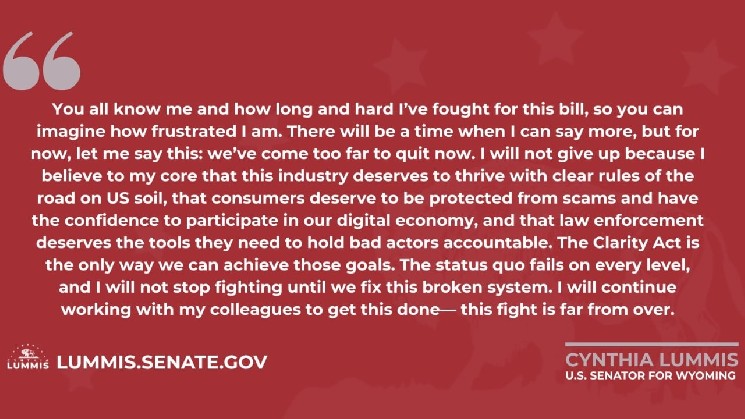
The humid midsummer heat of Washington, D.C., often brings a heavy quiet to the halls of Congress, but beneath the surface of the legislative recess, a high-stakes battle for the future of American finance continues to rage. Senator Cynthia Lummis, the fiercely independent Republican representing Wyoming, took to the social media platform X on August 7 to deliver a direct, uncompromising message to her constituents and the broader financial technology sector: the fight to establish a comprehensive federal crypto framework is far from over. As the chair of the Senate Banking Subcommittee on Digital Assets, Lummis has long been regarded as one of Capitol Hill’s most vocal and strategic champions of blockchain technology, earning a reputation for her willingness to challenge both party orthodoxy and cautious regulatory agencies. Her public statement, filled with an undeniable mix of exhaustion and resolve, laid bare the intense behind-the-scenes struggles that have characterized the push for the CLARITY Act. Expressing deep frustration that the momentum toward a historic vote had stalled on the Senate floor, Lummis made it clear that the immense intellectual and political capital invested by lawmakers over the past year could not be allowed to go to waste. For Lummis, the issue transcends simple partisan politics; it is a fundamental question of whether the United States will lead the next generation of global financial innovation or cede its dominance to more agile international competitors. By publicly recommitting herself to working with her Senate colleagues to break the legislative logjam, she has signaled to the financial world that the push for robust digital asset regulation remains her absolute priority, setting the stage for a dramatic showdown when Congress reconvenes.
Inside the Gridlock: Eleven Months of Intense Negotiations and a Postponed Senate Vote
The sudden halt in legislative progress came as a bitter disappointment to industry advocates who had watched months of painstaking, closed-door negotiations slowly bear fruit. Just days before her public admission of delay, Senator Lummis had harbored ambitious hopes that senators would remain in the capital through the weekend to secure a critical vote on the CLARITY Act before the start of the August recess. This optimism was built upon a grueling, eleven-month-long negotiation process that yielded over 300 pages of revisions, primarily driven by demands from Senate Democrats seeking to strengthen oversight, enforce stricter ethics rules for senior federal officials, and bolster national security measures against illicit finance. These comprehensive changes reflected the complex administrative tightrope lawmakers must walk, as they attempted to reconcile the freewheeling, borderless nature of cryptocurrency with the stringent demands of American law enforcement and federal market oversight. Key debates continue to center around the exact jurisdictional boundaries of the Commodity Futures Trading Commission (CFTC) versus the Securities and Exchange Commission (SEC), a bureaucratic turf war that has plagued the digital asset space for nearly a decade. Despite these monumental efforts to build a durable, bipartisan consensus, the realities of a crowded legislative calendar and deep-seated political hesitations ultimately prevailed. Senate Majority Leader John Thune officially confirmed that a vote on the market structure bill would be deferred until September, dampening hopes for an immediate breakthrough but underscoring the reality that major cryptocurrency legislation requires an extraordinary level of systemic alignment before it can hope to clear the upper chamber.
Safeguarding the Retail Investor: Why Consumer Protection Lies at the Heart of the CLARITY Act
At the very core of Senator Lummis’s relentless legislative crusade is a profound commitment to consumer protection in crypto, a theme she repeatedly emphasized in her August statements. For years, the digital asset market has resembled a financial wild west, leaving ordinary American investors vulnerable to predatory bad actors, opaque exchange architectures, and devastating market collapses. The CLARITY Act aims to systematically dismantle this status quo by introducing ironclad, common-sense safeguards designed to restore public confidence in the digital economy. Perhaps the most revolutionary and tangible consumer protection feature within the proposed federal crypto framework addresses the legal treatment of customer holdings during exchange bankruptcies. Under the current, ambiguous legal landscape, when a major digital asset custodian or exchange files for bankruptcy, customer funds are frequently treated as general corporate property rather than the personal assets of the individuals who deposited them. This systemic flaw was catastrophically illustrated during the high-profile collapse of Celsius Network, where approximately 600,000 retail Earn accounts holding an estimated $4.2 billion were frozen, leaving everyday investors trapped in years of agonizing bankruptcy proceedings with little hope of recovery. The CLARITY Act directly resolves this vulnerability by legally requiring exchanges to segregate client assets from corporate operational funds, ensuring that in the event of an institutional failure, customer holdings remain protected, distinct, and easily retrievable. By linking the survival of domestic blockchain innovation directly to the physical security of the retail investor’s wallet, Lummis is making a powerful, highly persuasive moral argument that clear federal guidelines are the only way to protect consumers while allowing legitimate enterprises to thrive on American soil.
Overcoming the Bicameral Divide: Bipartisan Momentum Meets the Reality of Congressional Timelines
Despite the current legislative slowdown, the journey of the CLARITY Act has already demonstrated an unprecedented level of bipartisan cooperation, defying the deep political polarization that currently paralyzes much of Washington. The groundwork was laid over a year ago when the House of Representatives took the historic step of passing comprehensive digital asset market structure legislation, signaling to the Senate that a broad, bipartisan coalition of lawmakers was ready to take action. The momentum carried over into the upper chamber, culminating in a landmark 15-9 vote by the Senate Banking Committee on May 14 to officially advance H.R. 3633, the Digital Asset Market Clarity Act of 2025. This committee milestone was a watershed moment, proving that lawmakers from vastly different ideological backgrounds could find common ground when confronted with the urgent need to address the structural flaws of the current regulatory environment. However, the path from committee approval to a full floor vote in the Senate is notoriously treacherous, particularly when dealing with an asset class that continues to evoke deep skepticism from traditional financial watchdogs. The unresolved framework continues to leave critical questions unanswered regarding the precise legal classification of various digital assets, the exact registration requirements for decentralized platforms, and the scope of federal oversight. Without a unified, statutory standard passed by both chambers of Congress and signed into law by the President, the operating environment for American asset managers, Web3 developers, exchange platforms, and traditional banking institutions will remain mired in a paralyzing fog of regulatory uncertainty.
The Cost of Inaction: Lummis Warns of a Lost Decade for U.S. Crypto Innovation
The urgency driving Senator Lummis’s legislative push is fueled by a stark, realistic assessment of the geopolitical and economic consequences should Congress fail to act during this critical window. The Wyoming Senator has issued grave warnings to her colleagues, suggesting that if this current legislative effort fails to cross the finish line before the upcoming electoral cycle disrupts congressional focus, the United States may not see another viable opportunity to pass comprehensive crypto market structure legislation until 2030. A gap of this magnitude could prove catastrophic for the domestic technology sector, effectively sentencing American innovators, developers, and financial institutions to a lost decade of regulatory limbo. While the United States hesitates, other major global economies are aggressively moving forward to establish clear, predictable regulatory environments. The European Union’s landmark Markets in Crypto-Assets (MiCA) regulation has already begun providing a unified, legal playbook for twenty-seven nations, while jurisdictions like Singapore, Hong Kong, the United Kingdom, and Dubai are actively rolling out sophisticated licensing regimes designed to attract top-tier blockchain talent and capital. If the status quo of “regulation by enforcement” persists in America, with the SEC and CFTC continuing to wage sporadic, inconsistent legal battles against domestic firms, capital flight will inevitably accelerate. Millions of high-paying jobs, billions of dollars in venture capital, and the foundational infrastructure of the future internet will be built overseas, leaving American regulators with little influence over global standards and leaving American consumers entirely exposed to offshore entities operating outside the reach of U.S. law enforcement.
Merging Oversight: The New Legislative Text and the Path Forward in September
Rather than allowing the legislative stall to halt her momentum, Senator Lummis has spent the weeks leading up to the recess actively refining and strengthening the legislative text of the CLARITY Act, demonstrating that her commitment to the cause extends far beyond mere political rhetoric. On July 22, she released an updated draft of the bill that masterfully synthesized months of intense work from both the Senate Banking and Senate Agriculture committees. This unified text represents a monumental legislative achievement, successfully bridging the distinct perspectives, priorities, and oversight jurisdictions of two of the Senate’s most powerful committees. By integrating the consumer-focused, investor-protection mandates of the Banking Committee with the market-liquidity and commodities expertise of the Agriculture Committee, the revised proposal presents a highly polished, legally robust framework that addresses the core concerns of both regulators and industry participants. This strategic consolidation of legislative text reinforces Lummis’s position as the primary architect of U.S. digital asset policy, showcasing her ability to navigate the complex committee structures of the Senate to produce viable, compromise-driven legislation. As the Senate prepares to return to Washington in September, the eyes of the global financial sector will be squarely focused on whether Lummis and her allies can convert this refined draft and the hard-won committee momentum into a decisive, history-making floor vote. The fight for the CLARITY Act is indeed far from over, and its ultimate outcome will shape the trajectory of American financial innovation and consumer security for generations to come.