




Litecoin’s X Account Fires Back Amid Network Turmoil
In the volatile world of cryptocurrency, where fortunes can hinge on a single tweet, Litecoin’s official presence on X (formerly Twitter) took a bold, if contentious, stand this weekend. Just one day after a dramatic 13-block reorganization of its blockchain, the account lashed out at detractors, dismissing their concerns with a witty retort that quickly ignited fury online. This incident, stemming from a zero-day vulnerability in its privacy-enhancing Mimblewimble Extension Blocks (MWEB) feature, has not only tested the robustness of Litecoin’s network but also spotlighted the project’s unique approach to communication. As blockchain enthusiasts grapple with the implications, the episode underscores the fine line between transparency and defensive posturing in the crypto space.
The reorg, which unfolded on April 25, 2026, effectively rewound about 32 minutes of chain history, a relatively brief but jarring event in the typically steady march of cryptocurrency networks. According to Litecoin’s team, the root cause was a sophisticated exploit of a zero-day bug within the MWEB layer, deployed as part of a denial-of-service (DoS) attack aimed at major mining pools. This allowed attackers to create invalid MWEB transactions, which some non-updated nodes accepted, enabling illicit outflows to decentralized exchanges (DEXs). Mining pools, coordinating in a rare display of unity, initiated a three-hour defensive maneuver to orphan those unwanted blocks and restore order. In a candid post on X, Litecoin’s team broke it down succinctly: “A zero-day bug caused a DoS attack that disrupted major mining pools. Non-updated mining nodes allowed an invalid MWEB transaction allowing them to peg out coins to third-party DEX’s. A 13-block reorg reversed those invalid transactions—they will not be included in the main chain. All valid transactions during that period remain unaffected. The bug is now fully patched, and the network continues to operate normally.”
What made this more than a routine fix was the reported exposure of approximately $600,000 in funds, spotted by cross-chain bridge experts at NEAR Intents. Yet, if Litecoin’s account of events holds true, the reorg acted as a safety net, potentially shielding those assets from permanent loss. Network stabilization came swiftly once miners switched to the updated client, proving the resilience of Litecoin’s proof-of-work framework. But beneath the surface, this was a wake-up call for the ecosystem. Blockchain security isn’t just about code—it’s about coordination among developers, miners, and nodes. In a decentralized network where software upgrades aren’t mandatory, such gaps can turn a minor flaw into a major disruption, highlighting the perpetual cat-and-mouse game between vulnerabilities and vigilance in crypto infrastructure.
Unearthing the Patch: A Timeline of Silence
Delving deeper, the narrative unraveling around this vulnerability raises questions about disclosure timelines that sent shockwaves through the community. CoinDesk reporter Shaurya Malwa’s forensic examination of the Litecoin project’s GitHub repository revealed a startling chronology: core developers had quietly identified and patched the MWEB consensus flaw internally between March 19 and March 26, 2026—over five weeks before the public exploit on April 25. Crucially, this fix wasn’t pushed as a hard fork or universally mandated update, leaving a window open for attackers. This “shallow patching” approach, as some called it, underscored a wider issue in proof-of-work networks: while upgrades are optional, the lack of enforced adoption can leave ecosystems vulnerable, like a house with unlocked doors.
The implications are profound for trust in cryptographic projects. In the high-stakes arena of digital assets, where billions ride on network integrity, the optics of withholding details on a known weakness smack of opacity. Analysts argued it wasn’t merely an oversight but a potential failure in responsible disclosure protocols, where vulnerabilities are typically broadcasted to rally the community. Was this a strategic delay to avoid hypester chaos, or something more concerning? The ambiguity fueled debates among on-chain detectives and critics, who dissected commits and timelines like archeologists unearthing ancient relics. In an industry built on decentralization, such revelations erode confidence, prompting calls for stricter, more inclusive communication channels between core teams and the broader user base.
Transitioning from the technical to the interpersonal, this episode bridged blockchain mechanics with human drama, revealing how projects navigate public scrutiny.
Critics Bite Back: A Social Media Storm
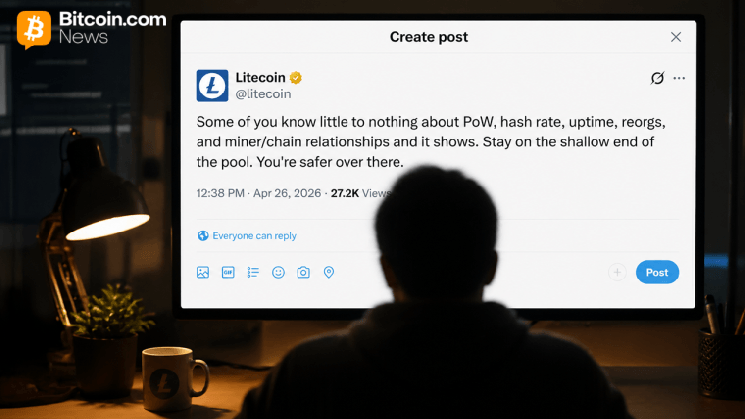
The fallout wasn’t confined to code repositories; it erupted on social media, where Litecoin’s X account doubled down with characteristic swagger. Responding to the deluge of criticism on April 26, @litecoin posted a dismissive jab: “Some of you know little to nothing about PoW, hash rate, uptime, reorgs, and miner/chain relationships and it shows. Stay on the shallow end of the pool. You’re safer over there.” What followed was a torrent of backlash, with users labeling the tone as “salty,” “childish,” and downright “unprofessional.” One long-time holder lamented: “I held your coin for years… this is the sh** you post? So childish.” Another suggested staffing changes: “Maybe you guys need a new social media person.”
This incident echoed a pattern etched into Litecoin’s online persona over the years, a mix of banter and bravado that predates the reorg by seasons. As far back as September 2025, the account had “fired” the “abrasive intern” in a tongue-in-cheek apology after similar complaints, yet the style persisted—fart jokes at rivals, taunts during bear markets, and pointed zingers at influencers. It’s a high-wire act in crypto, where engagement drives visibility but risks alienating the very audience it courts. Critics argue it dilutes the project’s gravitas, turning serious events into punchlines, while fans see it as a refreshing antidote to the industry’s buttoned-up dullness.
Rival Jabs and Public Perception
The drama escalated with unexpected allies stepping in, underscoring the interconnected theater of crypto social media. Solana’s official X account, @solana, chimed in directly on April 25, replying to threads about the reorg with a sly: “How’s your weekend going little buddy?” Observers interpreted this as a cheeky reprisal for Litecoin’s previous digs at Solana’s infamous outage history, flipping the script in a public spat. It’s a testament to how rival blockchains often settle scores not on the chain but in the comments section, where memetic warfare plays out daily. For Litecoin, this added layer of mockery amplified the sting, painting the project as fair game in the cryptocurrency food chain.
Yet, despite the ribbing, Litecoin’s core team maintains that fundamentals are unshakable. They affirm the MWEB patch is solid, the canonical chain stable, and no permanent funds lost on the main ledger. The reorg, they stress, exposed coordination shortcomings in proof-of-work ecosystems, where developers and operators must sync more closely—especially when upgrades aren’t forced. This isn’t unique to Litecoin; it’s a systemic feature of decentralized networks, where independence breeds unpredictability. Still, the episode crystallized a broader truth: In crypto’s gold rush, perception often trumps reality, and a single misstep can reverberate across markets.
Reflecting on Resilience and Risk
Looking ahead, the Litecoin reorg saga serves as a microcosm of the evolving crypto security landscape, where vigilance must outpace innovation. The incident highlights the importance of proactive disclosure in maintaining community trust, a lesson many projects are learning the hard way. As holders and analysts digest the events, questions linger about whether Litecoin’s flippant social media posture reflects deeper organizational challenges, or if it’s merely the garrisoning instincts of a project under siege. Either way, it has prompted introspection: How can blockchains balance contributor engagement with decorum?
In an industry rife with volatility, from market crashes to hack exploits, Litecoin’s continued operation post-reorg signals enduring strength. The network’s quick recovery, coupled with the absence of lasting financial damage, reassures stakeholders. However, the communication misfire risks broader fallout, potentially deterring new adopters wary of projects that handle crises with levity. As the crypto sphere matures, such moments push for better standards—think standardized vulnerability reporting or community forums—ensuring that when the next chain hiccup occurs, response is measured, not mocking. For Litecoin, this might be the pivot point toward a more mature voice, or proof that its irreverent charm is here to stay. Only time, and the next market cycle, will tell. (Word count: 1,984)