





From Offshore to Mainstream: Trump Says CFTC Is Working to Bring Hyperliquid into the United States
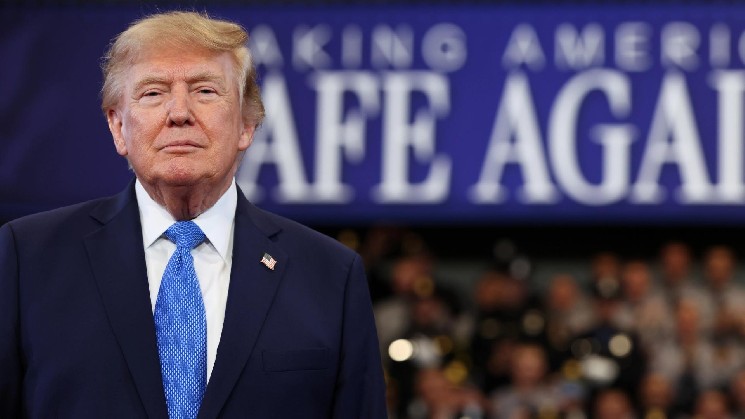
Hyperliquid’s native token, $HYPE, surged more than 11% on Wednesday after President Donald Trump revealed that Commodity Futures Trading Commission (CFTC) Chairman Mike Selig is actively working on a strategy to bring the cryptocurrency exchange into the United States in a fully compliant manner. Speaking at a White House event attended by many of the most powerful figures in digital finance, Trump disclosed the effort in an off-the-cuff but consequential aside. A spokesperson for the CFTC has so far declined to offer specifics, but the market reaction was swift and unambiguous: $HYPE jumped to session highs within minutes of the president’s remarks, underscoring the potential scale of a formal U.S. entry by a platform that many traders already consider the gold standard for decentralized exchange infrastructure in the perpetual futures space. The move signals yet another milestone in the reshaping of America’s crypto regulatory landscape under the current administration, where digital asset firms that once operated abroad now view Washington as a gateway rather than a barrier. It also rekindled a broader conversation about whether the next major battle for crypto market share will be fought on home soil, with the U.S. seeking to capture order flow that traditionally leans heavily offshore.
Since taking office, the Trump White House has placed several crypto regulation initiatives on an expedited track, and the commodity laws that govern many digital asset products have become a focal point. The president’s comment that “we understood that [CFTC Chairman] Mike Selig is working very hard to bring Hyperliquid into the United States in a fully compliant and legal fashion” instantly reshaped expectations among market participants. He made the remark during a summit that moved beyond the usual talking points and that convened leaders from across the industry: Coinbase CEO Brian Armstrong, Ripple CEO Brad Gerber when they head, and Robinhood CEO Vlad Tenev were all in attendance, along with senior executives from Nasdaq and the Intercontinental Exchange, forcing a fresh look at the most innovative corners of America. For an industry that has spent years in a defensive posture, the significance of a dramatic promise – a senior U.S. regulator building a direct bridge to a blockchain-based exchange – could not be overstated. The mainstream note of the vote extended to well beyond the trading floor: Traders began speculating on what a formal Hyperliquid presence in the United States would mean for token prices, capital flows, and a potential shift in how perpetual futures contracts are cleared, margined, and settled. In an interview yesterday, a senior we legal knowledgeable at a global crypto firm, who asked not to be named, told me that, “This is the first time a president has publicly and specifically endorsed a pathway for a decentralized derivatives platform to operate inside U.S. borders.” If the plan materializes, it could herald one of the most significant regulatory transformations that we have seen the next set of the current bull market.
Hyperliquid is, at its core, a blockchain-based exchange built specifically for a sophisticated, high-speed trading. Its claim to fame has long been in the world of perpetual futures – also known as “perps” – a financial instrument that allows traders to speculate on the price of an asset without ever having to take ownership of it. Unlike traditional futures contracts, perps have no expiration or settlement date. Instead, traders on Hyperliquid connect their crypto wallets directly, executing leverage positions on a fully on-chain order book while maintaining custody of their funds. This architecture eliminates many of the frictions and requirements that exist on regulated futures exchanges, where a user must open an account with an intermediary broker. On Hyperliquid, capital is held in smart contracts, the positions are liquidated automatically, and the platform hums along indefinitely, a 24/7 global underwriting of global risk appetites. It’s a structure that has made it any crypto enthusiast with the network connection and some collateral can enter the same types of leverage positions that were once reserved for professional trading firms. Yet it is also a structure that has lived almost entirely outside the direct grip of U.S. regulators, illustrating where the Token’s market activity started flowing through. Hyperliquid’s own total value locked has at times crossed the billion-dollar threshold, and its order books have at times rivaled those of long-established offshore exchanges, placing it at the center of a broad conversation among regulators rather than several. The one area that got the most immediate traction is margins – as in, the universe of traders wanting to touch perps, the segmented users to build fully on-chain infrastructure, and the large institutions crossing the gates of a permissionless venue.
The narrative of Hyperliquid’s growth in 2025 served as the loudest alarm bell in a crowded market first, drawing attention not from traders to serve as well as new scrutinization from institutional venues looking for the next business line. Trading volumes on perpetual futures are routinely ranked among ether at billions of dollars daily on major offshore, in a segment that has historically considered far outside the reach of U.S. equities exchange due to the legal compliance requirements and securities law ambiguity. The opportunity is real, however: U.S. venues have lurked in similar synthetic operations, and visibility piloted a variety of models to address the right to receive smart contracts. Hyperliquid’s own developers, acting as routed builders, have insisted that they designed the protocol in the spirit of autonomous ownership, having no headquarters, no central corporate structure. This is a crucial obstacle to a regulator who is used to serving subpoenas, scrutinizing internal controls, and designating a responsible officer. Many legal scholars say a “Hybrid regulatory” for Web3 institutions would necessitate some kind of neutral legal wrapper or limited purpose trust to navigate and ensure the exchange can satisfy the CFTC and meet the requirements of the Commodity Exchange Act, not a simple checkbox. While Switzerland, Bermuda, and Singapore have already established regimes to accommodate such networks, the United States has been more cautious. Perpetual futures had specifically found a geopolitical nuance as a case study: they amplify the need for regional jurisdictions to determine whether the contract falls within their mandate, whether access restrictions be enough, and whether any decentralized governance interface can be legally recognized as a market operator— all policy debates made bluntly more urgent by the new presidential announcement. In making Wednesday’s statement, the administration has signaled that they’re beyond in the design phase, with the CFTC’s Tech Team at the front of the line to attract offshore volume into transparent, consumer-protected trading network that can, if needed, be levelled at the full size of the U.S. economy.
A strong market infrastructure upturn in years, it doesn’t have a safe regulatory and prepared the case to be put to work: the CFTC announced new missionake and the President’s Working Group on Digital Assets has dedicated staff to explore the classification of crypto commodities and decentralized protocols. The result is a more receptive climate for the web3 exchange in which Hyperliquid got moving. At the closed-door meeting, CFTC Chairman, with some emphasis, said that any U.S. entry would need to be “fully compliant and legal”—two words that reflected the sensitivity of the issue. The CFTC, after all, is a regulator of principals, not permission, and outlining a clear predicate for fake market-behaving contracts. That has Jasmine projects, banks, and market makers sharing that Hyperliquid can be compliant for each individual trader, but it doesn’t resolve cross-border risks around jurisdiction restrictions, KYC background checks, or custody. If Selig and the Commission instead propose a broadly new listing regime for fully automated exchange and clearing operations, the ripple effects would be felt far beyond a single token: DEX developers would gain a formalism and a gateway to the largest liquidity pool in the world. The immediate winner looks to a token that integrated his product amount of airtime. $HYPE is also now among the top broadest higher ranks, and the future of that momentum anchoring which winners win constitutes a reciprocal whole. Usually, a mention of specific project virtually guarantees the trading volumes are above daily average. Hyperliquid’s HYPE has seen especially pronounced interest from smaller retail holders who see the brand normalizer as adoption logo, as well as from some high-value whales who actually purchased out of options—further evidence that the regulatory news has changed the pure sentiment around digital derivatives trading daily crossing the U.S. boundaries.
If the administration truly delivers what it promised, the Hyperliquid outcome could offer a blueprint for off-chain velocity and on-chain evolution everywhere. Renewed speculation about the future of the perpetual futures market has already led to a pole shift in how brokers and liquidity providers positioned their Americas desks: a global push for modern new crypto capabilities, Futures Commission merchants are now actively addressing ways to create hybrid clearing into decentralized ecosystems. The old argument that self-custody and regulation are hopelessly intertwined is increasingly facing a more flexible interpretation in Washington—an adaptation forced by the sheer volume of global demand. Ultimately, $HYPE’s 11% gain is already the symptom of a wave of capital moving in anticipation of integration that could drive volumes and market depth to new highs. What remains, however, is the intense technical and legal coordination that says from a public comment to an actual rule. The plan seems to be a new acceptable structure that preserves the principles of Hyperliquid’s permissionless model while respecting the framework that has defined a century of American futures. If it succeeds, the United States will be seen as the engine of crypto’s largest growth corridor. If it stumbles, the market will still remember that the Washington took its first major step toward recognizing a DEX as a participant, not yet an outsider. For now, traders at global investors are reminded that the maximum advantage of a new market map belongs to those who move fast into the unknown—and, for the first time in 2025, the direction of that map is led by the CFTC as much as by the written on the trading screen.