


GameStop’s Bold Capital Restructuring: Inside the $1.4 Billion Debt Swap and the Mystery of Its Pledged Bitcoin Treasury
The GameStop Balance Sheet Shift: A Strategic Move to Swap Debt for Equity
In an era defined by unconventional corporate finance and retail investor enthusiasm, GameStop Corp. has once again captured the attention of Wall Street with a sweeping capital restructuring strategy. The video game retailer turned market phenomenon has finalized an agreement to exchange a staggering $1.4 billion of its zero-coupon convertible senior notes for newly issued common stock, a move that would effectively retire approximately one-third of its total outstanding note principal. This financial maneuver represents a major pivot in the company’s capital management strategy, transforming long-term obligations directly into shareholder equity. However, the announcement has immediately triggered intense debates across trading desks regarding the resulting GME stock dilution, the true value of the company’s underlying assets, and the long-term implications for its passionate retail investor base. Because the final share issuance depends on dynamic pricing models, the precise dilution percentage remains a mystery, leaving the market in a state of tense anticipation as the company prepares to publish its finalized share counts in forthcoming regulatory filings.
Deconstructing the $1.4 Billion Convertible Debt Swap Mechanics
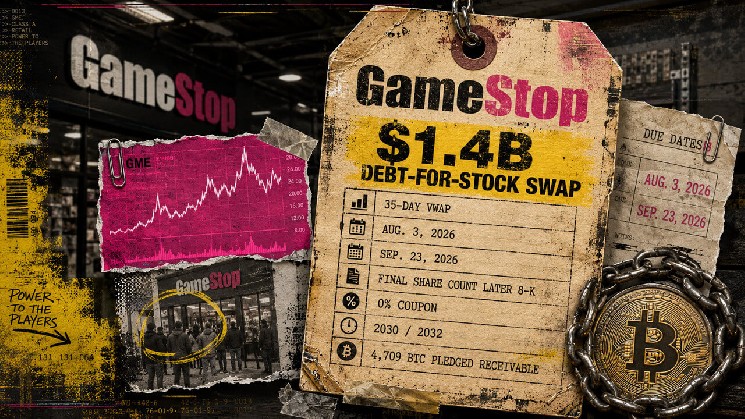
To understand the scale of this restructuring, one must look at the specific tranches of debt being targeted in GameStop’s August 2026 filings. The proposed transaction targets two distinct tranches of zero-coupon convertible notes: approximately $400 million of notes maturing in 2030 and a massive $1 billion slice of notes due in 2032. Should the exchange successfully close, GameStop’s remaining debt obligations will be reduced to roughly $1.1 billion of the 2030 notes and $1.7 billion of the 2032 notes. Crucially, because these notes carry a 0% coupon interest rate, this massive debt-for-equity exchange will not actually lower GameStop’s immediate quarterly or annual cash interest expenses. Instead, the primary strategic benefit of this transaction lies in the balance sheet optimization; it replaces $1.4 billion of future capital repayment obligations with immediate, newly minted shares of stock. By liquidating these future liabilities today, corporate leadership is betting that the long-term flexibility gained by freeing the balance sheet from future cash redemption demands outweighs the immediate dilution pain felt by current equity holders.
Market Volatility and the 35-Day VWAP Pricing Window
The mechanical path to closing this complex transaction is paved with significant market variables, most notably a 35-consecutive-trading-day volume-weighted average price (VWAP) calculation period that commenced on August 3, 2026. This extensive pricing window will serve as the mathematical foundation to determine exactly how many shares of GME common stock will be handed over to the participating noteholders just prior to the transaction’s anticipated closing. While GameStop has confirmed that a minimum per-share safety price applies to the exchange formula to protect the company from extreme downside market crashes, the exact threshold of this floor remains undisclosed to the public. As the market approaches the target closing date around September 23, 2026, analysts warn that GME stock is highly likely to experience elevated volatility. The company itself issued a formal warning to investors, noting that participating noteholders may actively trade GameStop shares or execute complex derivative hedging strategies to lock in their spreads before the closing date, a classic convertible arbitrage behavior that could trigger unpredictable, high-volume price swings.
Analyzing GameStop’s Massive Capital Reserves and Long-Term Leverage
This aggressive equity dilution comes at a fascinating moment for GameStop’s broader capital position, which remains remarkably robust compared to the cash-strapped struggles of its retail past. Entering this transaction, the company reported a massive war chest of approximately $7.4 billion in cash and cash equivalents, contrasted against $4.2 billion in total long-term debt as of its May fiscal reporting. The sheer size of this cash reserve begs the question of why management chose to dilute shareholders to retire debt rather than deploying its existing cash to pay down the notes. The answer lies in the playbook of modern corporate treasury management: by preserving its $7.4 billion in liquid cash, GameStop retains the ultimate strategic flexibility to execute large-scale acquisitions, fund operational transformations, or shield itself from macroeconomic downturns, all while using its highly valued equity as a currency to cleanly wipe out long-term debt liabilities.
The Bitcoin Custody Conundrum: Pledged Assets and Covered-Call Yield Strategies
While the corporate debt swap has captured the attention of credit markets, a second revelation regarding GameStop’s Bitcoin treasury strategy has sent shockwaves through the cryptocurrency and retail investing communities. Newly parsed quarterly disclosures reveal that the vast majority of GameStop’s previously celebrated 4,710 Bitcoin holdings were not actually held in the company’s direct custody, but were instead pledged as collateral under a sophisticated yield-generating covered-call options strategy. Specifically, as of May 2, 2026, a staggering 4,709 BTC were committed to Coinbase Credit, leaving GameStop with direct physical custody of only a single Bitcoin. Under this institutional agreement, GameStop sold covered calls with an $80,000 strike price that expired in late May, effectively sacrificing the direct control of their digital assets to chase institutional yield. Because Coinbase Credit retained the contractual right to reuse, commingle, pledge, or liquidate the collateral during the contract term, GameStop was forced by standard accounting principles to de-recognize the physical Bitcoin from its balance sheet, replacing the hard assets with a “digital-asset receivable” representing the equivalent cryptocurrency owed back to them upon contract settlement.
Valuation Ambiguity: What Lies Ahead for GameStop Shareholders?
This shift from holding physical cryptocurrency to holding a digital-asset receivable has introduced a layer of valuation ambiguity that has left market analysts scrambling for clarity. At the reference price of $63,846.52 per Bitcoin on August 3, 2026, GameStop’s original collateral position of 4,709 BTC represented a nominal value of roughly $300.65 million. However, because GameStop has subsequently rolled over these positions into new, undisclosed derivative contracts with Coinbase Credit—without revealing the new contract quantities, strike prices, expiration dates, or collateral ratios—the true current value of its digital treasury remains impossible to calculate with precision. Moving forward, the investment community is left waiting on two critical, market-moving disclosures from GameStop’s management: the finalized, post-VWAP share count that will define the true extent of the GME stock dilution, and an updated balance sheet disclosure outlining the precise terms of its ongoing, highly leveraged Bitcoin yield strategy.