





Crypto Outshines Wall Street as AI Giants Call for a Slower Race
A Market Split: Digital Assets Climb While Tech Stocks Tumble
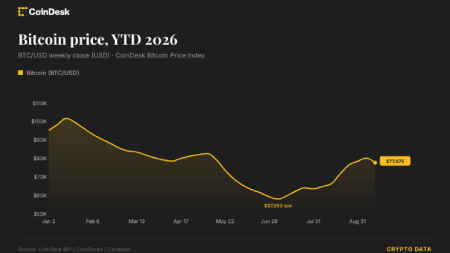
A fascinating split is taking shape across financial markets, and it is turning heads on Wall Street. Over the past 24 hours, cryptocurrency has been quietly outperforming the broader market, driven by a fresh wave of optimism around a long-shot piece of U.S. legislation called the Digital Asset Market Clarity Act. At the very same time, technology stocks tied to artificial intelligence have slipped lower, rattled by an unusual and highly public effort by some of the industry’s most prominent leaders to put the brakes on frontier AI development. The result is a market that seems to be moving in two different directions at once. Bitcoin, the largest cryptocurrency, traded up more than 1 percent to about $77,800, while ether added roughly 2 percent to reach around $2,500. AI-focused equities, meanwhile, lost ground as investors digested a weekend of cautionary statements from Anthropic CEO Dario Amodei, who publicly called for a slower pace of advanced AI development, citing serious safety concerns. It is a rare moment in markets when a single piece of legislation and a single weekend conversation can move two entire sectors in opposite directions, but that is precisely what appears to be happening. The divergence is not just a short-term trading curiosity. It is a telling signal about how investors are reassessing risk, reward, and the future of two of the most transformative technologies of the modern era.
The Digital Asset Market Clarity Act Gains Real Momentum
The catalyst for crypto’s latest move is the Digital Asset Market Clarity Act, a bill designed to establish a clear federal regulatory framework for digital assets. For years, the digital asset industry has operated in a frustrating gray zone, with regulators at the state and federal levels offering conflicting guidance and, at times, no guidance at all. The Clarity Act aims to change that by setting out a predictable, national set of rules for how digital assets are treated under U.S. law. It has been a source of cautious hope for some time, but until recently, the odds of it actually becoming law appeared slim. According to prediction-market data from Polymarket, traders have been steadily revising their expectations. The probability of the Clarity Act being signed into law in 2026 has climbed to roughly 30 percent, a significant jump from a low of just 12 percent at the start of September. That kind of shift in sentiment is meaningful, especially in a market like cryptocurrency, where perception and narrative often carry as much weight as fundamentals. The bill is still far from a guaranteed outcome, and a 30 percent probability is not the same as a comfortable lead, but the upward trajectory has caught the attention of traders and institutional investors alike. The next major test comes quickly: the measure faces a procedural Senate vote on Tuesday. A procedural vote is not final passage, but it is an important gate that determines whether a bill can move forward through the legislative process. A strong showing would inject new energy into the crypto policy movement, while a failure could send expectations falling back to earth. The fact that the market is already reacting to the possibility of progress says a great deal about how much the industry has been craving regulatory certainty.
Bitcoin and Ether Lead a Quiet Crypto Rally
The price action in crypto over the past day has been relatively modest by historical standards, but it stands out because of the broader market context. Bitcoin’s gain of more than 1 percent may not sound dramatic, but it comes at a time when many investors are cautious about risk, inflation, and interest rates. More importantly, the move signals that digital asset traders are starting to focus on Washington rather than watching the Federal Reserve with the same intensity they once did. Ether has fared even better, climbing about 2 percent to approach $2,500. That outperformance is notable because ether has often played a secondary role to Bitcoin in terms of investor attention, but it frequently captures a stronger bid when optimism about the broader crypto ecosystem rises. The theory is simple: if the United States creates a clear federal framework for digital assets, the entire sector benefits, not just the largest token. Exchanges, developers, and institutional investors could all operate with more confidence, reducing the legal risk that has kept many mainstream financial players on the sidelines. In that sense, the Digital Asset Market Clarity Act is not just about Bitcoin or ether; it is about unlocking the full potential of the crypto economy. A clearer regulatory structure could pave the way for new products, new listings, and a deeper integration of blockchain-based assets into traditional finance. For a market that has spent years navigating a patchwork of state laws and inconsistent enforcement actions, the mere prospect of federal clarity is enough to move capital off the sidelines.
AI Stocks Slip as Amodei, Altman, and Musk Urge Caution
On the other side of the ledger, the artificial intelligence sector is experiencing a decidedly different mood. The selloff in AI and technology stocks follows a weekend intervention by Dario Amodei, the CEO of Anthropic, who called for a more deliberate pace in the development of frontier AI models. His message was straightforward: the most advanced AI systems are moving forward so quickly that the industry needs to step back and think seriously about safety. This is not the first time someone has raised concerns about AI, but it is unusual to hear such a direct call from a top executive at one of the leading AI companies. What made the situation even more striking was the immediate show of support from other major figures. OpenAI CEO Sam Altman, who runs the company behind ChatGPT, publicly backed the call for greater caution, and Elon Musk, who has been both a founder and a critic in the AI space, also endorsed the idea of slowing down. When three of the most recognizable names in artificial intelligence appear to agree that the pace of development is a problem, investors pay attention. The market reaction makes sense when you consider how AI-related stocks have been priced over the last year. Much of the enthusiasm around AI has been built on the assumption that progress will continue at a breakneck pace, with new models arriving faster than anyone can fully absorb. Any suggestion that the industry should slow down, even for safety reasons, threatens the fundamental growth narrative that has lifted valuations across the sector.
Anthropic’s Reported Nasdaq IPO Adds a Complicated Twist
The tension between safety and growth was further complicated by another development over the same weekend. Reports emerged that Anthropic, despite its CEO’s call for a slower approach to AI, has selected Nasdaq for its anticipated initial public offering. The timing could hardly be more awkward. Here is a company that is, in effect, telling the world to pump the brakes on frontier AI, and at the same time preparing to enter the public markets, where investors typically expect growth, acceleration, and ever-higher revenue. It is a strange juxtaposition, but perhaps not a contradictory one. It is entirely possible to argue that responsible AI development is the only sustainable path to long-term growth, and that moving too fast today could create the kind of catastrophe that would bring the entire industry down tomorrow. From that perspective, Amodei’s call for caution is not anti-growth; it is a form of risk management. Still, the IPO itself will be closely watched, not just because of the company’s high profile, but because of the broader questions it forces investors to confront. If an AI company is telling the public that safety concerns warrant a slower pace, how should shareholders react when the next earnings report is underwhelming? If the industry as a whole adopts a more cautious approach, will the valuations that have become common in the sector hold up? And if they do not, are we looking at a correction or a rebalancing? These are the questions that markets are now beginning to wrestle with as the weekend’s declarations settle in.
A Week of Recalibration for Two Powerful Narratives
As the week gets underway, all eyes are on Tuesday’s procedural Senate vote on the Digital Asset Market Clarity Act. For crypto investors, it is a moment to see whether the legislative momentum is real or just a mirage. A positive vote would not guarantee that the bill becomes law, but it would keep the dream alive and likely support further gains in digital asset prices. A setback, on the other hand, could quickly erase the optimism that has been building over the past several days. The AI sector, meanwhile, is likely to remain under pressure as investors digest the implications of Amodei’s statement, the endorsements from Altman and Musk, and the counterintuitive news of Anthropic’s reported IPO plans. None of this means that artificial intelligence is suddenly a bad investment, just as a 30 percent probability on Polymarket does not mean that crypto regulation is inevitable. What it does mean is that the road ahead is more complicated than simple bull-and-bear narratives suggest. The most powerful dynamic in markets right now may be the growing recognition that both digital assets and artificial intelligence are at pivotal moments in their evolution. Crypto is no longer just a niche interest fighting for survival; it is an asset class looking for legitimacy, and regulation is the key to unlocking the next phase. AI is no longer an untouchable growth story; it is an industry being forced to confront its own limits and responsibilities. For professional investors and everyday observers alike, the coming months will be a test of patience, perspective, and the ability to see beyond the day-to-day noise. The market is not just pricing tokens and stocks anymore. It is pricing two very different visions of the future, and for the first time in a long while, those visions are heading in opposite directions.