


A Principled Departure: What Hester Peirce’s Exit Means for the Future of Digital Assets
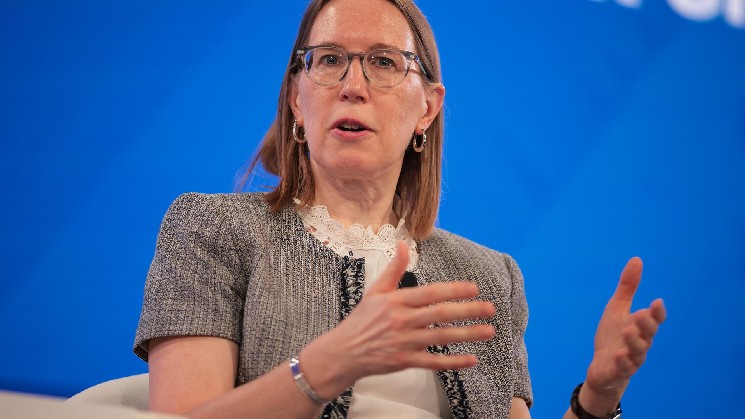
Today marks the end of an era at the U.S. Securities and Exchange Commission. After more than eight years of service, Commissioner Hester Peirce has walked out of the SEC for the final time, and the digital asset industry is taking a collective moment of reflection. Known affectionately to many as “Crypto Mom,” Peirce was never just a commissioner; she was a quiet force of intellectual consistency in a regulatory environment that often treated innovation as a threat rather than an opportunity. Her departure leaves a significant void in the nation’s financial regulatory landscape, but it also leaves behind something more durable: a blueprint for how regulators can protect investors without smothering progress. For the digital asset industry, and for every American who believes regulation should mitigate risk while fostering innovation, her service is something to be profoundly grateful for. In a town where power often speaks louder than principle, Peirce stood out as someone who understood that the SEC’s mission was not to pick winners and losers, but to create a fair, transparent, and safe marketplace for everyone.
Over more than eight years at the Commission, Peirce developed a reputation as a principled voice who was never afraid to stand alone. During the tenure of previous SEC leadership, she frequently dissented when the Commission chose to bring enforcement actions instead of writing rules that the industry could actually comply with. Her objection was not technical or procedural; it was deeply philosophical. She believed that the SEC’s job was not to punish after the fact when no clear guidance had been given, but to provide a predictable framework in advance. This approach, often described as “regulation by enforcement,” was, in her view, a fundamental betrayal of the regulatory mission. Time and again, she pointed out that companies and developers were being left in legal limbo, unable to know whether their digital asset projects would be treated as securities or commodities, and then penalized when the agency finally decided, with the benefit of hindsight, that a particular token had crossed a line that was never drawn in the first place.
Her most notable contribution to the field was the token safe harbor, a proposal she introduced years before many regulators were ready to listen. The idea was elegant in its simplicity: provide a temporary safe harbor for token projects to develop decentralized networks without immediately running afoul of securities laws. Under her framework, development teams would have a defined grace period to build their networks, and once sufficiently decentralized, tokens would no longer be considered securities. This would have given the industry something it had desperately lacked: legal clarity. Critics argued that such a proposal was too permissive, but Peirce countered that true investor protection could not be achieved through ambiguity. By requiring transparency, disclosure, and a genuine path to decentralization, her approach aimed to protect the very people the SEC was charged with defending—while still allowing innovative projects the space to grow. It was a bold idea, and one that was years ahead of its time.
At the helm of the SEC’s Crypto Task Force, Peirce insisted that the agency’s duty to protect investors meant it must use its authority to provide regulatory guardrails for the rapidly expanding digital asset space. To her, protection did not mean prohibition. It meant creating an environment where responsible actors could thrive, where fraud could be identified and prosecuted, and where ordinary Americans could participate in new asset classes without being treated like children. She understood that innovation and investor protection were not opposing goals. In fact, they were mutually reinforcing. A market without clear rules is a market where scams can flourish, where bad actors can hide, and where honest entrepreneurs are driven offshore. Peirce saw this dynamic clearly, and she fought relentlessly to shift the conversation from fear-based enforcement to forward-looking policy.
Throughout her tenure, Peirce brought a rare combination of humility, conviction, and humor to a building that often took itself far too seriously. Her speeches were laced with wit and genuine affection for the people she served, and her dissents were not just legal documents—they were calls for a better way forward. She was the kind of public official who made people believe that Washington could actually work: that regulators could be thoughtful, that policy could be compassionate, and that progress did not have to be sacrificed for the sake of caution. Washington could use more people like her. Her ability to listen, to admit when the law was unclear, and to engage with critics rather than dismiss them made her a trusted and respected figure across the political spectrum. Even those who disagreed with her positions often acknowledged her sincerity and intellectual honesty.
Her departure, however, does not mean the end of her influence. Although she will no longer be at the SEC, the ideals she stood for will live on in the many projects, policies, and people she inspired. The fight for clear digital asset regulation is far from over, but Peirce has laid a foundation that will serve as a reference point for years to come. Her work is not done yet—not because she has unfinished business, but because the movement she helped cultivate is bigger than any single person. The conversations she started, the safe harbor proposal she championed, and the principled approach she modeled will continue to shape the future of financial regulation. As the digital asset industry moves forward, it will do so on a path that she helped clear. Every entrepreneur who launches a token, every developer who builds a decentralized network, and every investor who participates in the digital economy owes a debt to Hester Peirce. Her voice, her conviction, and her belief in a better, more inclusive financial system have left an indelible mark on the world of American finance. And while she may be leaving the SEC, her legacy—like the technology she championed—will only continue to grow.
Will Schwartz is a Policy Associate at Blockchain Association, where he conducts research and analysis on digital asset legislation, regulation, and emerging policy developments.