






Bitcoin Sparks Hope as It Rebounds Toward Key Resistance Levels
In the rollercoaster world of cryptocurrency, Bitcoin has clawed its way back from the abyss, currently hovering around $77,600. Just two months ago, the digital asset was languishing near $60,000, painting a picture of despair for investors who had witnessed a brutal sell-off. This recovery has propelled it back into the cherished resistance zone between $75,000 and $80,000, a psychological barrier that has historically proven stubborn. Market watchers are now on edge, debating whether this bounce signals the start of a sustained rally or merely a brief respite before another downturn. As traders pore over charts and on-chain data, the question looms: Can Bitcoin break free and soar higher, or is it destined to be slapped back by resistance? This resurgence comes at a time when global markets are wrestling with economic uncertainties, making Bitcoin’s performance a litmus test for the broader sentiment in volatile times.
Revisiting the Dark Days and the Dawn of Recovery
Flash back to that rocky period two months prior, and the scene was bleak. Technical indicators screamed oversold territory—an RSI reading that dipped into capitulation levels—while on-chain metrics revealed a market in full surrender. Confidence had evaporated, with investors fleeing in droves, convinced that the bottom was still far out of sight. Yet, in hindsight, those lows now appear as stepping stones rather than dead ends. The dramatic rebound has reignited optimism, redirecting eyes toward potential upside moves. It’s a classic tale of phoenix rising from ashes, where fear morphed into fervor almost overnight. Analysts reflect on how such capitulation often precedes major reversals, underscoring Bitcoin’s resilience in the face of adversity. As we dissect these shifts, it’s clear that the cryptocurrency’s journey mirrors broader market psychology, oscillating between crippling doubt and electrifying hope.
Analyst Insights: Bulls Eye Higher Peaks, Bears Warn of Pitfalls
Amid this narrative, voices from the crypto trenches offer conflicting prophecies. Prominent analyst Michael van de Poppe, sharing his thoughts on X, remains bullish on the near-term outlook. He notes that while the Nasdaq has been charging ahead with remarkable momentum, Bitcoin is trailing in its wake, hinting at untapped potential. Van de Poppe argues there’s ample justification for further gains from here, predicting that a decisive breakout above $86,000 in the coming months could solidify the notion that we’ve already touched bottom—a scenario he assigns high probability. His perspective injects a dose of cautious enthusiasm into the equation, suggesting that patience might yield rewards for those positioned correctly.
Contrastingly, caution reigns in other quarters. Analyst Rekt Capital, also via X, highlights Bitcoin’s ongoing tussle with the 21-week exponential moving average (EMA), a critical resistance line that’s proving formidable. For Bitcoin to sustain its recovery and avoid a precarious retest of the double-bottom pattern it breached recently, it must transform this EMA into a supportive floor. Failure to do so could spell trouble, dragging prices back toward that multi-week formation’s peak. This dual viewpoint encapsulates the market’s schizophrenia: optimism tempered by realism, where every uptick is shadowed by the specter of reversal. As traders navigate these crosscurrents, the EMA stands as a pivotal battleground, dictating whether Bitcoin’s recovery blossoms or withers.
Navigating Liquidity Traps and Potential Market Shocks
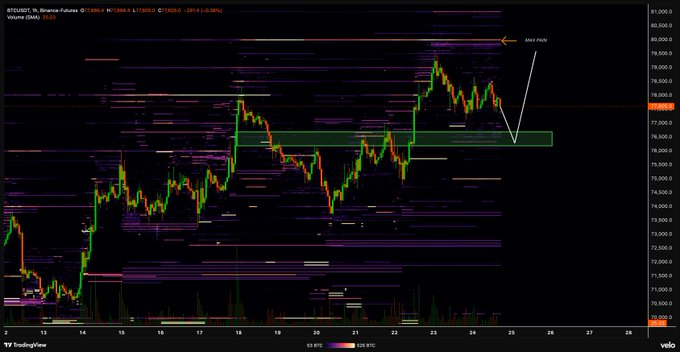
Delving deeper into the mechanics of the market, liquidity clusters emerge as a hidden undercurrent threatening to disrupt Bitcoin’s ascent. Analyst Ted, often insightful in his commentary, points to mounting liquidation zones below current prices, with a significant one anchored near $80,000—the very level where Bitcoin bottomed out in November 2025. This setup paints a grim “maximum pain” scenario for the months ahead, where a sudden dump could outpower any bullish thrusts. Such clusters act as tripwires, capable of amplifying volatility and triggering cascading sell-offs if activated prematurely.
Adding another layer, analyst Ardi zooms in on short positions amassed just above the recent local high. In a revealing X post, Ardi details hundreds of millions in short exposure concentrated around $79,500 to $79,900—a dense band of bets wagering against Bitcoin’s rise. If the green support zone endures during an impending retest, market makers might seize the opportunity to liquidate these shorts, unleashing a torrent of buybacks that could catapult the price through $80,000. Ardi’s observation that liquidity hovering a mere 2% above the current price seldom goes unchallenged underscores the market’s inherent drama. This interplay of longs and shorts creates a symphony of possibilities, where strategic positioning could either fuel a breakout or unravel the recovery’s fragile threads.
Derivatives Decline Signals Shift in Market Participation
On the derivatives front, recent data uncovers a quieter landscape beneath the surface buzz. The analytical outfit CoinGlass reports a notable contraction in Bitcoin’s options and futures activity, with trading volume plunging 20.20% to a still-substantial $61.97 billion and open interest ebbing 3.03% to $57.45 billion. These metrics reflect softening engagement—a pullback in speculative fervor that hints at investors adopting a more withdrawn stance amid uncertain global tides. Lighter positioning in futures markets could signify a retreat from leveraged bets, perhaps driven by wariness of geopolitical headwinds and economic pressures. This dichotomy—vibrant spot price action juxtaposed against derivatives dormancy—illuminates the complex layers of the crypto ecosystem, where spot demand and speculative trading don’t always march in lockstep.
ETF Surge: A Billion-Dollar Vote of Confidence
Yet, silver linings abound in the realm of institutional adoption, particularly through U.S. spot Bitcoin ETFs. Despite the derivatives lull, these vehicles are witnessing a surge in interest, with BlackRock’s IBIT soaring into the top 10 U.S. ETFs by inflows. This influx of capital underscores a growing cohort viewing Bitcoin as a hedge against geopolitical turmoil and inflationary fears, positioning it as a modern-day safe haven. As tensions simmer worldwide, investors are flocking to these ETFs, injecting billions into the market—a testament to Bitcoin’s evolving role beyond mere speculation. This trend aligns with broader narratives of diversification, where traditional assets mingle with digital ones in portfolios wary of conventional risks. The $2 billion inflow narrative further fuels ambitions of $85,000 targets, weaving a tapestry of narratives that balance caution with possibility in Bitcoin’s unfolding saga. In this vibrant market mosaic, ETFs represent a bridge between old-world finance and the frontier of crypto, potentially heralding a new era of legitimacy and acceptance. As Bitcoin dances toward resistance, the interplay of analyst forecasts, liquidity dynamics, and institutional embraces crafts a compelling story of survival and ambition in the face of relentless odds. The road to $80,000 and beyond remains fraught, but with each retest, the cryptocurrency fortifies its place in the global financial lexicon, ready to seize the next wave of opportunity.