



Bitcoin Holds the Line at $83K as Bond Rout and Oil Surge Reshape Global Risk Appetite
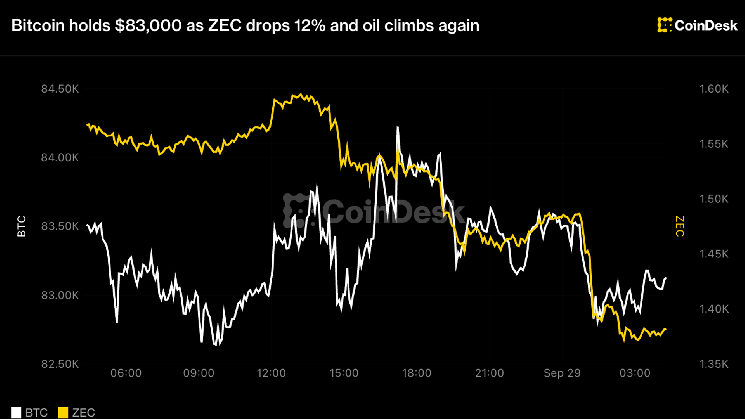
Bitcoin slipped toward $83,000 in a session that saw selling pressure intensify across the digital-asset complex, pulling the world’s largest cryptocurrency to the lower edge of last week’s consolidation band at a moment when global risk appetite appears to be rapidly deteriorating. The move lower represents a critical technical test for the market: after weeks of choppy, rangebound trading, investors are signaling they are unwilling to chase prices higher unless the macroeconomic backdrop offers clearer support. That uncertainty has thrust the $82,000-to-$83,000 zone into sharp focus, a region that technical analysts have flagged as a potential fault line for some time. Alex Kuptsikevich, chief market analyst at the multi-asset brokerage FxPro, said the pullback is consistent with a broader pattern of investor caution. “Bitcoin has pulled back to $83K, testing the lower boundary of last week’s consolidation range,” he noted in an email to CoinDesk. “As with the market as a whole, a retest of the $82K region, where peaks were formed in May and early September, is entirely to be expected under current conditions.” The significance of that level extends well beyond its historical relevance; it represents a line in the sand for institutional positioning. A clean break below it, financial strategists say, could accelerate selling among trend-following funds and momentum traders, triggering a cascade that might reach all the way to the psychological threshold at $80,000. A successful defense of the zone, by contrast, would send a powerful signal that dip-buying interest remains genuinely intact, setting the stage for investors to refocus their attention on record territory.
The forward-looking picture painted by Kuptsikevich highlights two sharply divergent scenarios for the weeks ahead, and the gap between them could hardly be more pronounced. The first, and arguably more cautionary, involves a sustained breakdown below the psychological $80,000 level—an outcome that would indicate the market simply lacks the conviction and liquidity required to push into uncharted territory. “Looking ahead, a sustained return to prices below $80K would be an important signal that the market is not ready to move higher for some time yet,” he warned. A daily close below that level would effectively mark a structural shift in tenor, one that could invite another wave of selling from investors who have been waiting for a clearer technical invitation to reduce exposure. The second scenario, however, is considerably more constructive. If the current consolidation phase proves short-lived and is followed by a decisive surge of buying interest, Kuptsikevich suggested, the path could open toward significantly higher valuations. “If, however, this consolidation is soon followed by a new bullish momentum, it could send the leading cryptocurrency well above $90K,” he wrote. That assessment captures the prevailing sense of ambiguity hanging over the market, where many traders remain convinced that the long-term bull case for digital assets is firmly intact but nevertheless struggle to reconcile that conviction with the increasingly difficult near-term headwinds coming from the macroeconomic sphere. For a market that has historically traded in lockstep with global liquidity conditions, much now depends on whether the pressure emanating from bond and commodity markets begins to show signs of easing.
The source of that pressure, meanwhile, extends well beyond the confines of the crypto industry itself. It is coming, first and foremost, from the bond market, where a dramatic repricing in U.S. Treasuries has reverberated through every corner of global finance. After tumbling sharply during U.S. trading hours, Treasuries steadied in Asia during the next session, with the benchmark 10-year yield edging one basis point higher to 5.25%—a level that marks a fresh cyclical peak and the highest reading since 2007. For a generation of investors who came of age during an era of near-zero interest rates, the scale and speed of the bond market’s reversal has been nothing short of stunning, forcing a wholesale reassessment of what constitutes an attractive risk-adjusted return. The implications for bitcoin are straightforward, even if they are not always fully appreciated by retail traders. A higher guaranteed return on government debt raises the opportunity cost of holding assets that generate no income or cash flow—and this calculation sits at the very core of the current market dynamic. In an environment where a risk-free yield north of 5% is available in the world’s most liquid financial market, holding a non-yielding asset like bitcoin becomes inherently more expensive in relative terms. Large institutional allocators who manage money across multiple asset classes can simply park capital in short-dated government paper, earn a healthy carry, and wait for a less turbulent entry point into digital markets. That is precisely the kind of behavior that has historically weighed on crypto valuations during periods of sharply rising real yields, and there are growing signs that the same dynamic is playing out once again.
The pressure is being compounded by developments in the oil market, where a renewed surge in crude prices has introduced fresh concerns about inflation persistence. Brent crude rose more than 1% to nearly $107 a barrel, marking a second consecutive daily gain as traders abandoned hopes for an imminent diplomatic breakthrough with Iran and braced for the possibility of new supply disruptions across the Middle East. The move reflects growing nervousness in a crude complex that has been whipsawed between fears of demand destruction and the very real prospect of tightening supply. Oil’s ascent carries significant implications for macro traders, particularly those with exposure to risk assets like equities and cryptocurrencies. Energy costs permeate nearly every layer of the global economy: when the price of fuel climbs, household budgets are squeezed, transportation expenses rise, and inflation expectations become more deeply embedded in the broader price-setting process. For central banks, the resurgence in crude is an unwelcome complication at a delicate juncture. The oil market is, in effect, doing the work of an interest rate hike—tightening financial conditions across the economy at a time when global growth is already showing signs of strain. The surge has also reignited concerns about a phenomenon that policymakers in Washington and Frankfurt had hoped was firmly behind them. Pricier oil feeds directly into consumer price indices through utilities, airlines, shipping, and agriculture, and it casts real doubt on the disinflationary narrative that provided the intellectual justification for the Federal Reserve’s aggressive tightening campaign in the first place.
It should come as little surprise, then, that futures markets are beginning to reflect a greater willingness among traders to price in additional rate increases from the U.S. central bank—a marked reversal from just a few weeks ago, when markets were confidently pricing in imminent cuts. This repositioning is an acknowledgment that the road back to the Fed’s 2% inflation target will be neither straight nor smooth, and that the central bank may be forced to keep its policy rate elevated well into 2024. That realization has triggered a measurable shift in market sentiment, with investors forced to retreat from their bearish rate outlook and reassess the entire front end of the U.S. rates curve. The fallout has been visible far beyond the bond market. MSCI’s All Country World Index—a broad gauge of global stock performance—fell to its lowest level since September 18, reflecting the deterioration in sentiment that followed Monday’s tech-led selloff on Wall Street. Defensive rotations, profit-taking in high-duration technology names, and a flight out of interest-rate-sensitive sectors all contributed to the weakness, and the ripple effects bled directly into the broader risk complex. Futures markets, meanwhile, point to additional trouble ahead, with Nasdaq 100 contracts slipping 0.3% in early trading and growth-focused investors clearly wary of adding exposure in an environment defined by elevated volatility and deeply uncertain monetary policy. With earnings season now entering a critical phase, the interplay between rising yields and corporate profit expectations is likely to dominate trading flows in the coming sessions.
For bitcoin, the current backdrop represents an uncomfortable collision between structural adoption trends and cyclical macro headwinds. On one level, the asset’s maturation into an institutional-grade investment product—driven by the approval of spot exchange-traded funds, growing corporate treasury involvement, and steady mainstream acceptance—has created a genuine floor under demand that did not exist in previous cycles. On another, however, bitcoin remains a highly sensitive risk asset in this environment, one that performs best when liquidity is abundant, monetary policy is accommodative, and the global economy is firmly in expansion mode. That is precisely the opposite of the current picture. As traders closely monitor the $82,000-to-$83,000 support corridor, the next several sessions are shaping up to be decisive. A convincing hold above those levels could reignite momentum and draw fresh capital from sidelined buyers. But if the selling pressure resumes with conviction, the long-held assumption that dips will be quickly bought could face its most serious test in years. For the time being, the message from across global markets is unmistakable: sovereign bonds are repricing at a pace not seen in a generation, crude oil is pushing higher on renewed geopolitical risk, and bitcoin—caught squarely in the crossfire—finds itself waiting for a signal that may not arrive until investors fully digest the implications of a world in which cheap money is no longer available to support speculative markets. The next big move in digital assets, in other words, will likely be determined less by the coin itself than by the broader tides of macro finance.