





The Midsummer Crypto Pivot: Inside the Short Squeeze That Shook Digital Asset Markets
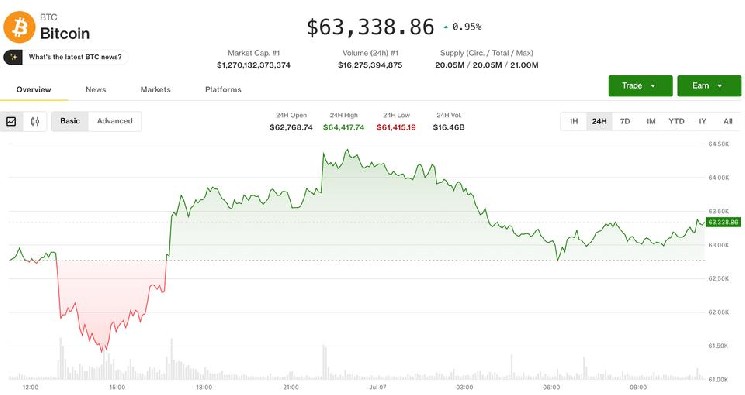
The relentless summer rally that injected renewed optimism into the cryptocurrency sector has hit its first significant speed bump. After an impressive multi-day streak that evoked memories of early-spring optimism, Bitcoin ($BTC) stalled on Tuesday, snapping its longest run of consecutive daily gains since March. The leading digital asset, which had scaled a two-week peak of $64,500 on Monday, retreated toward the $63,000 mark as profit-taking and cautious derivatives positioning cooled the market’s momentum. This sudden pause reverberated across the broader digital asset ecosystem, with Ether ($ETH) tracking its larger counterpart downward to trade near $1,770, erasing a brief climb to $1,830. Despite this mid-week retracement, the digital currency landscape remains fundamentally altered from its late-June doldrums, boasting an aggregate market capitalization of $2.16 trillion—a notable 8.4% expansion since the start of July.
To understand this sudden shift in market dynamics, one must examine the mechanics of the late-June trading landscape. The early July surge was largely fueled by a classic, highly coordinated short-squeeze setup. In late June, while Bitcoin languished at some of its lowest valuation levels of 2024, institutional and retail sentiment grew excessively bearish, resulting in an unsustainable concentration of short positions. When prices began to stabilize, these short sellers were forced to buy back their contracts to limit losses, triggering an upward price cascade. This technical rebound allowed major tokens to recover swiftly from oversold territory. Yet, this upward march occurred against a backdrop of darkening skies in traditional finance, where Wall Street has faced its own challenges; Nasdaq 100 index futures slid by nearly 1% as the correction from June’s historic highs continued to pressure global equity valuations.
Bitcoin Price & Open Interest Divergence (July)
Price Trend: [ $58k ] —-> [ $64.5k (Peak) ] —-> [ $63.2k (Current) ]
Open Interest: [ 776k BTC ] ————————-> [ 740k BTC ]
Observation: Price increased while Open Interest fell.
This divergence points to short-covering rather than aggressive new spot buying.
Deconstructing the Derivatives Wave: Liquidations and Diminishing Open Interest
A look under the hood of the cryptocurrency derivatives market reveals the friction currently capping these gains. In a span of just 24 hours, exchanges liquidated more than $500 million in leveraged crypto futures bets. For the sixth consecutive day, bearish short positions bore the brunt of these liquidations, illustrating how costly it has been to bet against the July recovery. However, a deeper divergence is emerging between rising asset prices and trader participation. Despite the recent price strength, Bitcoin’s futures open interest (OI) has quietly slipped from a July 3 high of 776,000 BTC down to 740,000 BTC. This decline in open interest indicates that derivatives traders are systematically closing out their positions rather than initiating new bullish bets, a trend matched by stagnant spot market demand, lackluster inflows into spot Bitcoin ETFs, and a flatlining Coinbase premium.
This pattern of declining participation is not isolated to Bitcoin. Ether, which had recently showcased moments of relative strength, exhibits a similar divergence, as does Solana ($SOL). Open interest for Solana has pulled back to approximately 68 million tokens from its June peak of over 76 million, proving that its resilient 10% price bounce has failed to inspire fresh leveraged buying. Meanwhile, niche networks present an even more explicitly bearish outlook; Canton Network’s CC token slid by over 4% within a single day, accompanied by a 3% uptick in its open interest to 245.59 million tokens. When expanding open interest coincides with falling prices, negative funding rates, and a declining cumulative volume delta (CVD), it points to aggressive market-order shorting by bears rather than passive limit-order buying, signaling that further downside pressure may be brewing across altcoin pairs.
| Metric | Peak Value (Late June/Early July) | Current Level (Mid-July) | Market Implication |
|---|---|---|---|
| Bitcoin Open Interest (OI) | 776K BTC | 740K BTC | Declining speculative participation |
| Solana (SOL) Open Interest | 76M Tokens | 68M Tokens | Weakening leveraged demand |
| Bitcoin Volatility Index (BVIV) | ~34% (June Low) | 40% | Rising hedging activity; stable long-term outlook |
| Altcoin Season Index | 30/100 (May) | 46/100 | Moderate transition toward altcoin selectivity |
Volatility Safeguards and Sophisticated Options Strategies
Despite these underlying headwinds, option markets suggest that institutional players are not ready to panic-sell. Bitcoin’s 30-day implied volatility index, the BVIV, recently ticked up to 40%, breaking a six-day streak of declines, while Ether’s volatility index (EVIV) showed a similar stabilization. While an uptick in implied volatility usually reflects rising uncertainty, current figures remain comfortably below the frantic 60% levels recorded during the ETF-fueled rallies in January. On major options exchanges like Deribit, trading volume paints a highly nuanced picture. Market participants are actively purchasing both protective put options and upside call options in almost equal measure, reflecting a split outlook on near-term price direction.
                      [ Underlying Spot Price ]
                                 |
           +---------------------+---------------------+
           |                                           |
 [ Downside Hedging ]                       [ Upside Speculation ]
BTC & ETH Put Options                      BTC & ETH Call Options
(Defending $60k Support) (Targeting $65k+ Resistance)
This polarization is even more visible in decentralized finance platforms. On the non-custodial options exchange Derive, large volume block trades have caught the attention of analysts. Specifically, a major “long call condor” options strategy was executed on the HYPE token. This complex, four-legged options structure is designed to yield maximum profitability if the underlying asset stays within a tightly defined price window—specifically between $75 and $80—through late July. By placing such highly targeted, range-bound bets, sophisticated players are signaling to the broader market that they expect a period of consolidation rather than a dramatic breakout or a devastating crash.
The Altcoin Divergence: A Sign of Market Maturity
Perhaps the most fascinating development of this midsummer cycle is the fragmentation of the altcoin market. Historically, the crypto market has operated as a highly correlated monolith: when Bitcoin soared, altcoins followed in lockstep; when Bitcoin faltered, altcoins suffered double-digit losses. Today, that dynamic is breaking down. Even as the aggregate market capitalization posted weekly gains, prominent tokens like Fetch.ai ($FET), Kaspa ($KAS), and Worldcoin ($WLD) ended the week in negative territory. Conversely, decentralized finance protocols like Ether.fi ($ETHFI) and Litedex ($LIT) proved highly resilient, posting gains of over 30% during the same seven-day window.
   [ Traditional Crypto Cycle ]              [ Modern Maturing Crypto Cycle ]
          Bitcoin Move                                 Bitcoin Move
                |                                            |
     +----------+----------+                      +----------+----------+
     |                     |                      |                     |
Altcoin A (Up) Altcoin B (Up) DeFi Tokens (Up) AI/Data Tokens (Down)
(Driven by Onchain) (Driven by Sentiment)
This divergence suggests that the altcoin sector is beginning to mature, with token valuations increasingly tied to project development, protocol revenue, and real onchain activity rather than pure speculation. This shift is reflected in CoinMarketCap’s Altcoin Season Indicator, which currently sits at a moderate 46 out of 100. While this is down from its recent weekly highs, it marks a substantial recovery from May, when the index hovered around 30 out of 100. This middle-of-the-road reading indicates that while we are far from a speculative “altseason,” capital is actively rotating into select altcoins rather than abandoning the ecosystem entirely.
Political Meme Coins and the Road Ahead for Digital Assets
The intersection of politics and digital assets has added another layer of volatility to this market cycle. Among the top-linked tokens making headlines is World Liberty Financial ($WLFI), a project connected to the family of former U.S. President Donald Trump, which gained nearly 5% within a single trading session. Despite this brief daily spike, the token serves as a reminder of the risks of speculative projects, remaining down more than 89% since its launch last August. As the lines between political campaigns, regulatory policy, and digital assets blur ahead of the upcoming U.S. presidential election, traders are increasingly using themed tokens to hedge against political outcomes, even if the underlying utility of these assets remains highly questionable.
As the market navigates the remainder of the summer, the key question is whether spot demand will rise to support the current price levels. Without net-positive inflows into Bitcoin ETFs and a sustained recovery in the retail-driven Coinbase premium, the gains achieved through short squeezes may struggle to hold. For long-term investors, however, the cooling of leveraged futures open interest and the stabilization of implied volatility represent a healthy reset. By clearing out speculative leverage and allowing individual altcoins to trade on their own merits, the crypto market is building a more sustainable base. This transition away from hype-driven rallies toward a mature, differentiated ecosystem could define the next stage of the digital asset market.