



Over 6 Million Bitcoin Sit Exposed On-Chain as Experts Warn of a Coming Cryptographic Storm
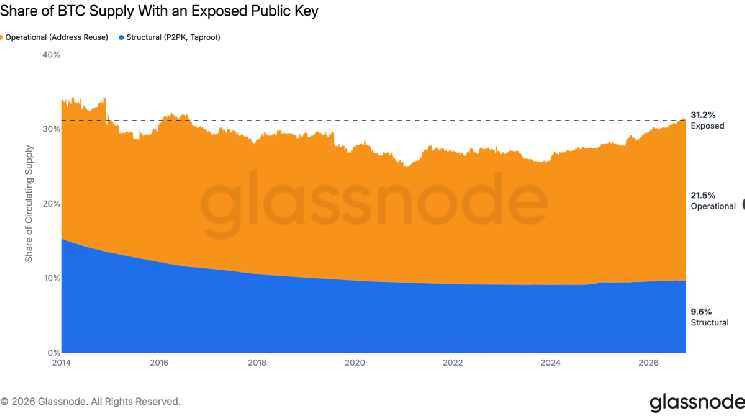
Fresh on-chain data has illuminated a vulnerability that strikes at the very heart of Bitcoin’s promise of security: more than six million Bitcoin, representing roughly 31.2 percent of the entire circulating supply, are currently held behind public keys that are plainly visible on the blockchain. The statistic, painstakingly compiled by Glassnode, one of the most respected names in blockchain analytics, has sent ripples through the digital asset community. On its face, it is a purely technical observation about the architecture of the network. But framed against the rapid acceleration of quantum computing research and the extraordinary leaps being made in artificial intelligence, it becomes something far more consequential — a quiet but persistent reminder that the cryptographic defenses underpinning the world’s most valuable cryptocurrency may not be as permanent as they appear. The figure is being studied closely by institutional custodians, security researchers, and long-term holders who have come to realize that protecting Bitcoin is not simply a matter of guarding private keys, but of understanding precisely what information is already out in the open.
For those unfamiliar with the mechanics, the distinction between a public key and a private key is the foundation upon which all cryptocurrency ownership rests. A public key acts as a kind of address that others can see and send funds to, while the private key is the closely guarded secret that authorizes the movement of coins. Every transaction on the Bitcoin network leaves traces, and in certain address formats — particularly older output types and the more recent Taproot standard — the public key itself is directly encoded into the ledger. Deriving a private key from that public key is mathematically infeasible with today’s conventional computers, which is precisely what makes Bitcoin work. But that balance of certainty rests on assumptions about computational limits that researchers on the frontiers of physics and machine learning are working hard to challenge. The Glassnode findings transform those abstract concerns into a concrete, measurable figure, giving the debate a new sense of urgency.
The Exposed Supply Is Growing Far Faster Than New Bitcoin Being Minted
The latest assessment from Glassnode marks a significant escalation from previous communication. Rafael Schultze-Kraft, the firm’s co-founder, noted that the volume of Bitcoin behind visible public keys has grown by 222,000 BTC — an amount worth roughly $18.2 billion at current market values — since the company’s prior report in May. That number takes on even greater significance when compared against the growth of the overall supply. In that same period, the total quantity of Bitcoin in circulation increased by just 64,000 coins, meaning the uptick in exposed supply was more than three times the rate of new issuance. In other words, the rising exposure cannot be chalked up to the normal growth of the network through mining rewards. It reflects instead a genuine shift in behavior among holders, custodians, and trading platforms, with coins that were once tucked behind unexposed addresses moving into more transparent, and in some ways more vulnerable, positions.
Glassnode’s data also reveals that the current level of exposure sits approximately 5 to 6 percent above the cyclical low observed in 2023. That reversal of fortune, as one might call it, suggests an industry that has become aware of the issue yet has not managed to alter its course. Analysts point to a confluence of contributing factors: an uptick in overall on-chain activity in recent months, the increasing utilization of newer Bitcoin output types that prioritize script flexibility and privacy features but inadvertently leave public keys logged, and a wave of inflows to centralized platforms amid renewed market volatility. For security specialists, the trend lines are uncomfortable. Every additional coin that lands behind a visible public key represents another potential casualty in a hypothetical — but increasingly plausible — scenario where cryptographic defenses are outmatched. The message from the data is unambiguous: while the community debates the likelihood of a catastrophic breakthrough, the quantity of exposed value continues to climb.
Binance’s 83% Exposure Shines an Uncomfortable Light on Exchange Custody Practices
The footprint of centralized exchanges looms large in Glassnode’s analysis, and the findings raise pointed questions about how the platforms that dominate the industry manage the security of billions of dollars in customer assets. According to the report, exchanges collectively added roughly 123,000 BTC to their visible public-key balances during the measurement period, bringing the total held by these platforms behind identifiable public keys to about 1.79 million Bitcoin. That concentration makes trading venues by far the largest single category of exposed supply, and it comes at a time when regulators and users alike are paying closer attention than ever to the operational resilience of the platforms entrusted with their funds. But the aggregate figures conceal a striking divergence among individual exchanges, and that divergence reveals just how different security postures can be.
Coinbase, the largest publicly traded crypto exchange in the United States, shows an exposed share of just 10 percent, suggesting that the vast majority of its Bitcoin is managed through carefully structured systems designed to keep public keys out of the open ledger. The architecture that produces such a figure is generally associated with institutional-grade custody solutions, where funds are distributed across a complex web of segregated addresses and routinely rotated to diminish on-chain visibility. Binance, by contrast, stands at the other end of the spectrum with a startling 83 percent of its holdings sitting behind exposed public keys. It is important to emphasize that exposed public keys do not mean immediate theft, nor do they necessarily indicate negligence — modern exchange operations are built around hot wallets that facilitate rapid withdrawals, and those wallets necessarily interact with the visible network far more often than deep cold storage reserves. Even so, the divergence points to very different philosophies of risk management, and it suggests that the security standards governing a major exchange can vary dramatically from one platform to the next.
Fidelity’s Discreet Holdings Contrast Sharply With Retail-Facing Platforms
Beyond the exchanges, Glassnode’s methodology paints a revealing portrait of how the major institutional players across the digital asset landscape approach address hygiene, and the picture is anything but homogeneous. Fidelity, the financial services behemoth that has emerged as one of the most influential traditional finance entrants into the Bitcoin market, controls an estimated 375,000 BTC across its various products and portfolios. Yet only about 2 percent of those holdings are exposed under the firm’s analysis — a remarkably low figure that indicates a custody framework refined for security above all else. That level of discretion is likely achieved through the deployment of advanced multisignature technology, the distribution of assets across countless dedicated addresses, and an operational culture that values cryptographic opacity as a defense-in-depth measure.
Grayscale, the digital asset investment giant whose Bitcoin Trust has served as a gateway for mainstream investors, presents a far more mixed picture, with nearly half of its substantial holdings — 49 percent — sitting behind visible public keys. This may surprise investors who assume institutional stewardship is universally synonymous with maximum privacy, but it reflects choices made in the design of the trust’s storage systems that favored operational simplicity. The retail-oriented platforms tell an even starker story: Revolut shows a 99 percent exposure rate, while Robinhood’s Bitcoin holdings appear to be fully exposed at 100 percent. These numbers are not inherently a sign that customer funds are at imminent risk, but they do highlight the fact that platforms catering to everyday users tend to construct their infrastructure around speed and efficiency, often sacrificing the kind of address rotation and key isolation that hardening against future threats would demand. Government entities, meanwhile, remain the quiet exception to the rule. The Bitcoin reserves held by the United States, the United Kingdom, and El Salvador — three jurisdictions known to have acquired coins through seizures or sovereign adoption — register no public-key exposure across their holdings. Whether through deliberate design or sheer fortune, state actors have so far avoided the same visibility that characterizes much of the private sector.
Why a Visible Public Key Could One Day Mean a Deciphered Private Key
Understanding the substance of the threat requires a closer look at the pathways through which public keys become visible in the first place. The most familiar route is address reuse, a practice that has been frowned upon for years by security experts but remains surprisingly common, particularly among entities managing large volumes of transactions. When a holder sends and receives funds multiple times from the same address, each transaction effectively broadcasts the relevant public key to the entire network, and the entire clearinghouse of that information is permanently recorded in the immutable blockchain. The second avenue is more subtle and is woven directly into the protocol. Early Bitcoin outputs that used pay-to-public-key formats, which date from the network’s foundational era and are still in circulation, encode public keys directly into the transaction record. Taproot addresses, introduced in the 2021 upgrade that brought enhanced privacy and smart-contract capabilities, do the same by design.
The actual risk emerges from the mathematical relationship between a public key and a private key. The elliptic curve cryptography that secures Bitcoin — specifically the ECDSA algorithm — is built on the principle that, given a public key, calculating the corresponding private key would require solving a mathematical problem that is computationally infeasible for classical computers. That assumption has held since Bitcoin’s inception, surviving more than a decade of relentless compute growth and increasingly sophisticated cryptanalysis. What threatens it is a sufficiently capable quantum computer, which could theoretically run algorithms such as Shor’s algorithm to invert the elliptic curve function with ease. More speculative, but perhaps closer to reality for a growing number of researchers, is the possibility that advanced artificial intelligence could discover mathematical shortcuts that have eluded human cryptographers for decades. Should either scenario unfold, every Bitcoin stored behind a visible public key — every coin in an address type where the key is exposed — could conceivably be drained by any adversary who noticed first. The Bitcoin community has discussed quantum-resistant signature schemes for years, and engineers have floated proposals to migrate the network to new cryptographic standards, but those transitions require billions of dollars in coordination and consensus upgrades across a decentralized protocol, and the pace of that work lags behind the growth of exposure now documented by Glassnode.
The ‘Bunker Mode’ Warning: AI Might Break Bitcoin’s Cryptography Before Quantum Arrives
The latest push to treat this issue with existential seriousness comes not from the Bitcoin camp but from a prominent researcher on the Ethereum side of the ecosystem. Justin Drake, a well-known and respected figure, recently urged the broader cryptocurrency industry to prepare for what he called “bunker mode” — an operational posture that assumes cryptographic defenses could crumble at any moment. Drake’s warning centered not on the standard quantum-computing timeline, which experts generally place decades into the future, but on the less-discussed potential of artificial intelligence. In his view, AI systems capable of advanced mathematical reasoning could, in a worst-case scenario, uncover a shortcut to breaking wallet cryptography “in months, not years,” leapfrogging quantum machines entirely. His remarks sent a jolt through security circles, where the conversation had long been dominated by the patient wait for quantum hardware.
Drake’s framing refocuses the debate on an uncomfortable truth: the security of every Bitcoin transaction, every address, and every coin in existence is ultimately dependent on theoretical assumptions that may one day be overturned. The Glassnode data transforms that philosophical point into a concrete statistic — more than six million coins are currently positioned in a way that would leave them exposed should those assumptions fail. That represents a meaningful chunk of the roughly 19.8 million Bitcoin that have been mined to date, and the fact that exposed supply is growing faster than total supply suggests the risk is compounding even as awareness rises. For the market at large, the stakes could hardly be higher. Bitcoin’s value has always been anchored in the certainty of its code, the mathematical absoluteness that guarantees scarcity and security. A cryptographic breach would strike at the very core of that trust, and the 6 million coins sitting in visible keys would be only the first domino to fall in a crisis that could reverberate across the entire digital asset economy.
The immediate responsibility rests with the custodians — the exchanges, the asset managers, the platforms, and the sovereign treasuries that collectively hold coins on behalf of millions of owners. The imperative is to reduce address reuse, move funds into quantum-resistant formats where the capability to do so exists, and build the infrastructure for a potential network-wide migration to new signature schemes. None of this is easy. Migrating millions of coins across cold wallets is a logistical challenge of massive proportions, and the Bitcoin protocol itself would need broad consensus to implement cryptographic upgrades. But the message from researchers like Drake and the data from Glassnode could not be more clear: in the race to secure the cryptocurrency economy, being visible is no longer a neutral condition. It is a liability, measured in billions of dollars, that must be managed with the same seriousness as any systemic threat. Bitcoin has survived regulatory crackdowns, exchange collapses, and endless forecasts of its demise, but the challenge of its own cryptography may prove the most enduring test of all. The question now is whether the industry will heed this warning before the theoretical becomes all too real.