

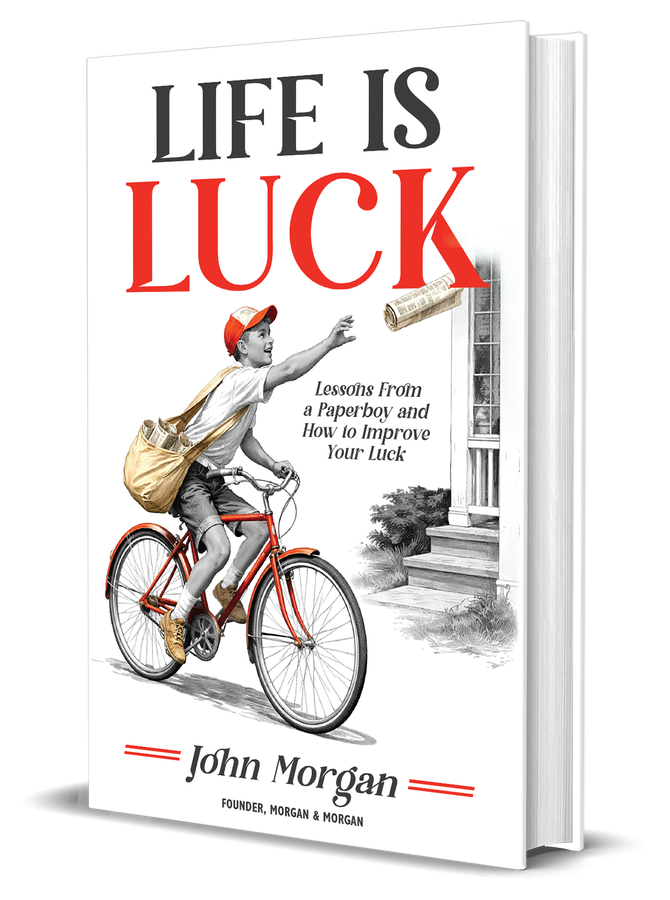
To the millions of Americans who see his face plastering highway billboards, bus stops, and television screens daily, John Morgan represents the absolute apex of the self-made American dream. Recently ranked 92nd on the prestigious Forbes 250 Self-Made list, the seventy-year-old legal titan has spent decades transforming his practice, Morgan & Morgan, into the undisputed heavyweight champion of the nation’s personal injury landscape. His formula has historically seemed straightforward: a relentless, near-manic devotion to non-stop advertising, an exhausting work ethic that leaves competitors in the dust, and a rare, almost magnetic ability to cultivate trust instantly with everyday citizens looking for a champion. Seen from the outside, his empire is a monument to individual willpower, a testament to what can be achieved through sheer grit, intellect, and stubborn determination. Yet, in his deeply introspective new book, Life Is Luck: Lessons From a Paperboy and How to Improve Your Luck, published by Maison Vero on April 21, 2026, Morgan dismantles his own carefully constructed monument. He argues with startling sincerity that the popular narrative of the self-made icon is not merely an exaggeration, but a fundamental misunderstanding of how human lives actually unfold. While he freely acknowledges that hard work is an indispensable requirement and that raw talent is necessary to seize the moment, Morgan insists that without the chaotic, unpredictable intervention of pure luck, his life would have taken a radically different, far less celebrated path. The book serves as a profound meditation on the boundaries of human agency, urging readers to look past the myth of the rugged individualist and recognize the invisible, serendipitous forces that shape our destinies. By reframing his monumental success as a product of good fortune rather than personal infallibility, Morgan offers a refreshing alternative to the typical billionaire memoir, inviting us to examine how gratitude, humility, and a keen eye for opportunity can transform our own lives.
The thematic anchor of Morgan’s philosophy is a deceptively simple childhood experience: his early years spent working as a paperboy on the streets of Kentucky. Though it felt like a relentless chore rather than a blessing at the time, Morgan now views that grueling paper route as one of the luckiest developments of his entire life, a crucible that forged his character long before he ever stepped foot inside a courtroom. The job forced a young boy to confront the harsh realities of the adult world daily, demanding that he wake up in the freezing, dark hours of the early morning, peddle papers through biting winter winds and torrential downpours, and meticulously collect money from strangers who were often reluctant to pay. This early trial-by-fire taught him invaluable, raw lessons about personal responsibility, financial accountability, salesmanship, and the art of human negotiation at an age when most young boys are insulated from such burdens. Intriguingly, Morgan points out that he is far from alone in this trajectory, noting that an extraordinary number of modern billionaires and legendary business leaders share this exact, humble starting point in their childhoods. The paper route served as a practical laboratory for developing physical and mental resilience, converting what appeared to be the misfortune of a chaotic, financially unstable childhood into a solid foundation for future success. This childhood lack of stability stands in stark contrast to the deeply close-knit family life he has painstakingly built as an adult, where his beloved wife, Ultima, and their three sons are not only his personal anchors but also active lawyers and core partners within his firm. By contrasting the instability of his youth with the familial fortress he commands today, Morgan illustrates how the coping mechanisms learned on those cold Kentucky mornings prepared him to build and protect an empire while keeping his family tightly bound together at the very center of his life and business.
A central challenge Morgan faces in this book is convincing a skeptical, often cynical public that his emphasis on luck is more than just false modesty or a billionaire’s attempt to avoid sounding arrogant. To counter this, he meticulously dissects the concept of luck, refining it from a passive, lottery-like phenomenon into an active lifestyle and an environmental discipline. While he concedes that “pure luck”—such as the circumstances of one’s birth, genetics, or catastrophic acts of nature—is entirely beyond human control, he introduces the empowering concepts of “planned luck” and “practiced luck.” According to Morgan, these dynamic forms of luck are cultivated through relentless preparation, consistent habits, the cultivation of deep relationships, and the deliberate act of putting oneself in high-opportunity environments. He argues passionately that people can drastically improve their cosmic odds simply by stepping into the right rooms, staying perpetually open to unexpected opportunities, and refusing to let inevitable failures dictate their ultimate trajectory. This philosophy is crystallized in his chapter “Never Eat Alone,” which champions the radical power of continuous human connection and networking as the primary pipeline through which good fortune flows. In an era increasingly dominated by remote work, screen-mediated communication, and the isolating efficiencies of artificial intelligence, Morgan’s plea for genuine, real-world human interaction feels incredibly urgent and counter-cultural. He reminds us that opportunities do not emerge from digital vacuums or algorithmic equations; they are carried to us by real people, through relationships built on trust, conversation, and mutual respect. For Morgan, luck is not a random lightning strike that hits a passive observer, but rather a constant, aggressive pursuit of opportunities that requires us to keep our eyes wide open, our minds receptive, and our schedules filled with face-to-face encounters.
Perhaps the most compelling and humanizing elements of Life Is Luck are the moments where Morgan willingly sheds his armor of wealth and power to discuss the persistent internal vulnerabilities that still haunt him. He writes with raw, refreshing honesty about his ongoing struggles with catastrophic thinking, severe imposter syndrome, and the lingering, deep-seated anxieties that have followed him from his impoverished childhood into his life of luxury. Despite his immense fortune and global influence, he admits to harboring an ever-present fear that the floor could drop out from underneath him at any minute, a psychological scar left by a childhood spent watching his father repeatedly lose jobs and struggle to provide basic stability. One of the book’s most emotionally resonant and symbolic passages centers on a deeply personal detail: a missing tooth that was pulled during his childhood because his family simply could not afford the expensive root canal required to save it. Decades later, despite possessing more than enough wealth to undergo any cosmetic procedure imaginable and having two brothers who are successful dentists, Morgan has deliberately chosen to leave that gap in his smile entirely unaddressed. For Morgan, the missing tooth is not an aesthetic failure or a sign of neglect, but a highly sacred, physical monument to his roots, an unyielding physical reminder of where he came from and how quickly life can pivot between poverty and abundance. By choosing to wear this physical scar openly, Morgan rejects the artificial, hyper-curated perfection so common among the modern ultra-wealthy, demonstrating a rare level of self-awareness and a refusal to let the comforts of his current status erase the painful, formative truths of his early life. This willingness to expose his psychological and physical imperfections transforms the book from a standard business manual into a deeply human confession, allowing readers to see themselves in his anxieties and find hope in his resilience.
This commitment to raw authenticity is also evident in how Morgan reframes personal tragedy, showing that some of our darkest, most devastating moments of “bad luck” can ultimately serve as the essential forces that push us toward our true callings. His own legendary career in personal injury law was not born out of a clinical business calculation or a passion for tort theory, but rather out of a deep well of anger, grief, and love following a catastrophic family tragedy. When his brother Tim was left permanently paralyzed after a severe lifeguard accident at Disney World, the young Morgan experienced firsthand the cold, bureaucratic indifference of large corporations and the immense struggles faced by injured victims and their families. This profound family trauma transformed his perspective, channeling his personal fury into a professional crusade and laying the groundwork for a law firm built on the premise of fighting for the powerless against the powerful. The narrative structure of the book itself mirrors this unpolished, raw approach to life, written in a highly conversational, colloquial style that feels less like a polished literary document and more like a late-night chat with an old friend at a local dive bar. Morgan writes exactly as he speaks in real life: he curses freely, wanders down eccentric side streets, jumps erratically between distinct narratives, and expresses bold, unfiltered opinions on everything from professional sports and legendary musicians to high-stakes gamblers and cultural trends. While his family members reportedly pushed him during the editing process to cut out these colorful tangents in favor of a more streamlined, professional business playbook, it is precisely this rambling, unvarnished honesty that gives the book its undeniable soul. By prioritizing authentic, human storytelling over corporate perfection, Morgan ensures that his message resonates on an emotional level, proving that a person’s failures, tragedies, and eccentricities are often the very elements that make their story worth listening to.
Ultimately, Life Is Luck—which was published to much anticipation on April 21, 2026, with a highly anticipated audiobook release scheduled for May 25, 2026—stands as a powerful testament to the value of gratitude, humility, and resilience in an increasingly competitive and isolated world. Some readers might pick up the book hoping for a step-by-step corporate manual or a collection of slick marketing strategies, and they may find themselves initially frustrated by its loose, wandering structure and philosophical musings. However, those who look deeper will discover something far more valuable: a deeply moving, human portrait of a man who has scaled the absolute heights of material success, only to realize that the most precious things in life cannot be bought, sold, or manufactured through grit alone. By using his platform to champion luck, relationships, and gratitude rather than his own personal genius, Morgan subverts the typical, self-aggrandizing narrative of the billionaire class and offers a much-needed dose of perspective. The true power of the book lies not in the novelty of its individual pieces of advice, but in the unique identity of the messenger delivering them. To hear a man famous for his aggressive, confident advertising campaigns and larger-than-life media presence talk so vulnerably about luck, fear, and family tragedy is a uniquely arresting experience. It forces us to pause and reflect on our own lives, reminding us that while we must work tirelessly to prepare ourselves for the opportunities that come our way, we must also preserve the humility to acknowledge the unseen hands that help us along our journey. As Morgan’s story beautifully demonstrates, the ultimate measure of a successful life is not found in the size of one’s bank account or the number of billboards bearing one’s name, but in the depth of one’s gratitude for the wild, unpredictable, and incredibly lucky ride that brought us here in the first place.