



The morning had all the markings of an ordinary Tuesday. The sun was climbing over the Hudson River, casting a golden light on the Manhattan skyline, and the air was crisp with the promise of an uneventful day. At a small heliport in Kearny, New Jersey, a Bell 206 helicopter, operated by the sightseeing company FlyNYON, lifted off around 9 a.m. Onboard were two people: a pilot and a passenger. Their mission was routine — a maintenance flight, designed to test the aircraft after service, bound for Brooklyn. For anyone watching from the ground, it would have been an unremarkable sight, just another helicopter humming across the sky on a clear morning. But high above the streets, something went terribly wrong. The steady, rhythmic hum of the engine faltered. A moment of silence stretched into what felt like an eternity. And then the pilot’s voice crackled over the radio, urgent and unmistakably panicked: engine failure. In an instant, the mundane flight became a battle for survival. The pilot’s hands gripped the controls, his eyes darting across the instrument panel, his mind racing through the emergency procedures drilled into him over years of training. Below, the landscape sprawled in a maze of highways, warehouses, and waterways — none of it friendly to a falling helicopter. The passenger, who had been calmly observing the aircraft’s systems, felt his heart lurch into his throat. This was not supposed to happen. This was a check ride, a formality, a flight that was never meant to leave the realm of the ordinary. But here it was: the extraordinary, arriving without warning, demanding everything they had.
A maintenance flight is the kind of operation that rarely makes the news. It lacks the glamour of a sightseeing tour or the drama of a rescue mission. It is a practical chore — a flight conducted to ensure that a helicopter is mechanically sound, that its rotors spin true, that its controls respond correctly, that its instruments are accurate. The passenger on this flight was likely a mechanic or an engineer, someone whose job it was to observe the aircraft’s performance from the cabin, listen for unusual sounds, and report any irregularities to the pilot. The pilot, meanwhile, was focused on the route: a familiar path over the New Jersey Meadowlands, across the harbor, and toward the Brooklyn waterfront. Below them lay the iconic landmarks of the New York metropolitan area — the Statue of Liberty, the Verrazzano-Narrows Bridge, the container ships sliding through the bay, the endless rooftops of the outer boroughs. It was a picture-perfect morning, the kind that makes helicopter travel seem effortless and serene. Then the engine sputtered, and the picture shattered. The pilot’s training took over, but the fear was immediate and visceral. He had only seconds to assess the situation: a failed engine, a dense urban landscape below, and the urgent need to find somewhere — anywhere — to put the aircraft down. The radio call was brief, frantic, a cry for help that cut through the static of the morning commute. There was no time for explanations, no time for calm deliberation. There was only the desperate search for a patch of earth that would not kill them.
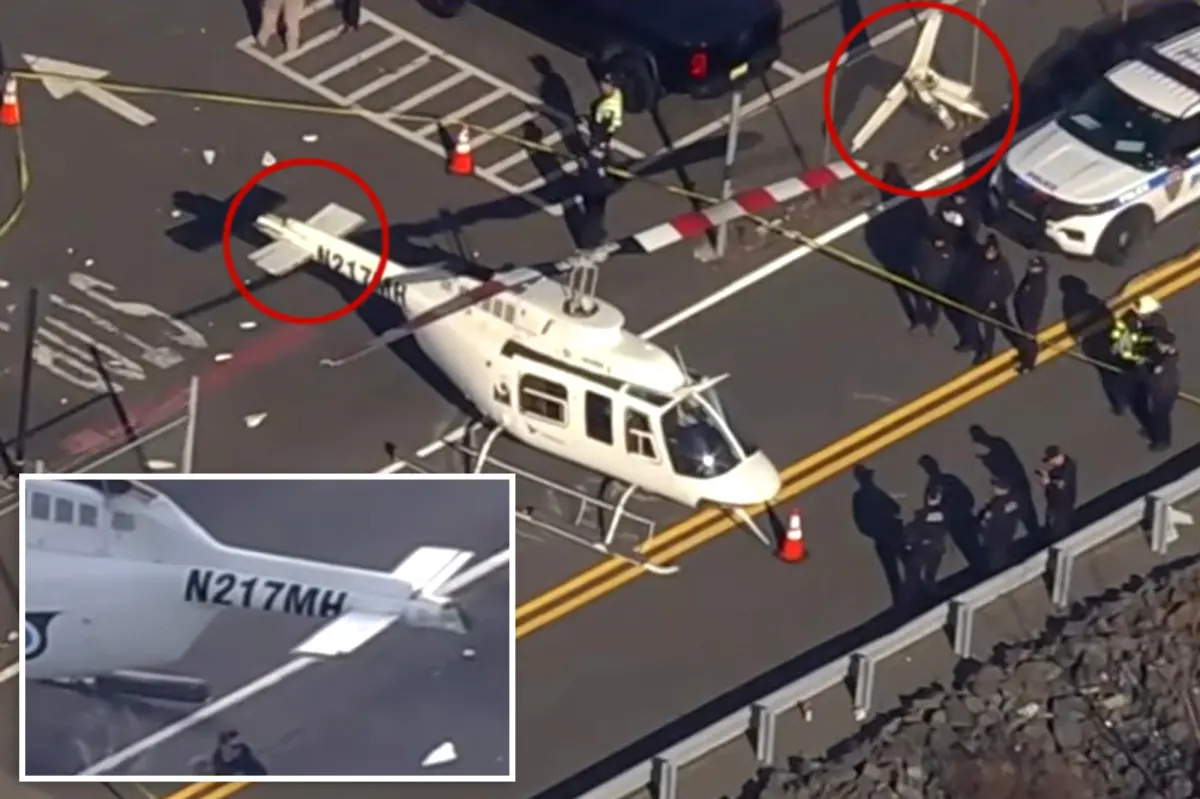
The emergency landing itself was a study in skill, instinct, and sheer desperation. With the engine dead, the pilot had to rely on a maneuver known as autorotation — a technique in which the helicopter’s rotor blades are driven by the upward flow of air as the aircraft descends, generating just enough lift to slow the fall. It is a procedure every pilot practices dozens of times in training, in controlled conditions, with instructors ready to take over at any moment. But never with the full weight of reality pressing down, never with the knowledge that a single miscalculation could mean the end. The pilot guided the stricken Bell 206 toward the Port Jersey Port Authority Marine Terminal, a sprawling cargo facility on the waterfront. It was not a helipad, not a clear field — but it was open ground, and it would have to do. The helicopter slammed down hard, the impact sending a shudder through the airframe and a jolt through the spines of the two men inside. The main cabin held, its structure intact, protecting them from the worst of the force. There was no fire, no explosion — just the sudden, deafening silence of a machine that had been screaming moments before. The occupants climbed out on shaking legs, alive, breathing, blinking in the morning sunlight. And then they saw the damage: the tail rotor, sheared clean off, dangling from a nearby fence like a grotesque piece of sculpture. It was a stark, surreal reminder of how close they had come to disaster. The main cabin stood intact, but the machine was broken, its grace and power stripped away in the brutal violence of the touchdown.
For FlyNYON, the incident carries a heavy and inescapable weight. The company has built its reputation on offering passengers an unforgettable experience — doors-off flights over New York City, the wind whipping through the cabin, the skyline stretching endlessly below, the thrill of feeling untethered from the world. It is an experience that has drawn tourists, photographers, and adventure-seekers from around the globe. But it is also a company haunted by tragedy. In March 2018, a FlyNYON helicopter crashed into the East River, killing all five passengers on board. That flight, too, had seemed routine — a doors-off excursion for a group of friends, a bucket-list adventure that ended in the dark, cold, unforgiving waters of the river. The crash prompted federal investigations, wrongful-death lawsuits, and a renewed focus on safety protocols, particularly the use of harnesses and the inherent risks of the doors-off configuration. The memory of that disaster lingers like a ghost in every hangar, every pre-flight briefing, every passenger waiver. Every new incident, no matter how minor, reopens the same painful question: how safe are these flights, really? For the two people who walked away from Tuesday’s emergency landing, the answer was clear — this time, they were lucky. But the shadows of the past are never far away, and every headline about a FlyNYON helicopter forces the company to confront the fragile trust it asks the public to place in it.
The broader context of helicopter safety in the New York metropolitan area is one of remarkable frequency and rare, but devastating, failure. Thousands of helicopter flights crisscross the region every year — tour flights, news helicopters, medical transports, police patrols, corporate shuttles, private charters. The airspace over the city is some of the busiest and most complex in the world, a three-dimensional puzzle of corridors, altitudes, and restricted zones. Engine failures, while rare, are the nightmare scenario every pilot prepares for but hopes never to face. When they happen, geography becomes destiny. A failure over open water might end in a controlled ditching, with the helicopter floating long enough for the occupants to escape. A failure over a dense neighborhood could be catastrophic, raining debris onto streets and homes below. On Tuesday, the pilot found the one patch of clear ground in a landscape of concrete and water — a cargo terminal with enough open space to accommodate a descending helicopter. The margin between a routine emergency landing and a tragedy is measured in seconds and feet, in the angle of descent, in the choice of a single field among thousands of rooftops. The fact that no one was injured, that the helicopter’s main cabin remained intact, that the tail rotor detached harmlessly into a fence rather than into a building or a person — these are details that border on the miraculous. The first responders who arrived at the scene likely expected the worst, braced for smoke and wreckage and worse. What they found instead was a pilot and a passenger standing on solid ground, the fear slowly draining from their faces, the relief washing over them like a wave.
In the days ahead, investigators will take that helicopter apart piece by piece, looking for the cause of the engine failure. The tail rotor will be examined, the engine meticulously inspected, the pilot’s actions reviewed and replayed. It is a process that will yield answers, though perhaps not closure. For the two people who were aboard, the aftermath will be measured in smaller, quieter moments: the phone call home to say, I’m okay; the long, slow drive away from the terminal; the phantom sound of the engine, still ringing in their ears; the involuntary flinch every time another helicopter passes overhead. They will walk into their homes that night, hug their loved ones a little tighter, and feel the ground beneath their feet with a new and profound gratitude. The helicopter, meanwhile, will sit in an impound lot or a hangar, a twisted testament to the fragility of flight and the thin margin between survival and catastrophe. And the sky over New York City will continue to hum with the sound of rotors, as thousands of people climb aboard helicopters every year, chasing views and thrills and once-in-a-lifetime memories, rarely thinking about the invisible line that separates a routine flight from a brush with death. On Tuesday morning, two people crossed that line and came back. The rest of us can only marvel at the skill, the luck, and the grace that brought them home, and remember that even the most ordinary Tuesday can suddenly become extraordinary in the blink of an eye.