


The Frozen Witness: How Ice Cores Revealed a Century-Old Environmental Crime
Beneath the pristine, windswept landscapes of the Arctic lies an extraordinary archive—not of paper and ink, but of ice. For decades, scientists have drilled deep into polar ice sheets, extracting cylindrical cores that serve as frozen time capsules, preserving the chemical fingerprint of Earth’s atmosphere across millennia. These icy layers capture everything from volcanic ash and sea salt to airborne pollutants, each year’s snowfall sealing a snapshot of the planet’s environmental health. But within these ancient layers of snow and ice, researchers have discovered something far more troubling than natural atmospheric variations. They have uncovered the hidden legacy of industrialization—a trail of toxic heavy metals and a silent, century-old crime against public health that has only now come to light.
In a groundbreaking study that bridges atmospheric science, history, and public health, researchers led by Joseph McConnell, an environmental scientist at the Desert Research Institute, have meticulously analyzed ice cores collected from Canada, Greenland, and Russia. While their examination covered an impressive timespan reaching back to 210 BCE, it was a specific and relatively brief period that captured their collective attention: the dawn of the American Industrial Revolution, roughly from 1870 to 1914. What they found in those ice layers was alarming. Concentrations of arsenic—a potent, cancer-causing heavy metal—soared to levels up to fifteen times higher than pre-industrial baselines. This dramatic spike was not a natural phenomenon, but a direct consequence of unchecked industrial activity. The discovery sets the stage for a detective story across continents and centuries, one that would eventually point to a single, massive source of contamination and force an entire nation to confront its toxic past.
The detective work began with a crucial clue hidden in the glaciers’ distribution. The most pronounced arsenic deposition appeared in cores from Greenland, a fact that provided an invaluable piece of the pollution puzzle. Atmospheric circulation patterns in the Northern Hemisphere follow a general west-to-east flow, meaning that airborne particles from North America are typically transported towards Greenland, while European pollution tends to spread across the Russian Arctic. As McConnell explains, the deposition pattern created an unmistakable fingerprint: “The only way you can explain that pattern of deposition is if the emissions are coming from North America. Had it been from Europe, we would have seen much larger increases in the Russian Arctic.” It was a geographical contradiction that ruled out European origins and identified North America as the unequivocal culprit. This atmospheric logic transformed what might have been a global story of contamination into a uniquely American tragedy.
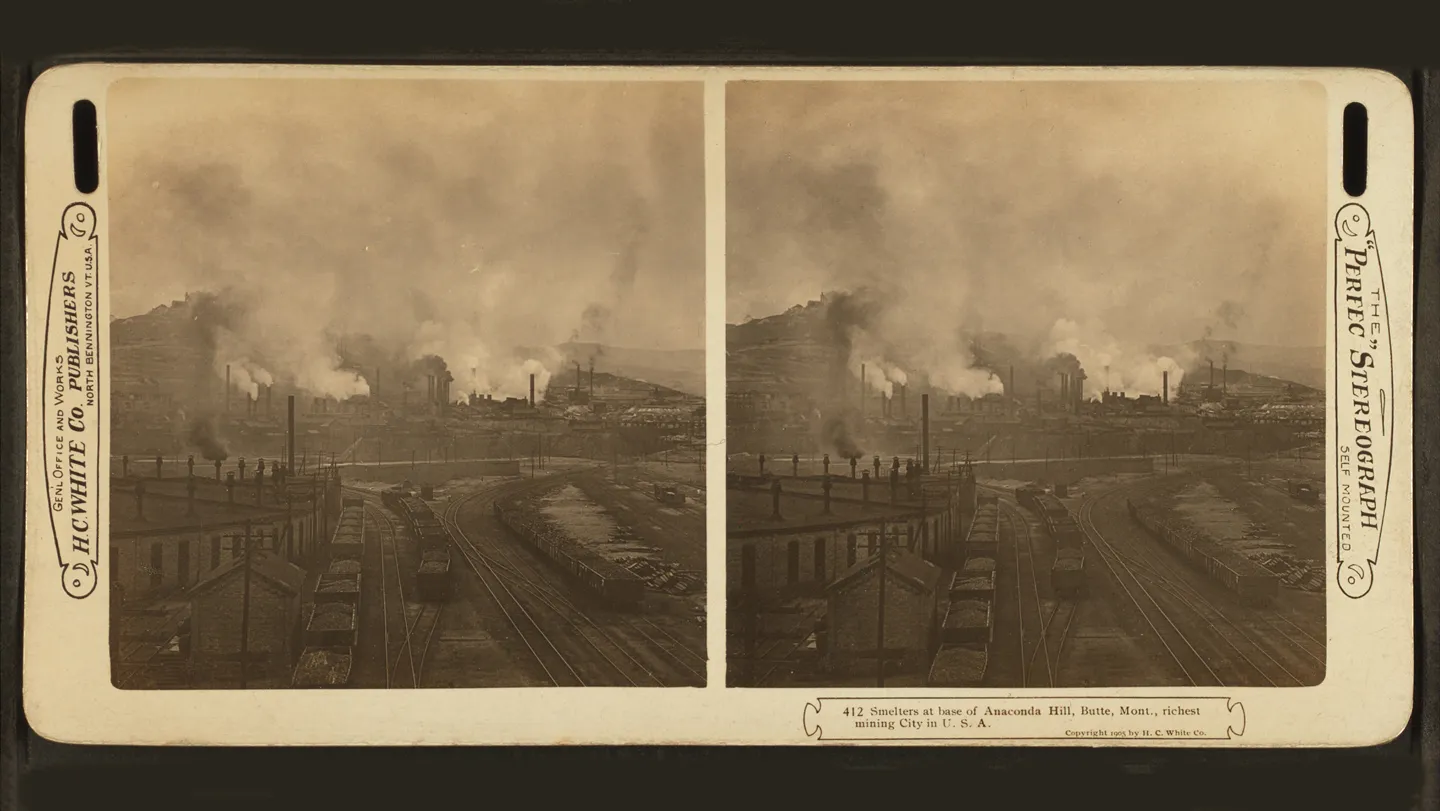
With the geographic investigation narrowing the search, McConnell and his team turned to historical records and industrial activity of the era. Their investigation zeroed in on the Anaconda Copper Mining Company in southwestern Montana, one of the largest and most powerful industrial operations in North America at the turn of the twentieth century. Although numerous copper smelters operated across the western United States, the Anaconda facility possessed a toxic distinction: its copper ore was uniquely rich in heavy metals like arsenic and lead. While other smelters released less hazardous waste, Anaconda’s furnaces pumped vast quantities of toxic, airborne particles into the surrounding atmosphere. This was no secret to those living in the shadow of the smokestacks. Fred Quivik, a historian and author of Smoke and Tailings, recalls the devastating local consequences: “Ranchers and farmers started seeing their livestock die from arsenic poisoning.” The company’s operation represented not just industrial progress, but an environmental catastrophe unfolding in real time.
The scale of pollution revealed by the ice cores is staggering. By combining ice core arsenic concentrations with sophisticated atmospheric dispersion models, McConnell’s team estimated that the Anaconda company was releasing approximately thirty tons of arsenic into the atmosphere every single day during the peak of its operations. To put this into perspective, modern-day Chile—the world’s largest copper producer, with over twenty mining operations—emits roughly one-quarter of that amount annually. Anaconda’s unchecked pollution was not just a regional problem; it was poisoning the entire northern hemisphere, leaving a permanent mark in the frozen record of Greenland’s ice. For decades, this industrial behemoth operated without meaningful pollution controls, exposing hundreds of thousands of people to dangerous levels of a known carcinogen, with documented links to higher rates of certain cancers and cognitive impairment. The ice cores reveal not just a period of industrial triumph, but an era of profound, avoidable environmental and human tragedy.
The story took a decisive turn in 1919, when the Anaconda Copper Mining Company finally installed pollution-abatement technology, capturing arsenic near its smokestacks and preventing further atmospheric release. According to the ice core data, arsenic emissions dropped by approximately sixty percent as a result. While an environmental victory in its own right, the improvement came decades too late for the thousands of residents who had already breathed contaminated air. McConnell and his team were disheartened to discover that the company had consciously delayed installing clean technology for more than a decade, despite knowing the devastating impacts on nearby communities. “They delayed installation for about a decade,” he laments. The question that now lingers is not just about what happened, but about what could have been prevented. The technology existed, but the political will and ethical commitment to public health did not.
This remarkable research is not just a scientific observation—it is an urgent call to reevaluate how we understand industrial history and its human costs. McConnell and his team suggest that these frozen records open a new research frontier, offering a chance to combine ice core data with historical census records to trace the true health impacts of pollution on populations during the nineteenth and twentieth centuries. From the haunted landscapes of Montana, now designated as Superfund sites, to the pristine ice fields of Greenland, a new narrative emerges—one that shows our planet keeps a meticulous and unforgiving record of human actions. The ice cores remind us that environmental pollution knows no boundaries, crosses political borders, and solves no problems through indifference or obfuscation. They stand as frozen witnesses to our past, constantly challenging us to do better in our future, urging a deeper investigation into how industrialization shaped human health, and empowering epidemiologists with the tools to uncover the true, long-hidden costs of progress.