

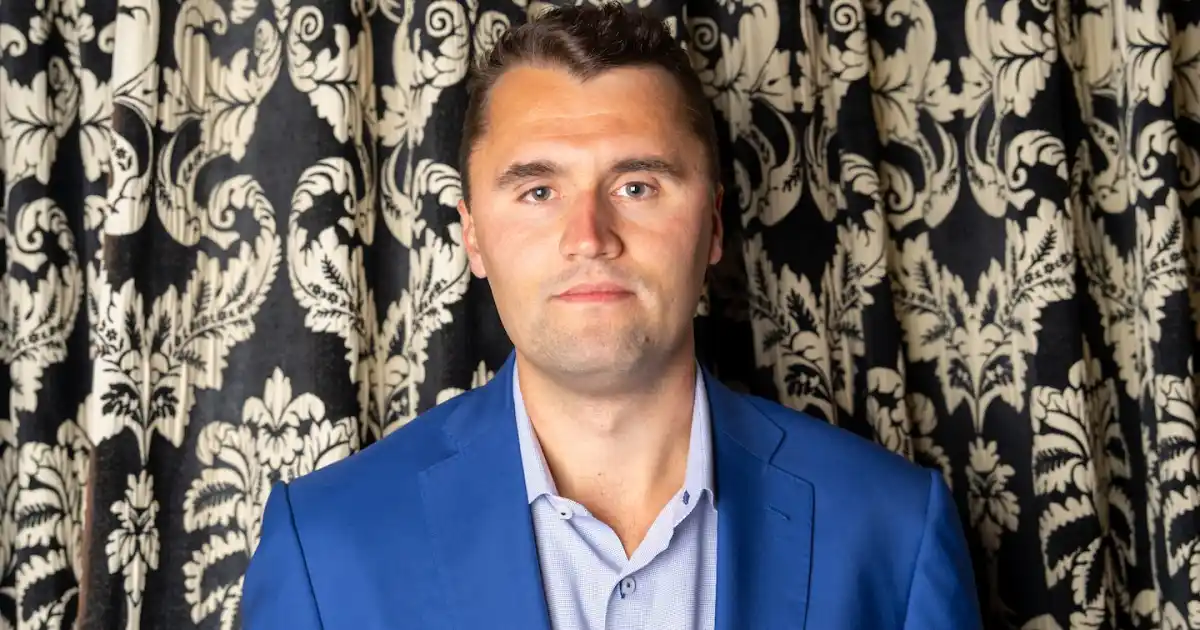
The crisp September air over Utah Valley University carried an ordinary hum of campus life until a single, deafening crack shattered it forever. On September 10, 2025, conservative commentator Charlie Kirk, just 31 years old and a father of two, was addressing a crowd from beneath a tent emblazoned with his tour’s slogan, “Prove Me Wrong.” He was answering a question about gun violence when a bullet, fired from roughly 200 yards away, struck him in the neck. A horrifying video captured the moment, showing the chaos as witnesses rushed to his aid. He was hurried to a nearby hospital, but his life had already slipped away. Later that evening, Turning Point USA, the influential organization he founded, released a somber statement, informing the world that their leader had “gone to his eternal reward with Jesus Christ in Heaven,” leaving behind a stunned nation and a grieving family.
In the immediate, frantic aftermath of the shooting, the scene was one of confusion and unsubstantiated accusations. Police swiftly took a man named George Zinn into custody, and images of him being restrained fueled a wildfire of speculation online, leading many to believe the shooter had been captured. However, authorities quickly determined Zinn was not the gunman; he was detained on suspicion of obstruction of justice and later released. The initial hours were marked by a flurry of mixed messages, with prominent officials, including FBI Director Kash Patel and Utah Governor Spencer Cox, first indicating another person was in custody, only to retract that statement hours later, clarifying that the individual was merely a “person of interest” who had been released after questioning. Utah’s public safety commissioner pleaded with the public to stop harassing these innocent individuals, emphasizing they had done nothing wrong and were simply swept up in a tragic and chaotic situation.
The search for the true perpetrator narrowed quickly. The FBI released two photographs and video of a masked suspect on campus, a man who had arrived before the event and was tracked climbing onto a rooftop, from which he allegedly fled after the shooting, leaving behind crucial forensic evidence. The investigation then moved with speed, culminating in the arrest of 22-year-old Tyler Robinson, a Utah native who had briefly attended Utah State University on a scholarship before dropping out. Robinson was turned in by someone very close to him, a family member who told authorities that he had confessed to the murder and had expressed deep animosity toward Kirk, describing him as “full of hate.” When law enforcement apprehended him, they also recovered a “high-powered, bolt action rifle” hidden in the woods, which they believe was the murder weapon.
The murder of Charlie Kirk was not just a personal tragedy; it was a lightning rod in the nation’s deeply polarized political landscape. President Donald Trump responded by announcing he would posthumously award Kirk the Presidential Medal of Freedom, praising him as “a giant of his generation” and “a champion of liberty.” While many on the right mourned a fallen icon, investigators struggled to find a broader conspiracy. Despite suggestions of left-wing involvement from some political figures, sources familiar with the investigation told NBC News that “every indication so far is that this was one guy who did one really bad thing because he found Kirk’s ideology personally offensive.” This lack of evidence connecting Robinson to a larger group complicated but did not deter the legal wheels of justice.
Erika Kirk, Charlie’s widow, emerged as a figure of profound grace and pain. Her grief was palpable, yet her perspective on her husband’s accused killer was strikingly nuanced. She told the New York Times that while she believed her husband’s death was “God’s plan,” she did not personally wish to seek the death penalty, stating, “I do not want that man’s blood on my ledger.” Meanwhile, her legal team fought for a swift and transparent judicial process, filing for a speedy trial to avoid what they saw as unnecessary delays. The legal proceedings became a drawn-out, arduous affair. A preliminary hearing in July 2026 brought forward a mountain of evidence, and by September 2026, after hearing closing arguments, the judge ruled that Robinson’s case would proceed to trial on a charge of aggravated murder, with prosecutors seeking the death penalty.
The path to justice, however, proved to be long and winding. In a ruling in November 2026, the judge set a trial start date of June 21, 2028, a timeline that allowed defense attorneys ample time to prepare for a possible capital punishment case. The decision was met with deep disappointment from Kirk’s family, who had hoped for the trial to begin sooner to avoid prolonging their pain and the waiting period for accountability. For them, every day was a day without Charlie, a constant reminder of the void his death left in their lives. As the legal marathon continues towards a trial that promises to be a national spectacle, the family holds onto their faith, their memories, and their hope for a process that is both fair and transparent. The case is not just about a trial date, but about the enduring legacy of a man who inspired millions, and the slow, deliberate march of a justice system trying to make sense of a senseless act.