

On a crisp Sunday afternoon in Philadelphia’s elegant Rittenhouse Square, what might have been a routine group bicycle ride became a flashpoint of raw anger and communal anguish. The demonstration, organized by the pro-Palestinian collective Philly Bike On Your Left, was conceived as a “boycott ride” targeting six local restaurants that the group labeled “Zionist establishments.” Cyclists waving Palestinian flags wound through the neighborhood as organizers issued an explicit demand: these Jewish-owned businesses should leave. What unfolded was not a quiet protest but a collision of worlds, with Palestinian supporters, Jewish residents, pro-Israel advocates, and ordinary diners all converging on the same narrow streets. The ride was deliberately timed to occur on the eve of the anniversary of Kristallnacht, the 1938 Nazi pogrom in Germany and Austria that shattered Jewish storefronts and synagogues and sent thousands to concentration camps. For many, the symbolism was impossible to ignore. To ride through a major American city and single out Jewish-owned restaurants for boycott was not, in their eyes, merely political speech; it was a reenactment of an old and dangerous pattern. The atmosphere crackled with accusations, chants, and raw emotion, as old wounds and new anxieties collided in real time. The message from the organizers was unambiguous in its hostility: these business owners were not simply being criticized for policy disagreements but were being publicly named, targeted, and told that they were not welcome. It was a scene that left many onlookers shaken, and one that would soon draw condemnation from city and state leaders, Jewish organizations, and ordinary residents who felt the ride crossed a line far beyond the boundaries of legitimate protest.
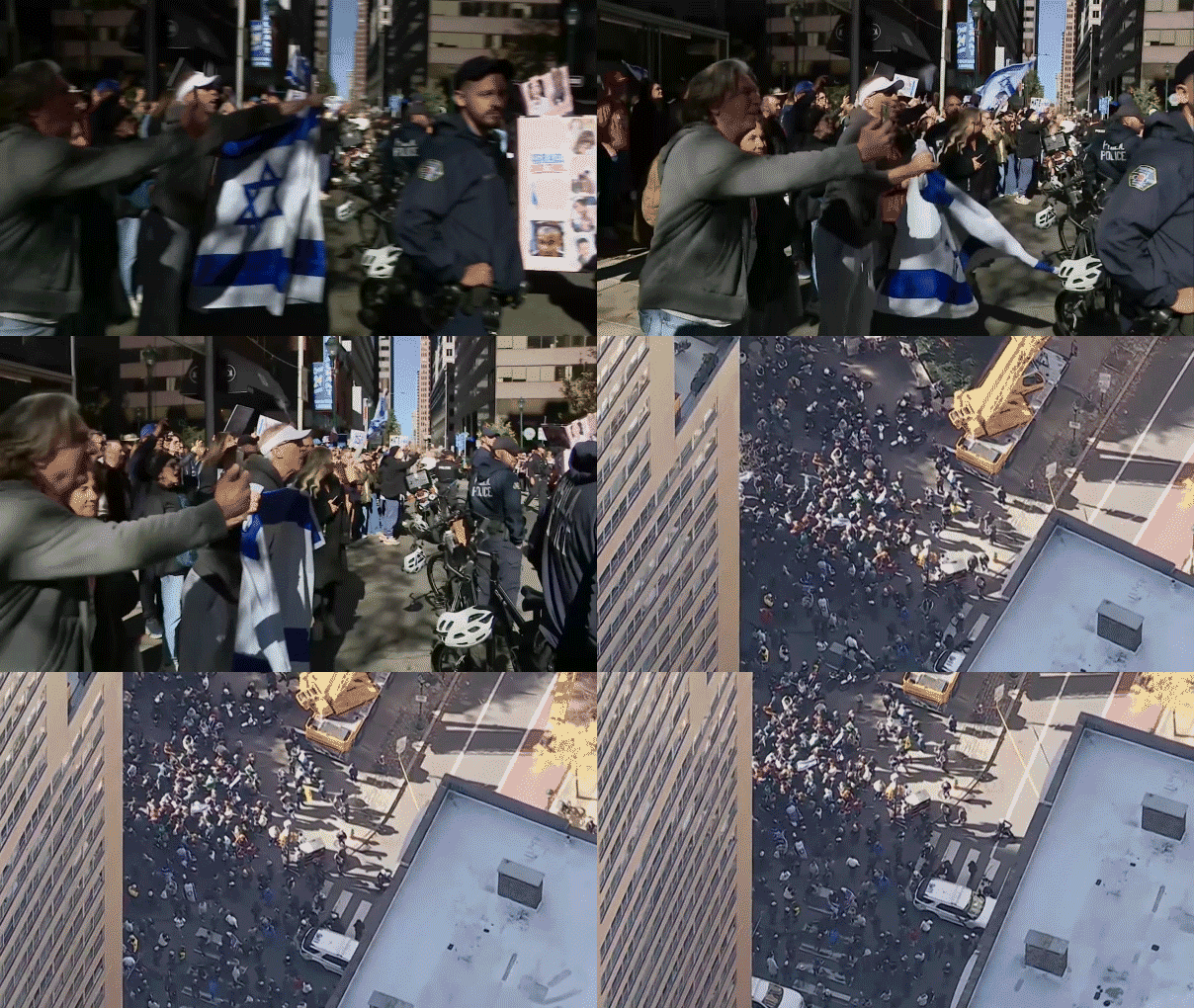
The backlash was swift and massive. Hundreds of Jewish and pro-Israel community members turned out to oppose the ride, lining the sidewalks in Rittenhouse Square and beyond with Israeli flags, signs, and voices raised in determined counterprotest. They were joined by dozens of diners who deliberately gathered outside the targeted restaurants, sitting at tables and filling seats in a show of solidarity with the Jewish-owned businesses. The scene was chaotic and emotionally charged: demonstrators shouted at counterprotesters, counterprotesters shouted back, and at times the air was thick with insults, accusations, and pain. Police estimated that about 500 people participated in total, including roughly 300 pro-Palestinian demonstrators, 200 of whom were on bicycles, and about 200 pro-Israeli counterprotesters. For hours, the city blocks around Rittenhouse Square became a stage for a larger international conflict, playing out in miniature on the sidewalks of a wealthy, historic neighborhood. Many of the counterprotesters were not there to argue about diplomacy or borders; they were there because they felt their community and its small businesses were under direct attack. Jewish business owners and their employees watched from behind glass windows as crowds swirled outside, some fearing for their safety, others simply bewildered that a restaurant could become a target simply because of the identity or beliefs of the people who ran it. The emotional weight of the day was compounded by the timing: the ride was happening on the eve of the anniversary of Kristallnacht, a night when Jewish businesses were destroyed across Germany and Austria. For many, the image of crowds gathering outside Jewish-owned shops to demand they leave was not abstract history but a painful echo, a reminder that hatred does not always begin with overt violence but often starts with naming, shaming, and exclusion.
The confrontations eventually led to arrests and injuries. Philadelphia police told Fox News that at least three people were arrested in connection with the protest: a woman accused of assault, a man accused of disorderly conduct, and a 17-year-old male accused of assaulting police. In addition, a female counterprotester reported being assaulted by an unknown individual, and two police officers sustained minor injuries during the arrest of one individual, though neither required medical treatment. The violence was not limited to one side, and the chaos of the day left a trail of bitterness and mistrust. Videos circulating on social media captured some of the most heated moments. In one clip, a restaurant displayed a Palestinian flag alongside a sign reading “No public restroom” on its entrance door. A man confronted the restaurant on camera, accusing it of sending a message that the Jewish community was not welcome. The restaurant’s gesture, whether intended as political commentary or provocation, became a symbol of how deeply the boycott had cut. No property damage was reported, and police said conditions returned to normal by late afternoon, but the emotional damage was not so easily repaired. For the people who had come to defend the targeted businesses, the arrests and accusations were proof that the protest had never been truly peaceful. For the organizers, the police response and counterdemonstrations were evidence that their message was being suppressed. But in the middle were the restaurant owners, their staffs, and the diners who simply wanted to enjoy a meal without being swept into a political storm. The physical scars of the day may have been minimal, but the psychological impact on a community already on edge was profound. The sight of young cyclists shouting slogans outside Jewish-owned restaurants, on the eve of one of the darkest anniversaries in Jewish history, was something that many residents said they would not soon forget.
The rhetoric of the organizers only deepened the sense of alarm. In the days leading up to the ride, Philly Bike On Your Left issued statements explaining why they had chosen the six restaurants. “We see them for the disgusting humans they are,” the group said. “There are business owners in our community who have raised funds for the Israeli military, hosted Israeli soldiers, were praised by Benjamin Netanyahu, or expressed support for Israel.” The language was personal and visceral, aimed not at policies but at individuals. The organizers framed the boycott as a form of resistance, arguing that supporting these businesses was equivalent to supporting what they called Israeli military actions. But by concentrating on Jewish-owned restaurants and labeling them “Zionist establishments,” the group drew accusations of antisemitism from a wide spectrum of critics. Jewish leaders and many political figures, including city and state officials, condemned the ride in stark terms, saying that singling out Jewish-owned businesses while ignoring others created an unmistakable pattern of prejudice. The fact that the ride was scheduled to take place on the eve of the anniversary of Kristallnacht was seen by many as a particularly callous choice. That historical night, also known as the Night of Broken Glass, saw Nazi-organized mobs destroy thousands of Jewish businesses, homes, and synagogues in Germany and Austria, while thousands of Jews were beaten, assaulted, and sent to concentration camps. Connecting that history to a modern boycott of Jewish restaurants was, for critics, not only offensive but a dangerous form of historical weaponization. The organizers, however, dismissed the criticism, insisting that their actions were legitimate political protest and that they were being unfairly demonized.
The Jewish Federation of Greater Philadelphia issued a powerful and emotional condemnation, calling on the community to stand together. “This is antisemitism. It is Jew-Hatred, plain and simple,” the organization said. The Federation noted the painful historical echo, stating: “The ride falls on the eve of the anniversary of Kristallnacht, November 9-10, 1938, when Nazi-organized mobs destroyed thousands of Jewish businesses, homes and synagogues in Germany and Austria, while thousands of Jews were beaten, assaulted and sent to concentration camps. The public targeting of Jewish businesses should alarm every person of conscience. We cannot allow such hatred to become normalized in Philadelphia.” These words captured the fear that many felt: not just that a particular protest had gotten out of hand, but that the broader climate had shifted in a way that made such targeting seem acceptable. The Federation’s call for a counterdemonstration, issued in early November, had clearly been heeded; the hundreds of people who showed up sent a message that the Jewish community would not be intimidated. Their presence was both a defense of the targeted restaurants and a plea to the wider public to understand that boycotts based on religion or national identity are not the same as boycotts based on human rights or political policies. To many, the ride represented a crossing of lines that should never be crossed: the line between protest and persecution, between political disagreement and scapegoating, between criticizing Israel and attacking Jews. The words of the Federation were not just a condemnation but an appeal to shared humanity, a reminder that the lessons of history are fragile and easily forgotten if not actively defended.
In the aftermath, the organizers pushed back against the wave of criticism, claiming that their ride had been “grossly misrepresented” and describing themselves as a nonviolent social cycling group. They insisted that their intention was never to attack Jewish people but to protest businesses that they believed supported Israeli government policies. Yet for many in Philadelphia, the distinction was hard to accept. The demonstration had targeted six specific restaurants owned by Jewish individuals, had used language that dehumanized those owners, and had chosen a date steeped in tragic significance for the Jewish people. Even if the organizers saw themselves as activists rather than bigots, their actions had consequences: they had frightened a community, polarized a neighborhood, and placed ordinary workers and diners in the middle of a geopolitical conflict. The scene in Rittenhouse Square on that Sunday afternoon was a reflection of a larger national and global struggle over the Israeli-Palestinian conflict, but it was also a reminder of the very particular history of anti-Jewish violence that has always haunted the Jewish people. The boycott ride may have been small, with only a few hundred participants, but its symbolism was enormous. It showed how easily political solidarity can slide into communal targeting, and how quickly a city’s streets can become a stage for ancient hatreds wearing modern clothes. As the sun set on Philadelphia, the restaurants reopened, the crowds dispersed, and life returned to the sidewalks of Rittenhouse Square. But the questions raised by the day lingered: How does a community balance legitimate political dissent with the responsibility to protect its vulnerable members? Where is the line between criticizing Israel and targeting Jews? And how many times must the Jewish people watch as the shops and restaurants that anchor their neighborhoods are singled out, before the world finally says, “No more”? The answers, as always, are difficult. But what was clear in Philadelphia is that the city’s Jewish community is determined to remember, to resist, and to stand together, even when the winds of public opinion blow against them.