




Paragraph 1: The Illusion of Solitude
The ocean has a way of lying to you. It presents a flat, shimmering surface that suggests a world of calm and solitude, a placid mirror reflecting the sky, hiding the teeming, chaotic universe that churns just beneath. On a crisp October morning, David Slavich paddled his 12.5-foot kayak into these waters off Half Moon Bay, California, buying into that illusion. The air was crisp, the water was relatively flat, and the rhythmic splash of his paddle was the only sound that punctuated the morning’s quiet. He was a fisherman, a man who understood the ocean’s rhythms, its tides, and its inhabitants. Yet, even with that understanding, he was unprepared for the sheer, breathtaking terror that was about to surface from the depths. Earlier in the day, a paddleboarder had offered a casual, offhanded warning about a shark sighting. It was the kind of remark that seasoned watermen often hear and dismiss, a bit of local folklore or a case of jittery nerves. Slavich, focused on his fishing, tucked the information away in the back of his mind, never imagining he was about to become the lead character in his own aquatic nightmare. He continued to fish, casting his line and enjoying the peace, blissfully unaware that his insignificant position in the food chain was about to be profoundly and violently recalibrated.
Paragraph 2: The Breach of the Ordinary
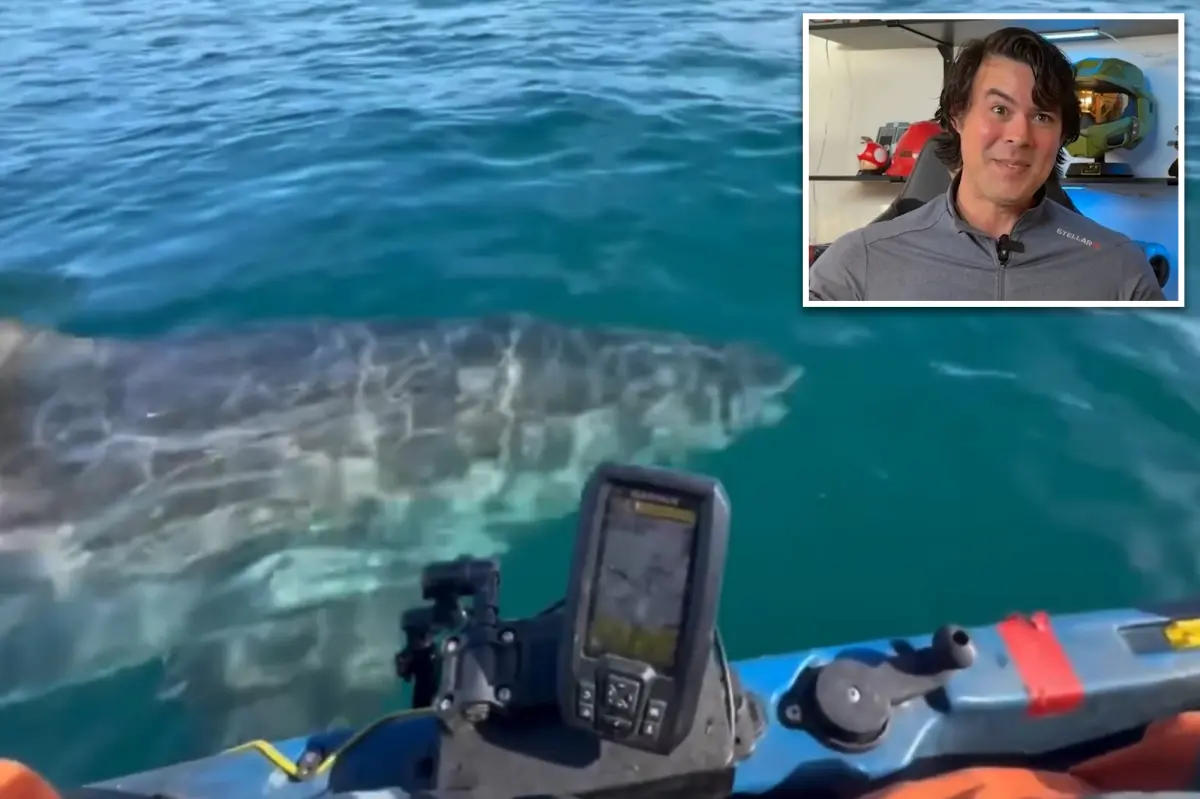
The tranquility of the morning was shattered not by a crash or a roar, but by a sound that Slavich would later describe as a deep, unsettling “woosh.” It was a sound of water being displaced on a massive scale, a sound that didn’t belong to the normal symphony of the bay—not the gentle lap of waves against his hull, nor the distant cry of a gull. It was a sound that triggered a primal, instinctual alarm deep within his nervous system, a feeling that he was not alone. He turned his head slowly, half-expecting to see a curious sea lion or a playful dolphin. Instead, his eyes met a silhouette that instantly froze the blood in his veins. It was massive, dark, and impossibly long, sliding through the water with an effortless grace that was as terrifying as it was mesmerizing. The iconic, triangular dorsal fin, slicing through the surface like a black knife, left no room for doubt or wishful thinking. In that instant, the idle warning from the paddleboarder came roaring back with horrifying clarity. This was not a false alarm. This was not a case of mistaken identity. The creature cruising alongside his small, fragile craft was a great white shark, an apex predator that has haunted human nightmares since we first took to the sea. The sheer scale of the animal was overwhelming; it dwarfed his twelve-and-a-half-foot kayak, making him feel less like a human and more like a piece of chum.
Paragraph 3: An Unblinking Gaze from the Deep
What happened next transcended the realm of mere fear and entered the surreal. As the colossal shark glided past, it turned its head, and its eye found his. Slavich described it as a giant, black orb locking onto his own gaze, a direct and unsettling communion between predator and prey. There was no aggression, no malice in that look, but a profound and terrifying curiosity. It was a moment of raw, unfiltered connection, a silent conversation across the evolutionary divide. “Oh my God, oh my God, there’s a great white shark, oh my God,” he recalled, the words tumbling out as he recounted the encounter. “There is this giant eyeball locking with my eyeballs. It was one of the most surreal moments I’ve ever had in my life.” The shark was close enough for him to see the details of its form, the ancient, powerful lines of its body, the sheer power held in that torpedo-like shape. It was a moment suspended in time, where the human mind struggles to process the reality of what it is seeing, a confrontation with a creature that has existed for millions of years and represents the ultimate embodiment of the ocean’s raw power. Slavich was face-to-face with a living dinosaur, and the experience was both awe-inspiring and utterly petrifying.
Paragraph 4: The Anticipation of the Strike
The moment of locked eyes was just the beginning. As the shark’s immense body began to pass his kayak, Slavich realized he was no longer just a spectator to an awe-inspiring sight; he was the object of its attention. The colossal form was so close that he could feel the displacement of the water rocking his small boat. He watched, his heart hammering against his ribs, as the shark’s tail fin began to near his position. This was the most dangerous moment, the point of no return. His mind raced through a terrifying checklist of scenarios: the shark could easily capsize him, take a bite out of his kayak, or, in a worst-case nightmare, turn on him. Feeling the vulnerability of every limb dangling over the edge, Slavich knew he couldn’t just sit idly by. With a surge of adrenaline, he scrambled to pull his fishing rig from the water, a seemingly futile gesture of defense against such a leviathan. He didn’t want the shark to latch onto the line or become entangled, and he braced himself for the inevitable impact, tensing every muscle in his body, preparing for the boat to be violently rammed or seized from below. The seconds stretched into an eternity, each one filled with the terrifying anticipation of feeling the hull splinter or the water explode around him.
Paragraph 5: The Apex Predator’s Decision
Yet, the impact never came. The great white, after its moment of intense curiosity, seemed to make a decision. With a powerful flick of its colossal tail, it veered away from the kayak, sliding back into the blue-green depths from which it had come. It vanished as silently and quickly as it had appeared, leaving Slavich alone on the surface, shaking, breathless, and utterly stunned by his survival. The encounter was over, but its psychological impact had just begun. The ocean, which had felt like a peaceful sanctuary moments before, now felt like a vast, unknowable wilderness teeming with unseen dangers. Slavich paddled back to shore, his mind replaying the events on a loop. He had stared into the abyss, and the abyss had stared back, then politely excused itself. He later reflected on the event with a surprising sense of rationalism, telling reporters that the encounter proved “they are not interested in eating people. They are pretty curious.” He acknowledged the terrifying irony of his situation, admitting, “that didn’t mean my heart wasn’t beating through my chest, because they can explore my leg a bit and I won’t necessarily survive that exploration.” It was a mature and insightful assessment, but one that came from the precipice of mortal terror.
Paragraph 6: A Changed Perspective on the Water
The experience has fundamentally changed Slavich’s relationship with the ocean. The easygoing confidence he felt that morning has been replaced by a new, ever-present hypervigilance. “Every splash or seagull or anything while I’m out there, I’m hyperaware,” he admitted. The sounds he once dismissed as ambient noise are now potential alarms, signaling a danger he can no longer ignore. He has vowed never to fish alone again, a decision born not of paranoia but of a profound new respect for the power and unpredictability of the sea. He carries with him the vivid image of that giant eye, a constant reminder that even at the top of his own food chain, he is a guest in a world ruled by far more ancient and powerful forces. His story, captured on his phone, serves as a breathtaking testament to the resilience of the human spirit and the sheer, humbling power of nature. It’s a tale that has, no doubt, been retold countless times, a personal epic that begins with a simple fisherman’s quest for a catch and ends with a harrowing, life-altering lesson in humility. For Slavich, the ocean will never be the same; it will always hold that dark, moving silhouette, and he will always be listening for the “woosh.” He’s definitely going to want a bigger boat.