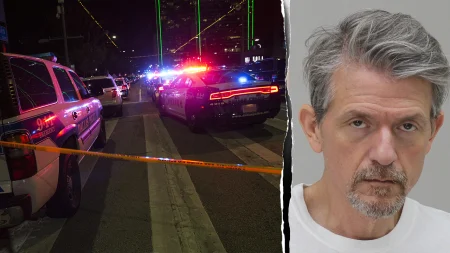




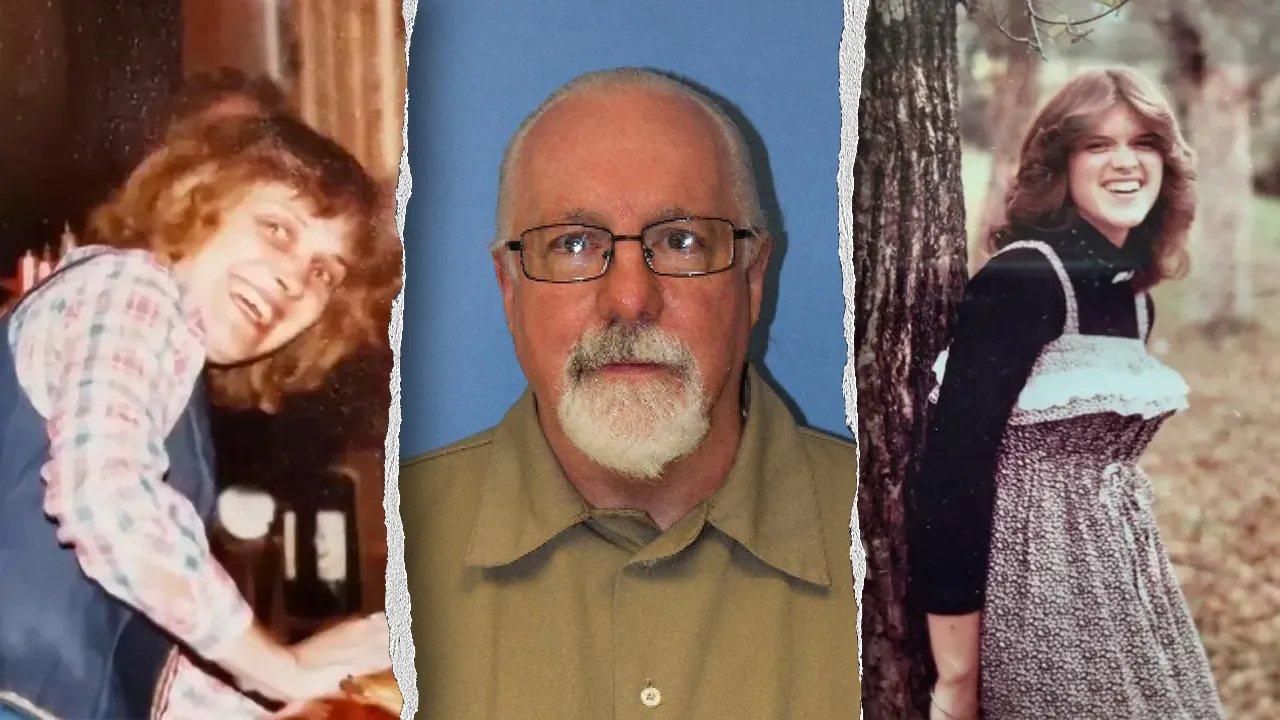
For more than four decades, the truth about Mitchell Gaff remained buried in the dark corners of the Pacific Northwest—hidden behind a string of aliases, a series of institutional failures, and the sheer unwillingness of the system to connect the dots. Long before a discarded piece of chewing gum sealed his fate and linked him by DNA to two brutal cold-case murders in Washington state, Gaff had already confessed to a pattern of sexual violence that should have made him impossible to ignore. During state psychological evaluations, he admitted to committing six rapes, yet those admissions were either not acted upon or not connected to the larger web of harm he was weaving. He was eventually released from civil commitment, allowed to walk free in the community without the restrictions imposed under Washington’s sexually violent predator program, and only years later was he finally held accountable for the murders of Judith “Judy” Weaver and Susan Vesey. In April 2026, Gaff pleaded guilty to both murders, and in May, a Snohomish County Superior Court judge sentenced him to 50 years to life in prison. But the story is not just about one man’s crimes—it is about the victims whose lives were stolen, the families who waited decades for answers, and the haunting possibility that there are more victims still waiting for justice.
The two murders that finally brought Gaff down occurred in the summer of 1984, a time when the Everett, Washington community was reeling from fear and confusion. In June of that year, authorities found Judy Weaver bound, sexually assaulted, and strangled inside her apartment off Rucker Avenue. The scene was horrific: her clothing had been sliced with a knife, and a fire had been set in an apparent attempt to destroy evidence. Weaver was not just a case file—she was a mother, a fiancée, a woman whose daughters remembered the volatile relationship she had with Bill Richards, the man who became the initial focus of the investigation. Richards remained a suspect until his death in 1994, which meant that for years, the case sat in the shadows, waiting for science to catch up. Susan Vesey’s story was just as heartbreaking. She was found beaten and bound inside her Everett home on June 2, 1984—the morning of her 21st birthday. A young woman with her whole life ahead of her, Vesey became another ghost in a case that seemed destined to go cold. It was not until November 2023 that Detective Susan Logothetti of the Everett Police Department submitted evidence from Weaver’s case for modern DNA testing. The breakthrough came through a carefully planned ruse: investigators obtained a DNA sample from Gaff using chewing gum, and in May 2024, authorities arrested him. The DNA evidence not only linked him to Weaver’s murder—it also connected him to Vesey’s death. For the families, it was a moment of long-delayed relief, but also a reminder of how much had been lost.
To understand how Gaff could have slipped through the cracks so completely, one has to look at his history of violence, which was documented long before the murders. In 1979, a jury convicted him of first-degree burglary and second-degree assault after he bound a woman’s hands, repeatedly struck her with a pistol, and smashed her head against concrete before she managed to escape. For that crime, he received probation and work release—a decision that seems stunningly lenient given the brutality of the offense. While still on probation in 1984, the same year Weaver and Vesey were murdered, Gaff broke into an Everett home and raped two teenage sisters, ages 14 and 16, at knifepoint. A judge imposed an exceptional prison sentence of 138 months and revoked his probation, ordering him to serve his sentences consecutively. Even then, the system seemed to recognize that Gaff was not an ordinary offender. He was dangerous, predatory, and capable of extreme violence. But even as he sat in prison, the full scope of his crimes had not yet come to light. Before his scheduled release, Washington authorities petitioned to commit him to a secure facility as a sexually violent predator, and during psychological evaluations, Gaff admitted to much more. He confessed to making obscene calls and to committing sexual assaults, including six rapes. A jury found that he met the legal criteria for civil commitment, and the Washington Court of Appeals upheld that decision in April 1998. A state psychologist diagnosed him with sexual sadism and concluded that he posed a risk of reoffending. A defense expert, however, believed Gaff could live safely in the community under controlled conditions—a prediction that would later prove devastatingly wrong.
The system’s response to Gaff’s dangerousness evolved in a way that placed public safety at risk. By 2005, state evaluators decided that Gaff no longer required maximum confinement and approved his transfer to a less restrictive setting. The following year, he left Washington’s Special Commitment Center on McNeil Island and was moved to a secure halfway house in Seattle’s SoDo district. The arrangement came with conditions: GPS monitoring and supervision whenever he left the facility, and a requirement that he give up his right to challenge his sexually violent predator status for eight years. But in September 2018, a court dismissed his sexually violent predator petition and unconditionally released him from civil commitment altogether. He was free, with no restrictions, no monitoring, no safety net—just a new identity. He later lived in Olympia under the alias “Sam Wise Price.” Dr. Katherine Ramsland, a forensic psychologist and author not affiliated with the case, explained the danger of ignoring a predator’s admissions. “Psychologically, if he’d confessed but discovered there’d be no consequence, he’d likely feel emboldened to potentially repeat it,” she told Fox News Digital. Ramsland also noted the inherent difficulty of holding someone beyond their sentence, saying, “It’s tricky to hold them beyond their sentence, and sometimes it means having to prove they’re an imminent danger, not just a possible one.” That legal standard, meant to protect civil liberties, became a shield for a man who had already proven he was a threat.
Now that Gaff is behind bars, law enforcement is grappling with a chilling question: how many other victims are there? Everett police are actively reviewing unsolved homicides, sexual assaults, and cold cases for possible links to Gaff, and Detective Logothetti has been clear about her belief that this is far from over. “This is ongoing. I absolutely believe there are more victims,” she said when asked whether detectives had reviewed other cases in light of Gaff’s admissions during psychological evaluations. What makes the investigation even more disturbing is what Gaff revealed about his own behavior. Logothetti said that Gaff told evaluators he would often alter his stories “without giving away too much.” He found it amusing to change details in his admissions, knowing that his treatment team did not pick up on the inconsistencies over the years. That calculated manipulation speaks to a level of cunning that allowed him to evade full accountability for more than four decades. Detectives have compared details from Gaff’s disclosures with unsolved cases across Washington and other states, but so far, they have not identified additional victims or crimes since his 2024 arrest or his 2026 guilty pleas. Still, the investigation remains active, and the tip line is open. Gaff’s defense attorney, Heather Wolfenbarger, declined to comment, but the search for truth continues.
For the families of Judy Weaver and Susan Vesey, the convictions bring a measure of closure, but they cannot erase the pain of decades spent wondering whether justice would ever come. There is also a deeper sorrow in knowing that Gaff’s history of sexual violence was documented, that he admitted to rapes, that he was diagnosed as a sexual sadist—and still, the system allowed him to reenter the community without sufficient oversight. His 2018 unconditional release was a catastrophic lapse, one that allowed a known predator to move freely under an assumed name. The case has sparked outrage and raised urgent questions about how society balances the rights of offenders with the safety of the public. It is a story that should serve as a warning: admissions must be taken seriously, patterns of violence must be viewed as predictors of future harm, and the comfort of a legal technicality should never outweigh the safety of potential victims. While the justice system has finally caught up with Mitchell Gaff, the full scope of his crimes may never be known. But the detectives, the families, and the community remain determined. Anyone with information about other potential victims linked to Gaff is urged to call the Everett Police Department tip line at 425-257-8450. No piece of information is too small, and for anyone who has suffered in silence, it may be the first step toward healing.