


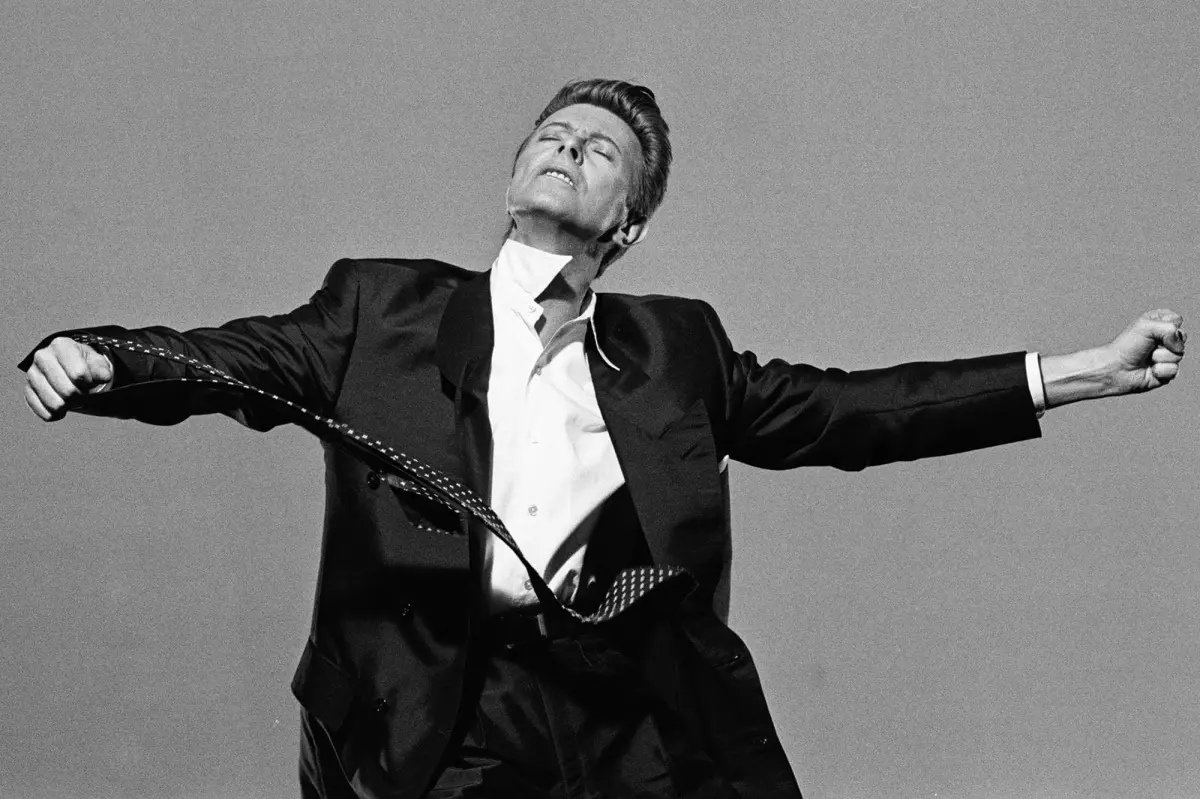
Everyone, at some point, digs deep for inspiration. Even David Bowie. And when the Thin White Duke needed a musical boost, he turned to black vinyl. That, more than anything, is what comes across in the recently published book “Music Lover: The Inside Story of David Bowie’s Record Collection.” Written by Jérôme Soligny, a French music journalist who became Bowie’s record-swapping friend, and Geoff MacCormack, Bowie’s lifelong friend, the book is a warm and carefully researched love letter to a side of Bowie that fans rarely saw: the hungry listener who never stopped looking for the next strange, beautiful sound. His collection was impossibly wide-ranging. It jumped from soul king Bobby Womack to glam rockers Mott the Hoople to rapper Kendrick Lamar. It took in Polish folk ballet, dusty rockabilly singles, avant-garde electronica, and whatever else caught his attention in a record store. The book makes clear that Bowie wasn’t the sort of superstar who only listened to music that matched his image. He was the opposite. He listened like an obsessive fan with no style loyalty, and he used what he found to keep reinventing himself.
MacCormack tells a story that feels like the key to the whole book. He and Bowie were browsing at Tower Records one day when Bowie pulled out a Polish folk ballet album called “Helokanie.” Most people would have shrugged at it. Bowie, instead, took it home, basically rearranged the thing, and made up his own words. The result, as MacCormack remembers it, eventually became something on one of his German albums—likely Low, from the Berlin era. It is a perfect little snapshot of how his mind worked. He didn’t simply enjoy music; he dismantled it and rebuilt it in his own image. A forgotten Eastern European ballet record could become part of a masterpiece by one of rock’s greatest chameleons. That is the kind of magic the book is full of—not the magic of a godlike star, but the everyday magic of a curious, restless person who treated the entire world as material.
Bowie also understood that greatness often wears a strange face. His most iconic alter ego, Ziggy Stardust, was rooted, at least in part, in the name of a Texan eccentric called the Legendary Stardust Cowboy. The Cowboy, who recorded a few singles for Mercury Records in the 1960s—the same label Bowie was signed to—was not exactly a mainstream success. But Bowie loved the grandeur of his name and the weirdness of his music. He paid tribute to the Cowboy by inviting him to perform at the 2002 Meltdown Festival in London, which Bowie curated, and by recording a version of the Cowboy’s otherworldly song “I Took a Trip (On a Gemini Space Ship)” on his 2002 album Heathen. It was a very Bowie move: taking someone whom the world had largely dismissed and treating them like an essential artist. This pattern ran through his whole life. Bowie also praised Florence Foster Jenkins, the famously terrible opera singer who could not hold a tune to save her life, but who performed anyway with absolute conviction. As Soligny points out, Bowie loved the idea of someone saying, “People can say I can’t sing, but no one can ever say I didn’t sing.” That idea—that the effort and the daring matter more than perfection—stayed with Bowie throughout his career. He understood that you could do something interesting and not have everyone get it. Even what looked like a mistake could be a gift. Soligny reminds us of the famous piano sound in “Ashes to Ashes.” It came from a keyboard that wasn’t working the day they recorded the song. They used it anyway, and it became a defining sound. Bowie believed in accidents, in the ragged edges, in letting the world in with all its flaws. The artists he admired were often the ones who refused to smooth themselves out: the outsiders, the eccentrics, the people who went ahead and said what they meant even if their voice cracked.
Sometimes Bowie’s love for a band was more direct and personal. Take the indie rockers Grandaddy, a California band with a tender, homemade sound that seemed miles away from the glossy world of stadium stardom. Bowie heard their 2000 album “The Sophtware Slump” and fell hard for it. He praised it in public, talked it up during an appearance on “Jimmy Kimmel Live!,” met the band backstage at a couple of shows, and even shouted out requests from his seat when he saw them perform at the Beacon Theater in New York. For Grandaddy’s frontman, Jason Lytle, the experience was almost surreal. “It was such a confidence boost,” Lytle said. “If you have David Bowie over there, saying he loves the band, then it’s, like, screw everyone else.” The validation of a hero can change the way an artist sees themselves, and Lytle clearly never forgot it. What did Bowie hear in Grandaddy? Lytle has his own theory. “I’m hoping he honed in on our sincerity,” he said. “The album was made scrappily in a little farm house where we tried to make something way beyond our knowledge and reach. Perhaps he tapped into that.” That idea—trying to make something beyond your reach—could describe Bowie’s own method. He wasn’t drawn to polished perfection. He was drawn to the effort, the stretch, the human sound of someone reaching for something they couldn’t quite grasp. Grandaddy might have seen themselves as the underdogs, but Bowie saw a reflection of the creative struggle he knew so well. He wasn’t just handing them a compliment; he was recognizing a kinship. In a way, that’s the best thing one artist can do for another: not just say “great work,” but enter the work, live in it for a while, and let the artist know they were seen.
Of course, Bowie was a superstar, and that came with certain perks. He was not beyond sending assistants off on record-buying sprees. In an unverified note that turned up on Reddit, he asked someone from RCA Records to pick up albums by the Stranglers, Ultravox, and the Damned before an impending trip to what he playfully called “Swizzleland.” That is hardly the image of Bowie as a brooding genius; it’s the image of a man who needed fresh music the way other people need air. But he also loved to do his own browsing. In Manhattan, he would stop by House of Oldies Rare Records in Greenwich Village, where owner Bob Abramson remembers him kindly. “His hair was fluffy, and he was extremely nice,” Abramson recalled. This was not a celebrity making scenes. Bowie knew what he wanted. He collected rare records, lots of rockabilly, like Carl Perkins and Gene Vincent. He bought a first pressing of a Larry Williams album—the man who wrote “Bony Moronie” and “Dizzy, Miss Lizzy”—for around $200, which was a significant sum at the time. He was a serious collector with serious taste, but he was also a regular guy browsing the racks. Not every shop owner was as respectful of Bowie’s low-key approach. At Bleecker Bob’s Golden Oldies, the legendary punk-centric record store, owner Bob Plotkin was a loveable curmudgeon who could not resist having fun with his famous customer. As Jennifer “JK” Kitzer, Plotkin’s girlfriend and partner, told Dylan Jones for his Bowie biography, “Bowie came into the store and Bob called him ‘Davie’ before putting on Bowie’s silliest song, ‘The Laughing Gnome.’ Bowie got embarrassed but loved it.” It was a perfect moment: a man who helped define cool, made human by a shopkeeper who refused to treat him like a god. The same visit had a practical side too. Before touring with Nine Inch Nails in 1995, Bowie bought lots of techno stuff from Bleecker Bob’s. He was always prepping for the next chapter, always loading his brain with new sounds. Even when he was being teased, he was also working. That combination of seriousness and play is what made his record shopping so important to his art.
Some of the most meaningful records in Bowie’s life came from the people closest to him. Geoff MacCormack, who knew Bowie from childhood, was more than just a friend—he was part of the creative ecosystem, someone who shared travel, stages, and endless hours of music talk. For years, MacCormack and Bowie traded recommendations by text and email. It was a running conversation, a friendship conducted in sound as much as words. But it had to end, as all such conversations eventually do. MacCormack sounded a little sad when he remembered the last recommendation he sent to Bowie. It came in late August 2015, only a few months before Bowie died. The suggestion was a YouTube clip from an experimental band called Algiers. Bowie checked it out and wrote back with a message that is equal parts love and profanity: “Geoff, your music choices are so on the money, every time. I’m so glad you’ve been my friend all these years. I miss you lots — now f–k off!!” MacCormack, understanding that Bowie was responding in the spirit of their friendship, wrote back, “Yes, likewise pal. Off and f–ked.” Bowie replied: “Mission accomplished.” There is something perfect about that exchange. It shows the bond between two people who don’t need to say anything fancy to say everything. Bowie was not the distant demigod of myth; he was a man who, even near the end of his life, was still excited enough about a friend’s music recommendation to reach out with one last joke. The fact that “Mission accomplished” was his final message—at least in that exchange—feels right. He had been telling the truth: his friend’s music choices were always spot on. And he had let his friend know he was loved. That little text thread, preserved in memory, is a small treasure, and it humanizes Bowie in a way no official biography ever could.
In the end, Music Lover is about more than just records. It is about the way art passes through us and connects us. David Bowie was able to make so much and change so often because he was always paying attention. He listened to Polish ballet records and Texan oddballs and indie bands from California and experimental artists from wherever they could be found. He took the weird and the rough and the unwanted and turned them into something beautiful. He also gave back. He championed bands like Grandaddy, invited forgotten heroes like the Legendary Stardust Cowboy to perform, and adored outsiders like Florence Foster Jenkins who refused to be silenced by their limitations. He understood that music was not a ladder to be climbed but a web of influences, kindnesses, and exchanges. A record store clerk’s teasing, a friend’s late-night YouTube link, a broken keyboard, a ridiculous folk ballet album—these were the ingredients of his genius. What makes Bowie so enduringly beloved is not just his own records, though those are extraordinary. It’s that he was a fan. He could have stayed on a pedestal, but he kept getting his hands dirty, digging through crates of vinyl, writing charming profane texts to old friends, and treating music as a living conversation. That is why these stories matter. They remind us that inspiration is not a mystical gift from above. It’s something we find when we stay curious, when we listen well, and when we allow ourselves to be moved by unexpected things. Bowie’s last message to his best friend was “Mission accomplished.” It’s tempting to read it as a summary of his whole life. He made the music he wanted to make. He stayed true to the people who mattered to him. And he never stopped learning from a stack of old records. The mission, indeed, was accomplished. For anyone who loves music, that mission continues—and we can still borrow a page from Bowie’s record collection.