

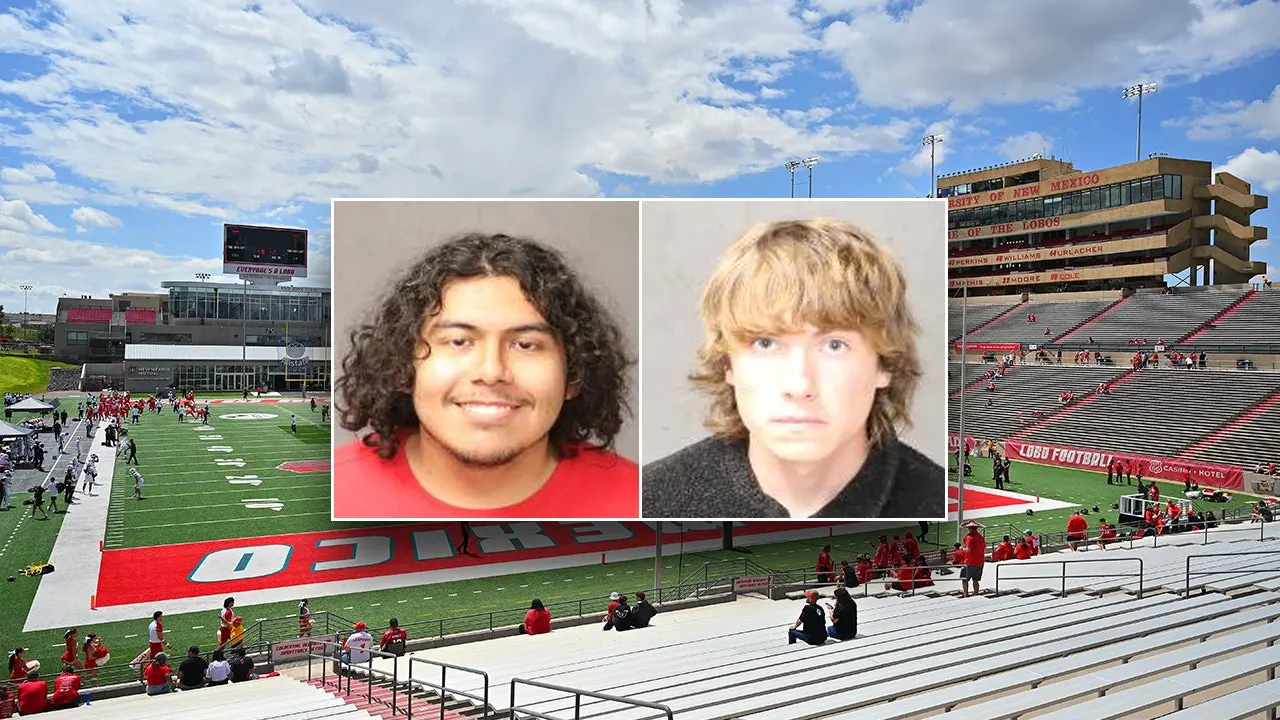
It begins with a microphone, a crowd, and a single moment that splits the air—someone shouts, someone pushes, someone throws. On Monday, at the University of New Mexico, that moment arrived during a Turning Point USA event, when two men were arrested after police said they plotted to hurl objects at people in the audience. Kevin Castro and Harrison Magnus, both identified in court documents as attendees of the campus event, now face criminal charges that could change the trajectory of their lives. The event itself, a “Prove Me Wrong” debate-style gathering hosted by the university’s TPUSA chapter, featured Kristan Hawkins, the president of Students for Life of America, and was meant to be an exercise in open dialogue. Instead, according to police, what unfolded was something far darker: a lacrosse ball thrown toward a crowd, a young man shouting while being handcuffed, and a campus community left to ask how a forum designed for persuasion turned into a scene of alleged violence. These are not isolated emotions in an increasingly divided country—they are symptoms of a moment when political conviction too often curdles into contempt, and contempt into action. And yet, behind every police report and charge are people, each with their own story, their own frustrations, and their own failure to find another way to be heard. That is the human truth at the center of these incidents, and it deserves more than a headline.
The University of New Mexico incident unfolded with alarming speed, leaving students and staff to piece together what had gone wrong. According to KRQE, which first reported the arrests, Kevin Castro and Harrison Magnus were taken into custody by the University of New Mexico Police Department after attending the TPUSA event. Court documents did not explicitly name the event, but the university’s Turning Point USA chapter had hosted a “Prove Me Wrong” event that day, a format that invites speakers to defend provocative positions while audiences challenge them. For many, such events are an opportunity for energetic but peaceful debate; for others, they become a stage for performative outrage. In this case, police allege that Castro hurled a lacrosse ball toward the crowd, nearly striking someone. That single act transformed what might have been a heated conversation into a criminal matter. Castro was arrested on charges of aggravated assault with a deadly weapon, disorderly conduct, and conspiracy. Magnus, meanwhile, was accused of talking with Castro about plans to throw objects into the crowd, and he was arrested on charges of conspiracy, disorderly conduct, and concealing identity. Video posted online by the Turning Point USA chapter shows Magnus appearing to yell at the crowd as police officers placed him in handcuffs. The image is jarring: a young man, face flushed, voice raised, being led away while onlookers watch. It is impossible to know exactly what was going through his mind in that moment, but the scene speaks to a broader tragedy—when people feel unheard, they sometimes act out in ways that ensure they are remembered for all the wrong reasons. The lacrosse ball, if it really flew as described, was not just a weapon; it was a symbol of a conversation that had utterly broken down.
The university’s response to the arrests was measured, careful, and perhaps instructive for institutions across the country wrestling with similar tensions. A University of New Mexico spokesman confirmed the arrests to Fox News Digital and issued a statement that tried to balance two essential commitments: protecting free expression and ensuring campus safety. “UNM remains committed to providing a safe, healthy and inclusive environment for all who learn, work and live on our campuses,” the spokesman said. “The university upholds freedom of expression and will not tolerate threats, violence or other conduct that violates the law or university policies.” Those are strong words, but they also reflect a difficult reality. American universities are now the front lines of the culture wars, where national controversies play out in dormitories, lecture halls, and student unions. For every student who believes that holding a controversial speaker is an act of courage, there is another who sees the same event as a provocation. The challenge for administrators is to hold the line between allowing uncomfortable speech and preventing physical harm. It is a narrow line, and it is getting harder to walk. Fox News Digital reached out to an attorney for Magnus, but it was not immediately clear if Castro had obtained legal representation. In the absence of lawyers, the public is left with a story of two young men whose choices may have been impulsive, misinformed, or even out of character. Perhaps they attended the event looking for a fight, or perhaps they simply got caught up in the heat of the moment and made a terrible decision. Either way, their lives are now marked by a criminal record, and the people they allegedly endangered are left with the unsettling knowledge that a campus gathering could have turned violent. The tragedy is that no one seems to have stopped to ask, “What are we really arguing about?”
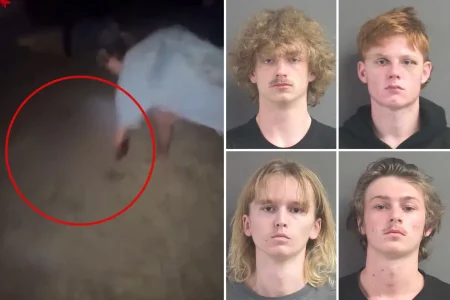
Just one day later, another incident illustrated that this problem is not confined to college campuses or young people. In Laconia, New Hampshire, a 70-year-old poet named Stephen Redic was arrested after he allegedly slapped a Turning Point Action member in the face outside a polling location. According to the Laconia Police Department, officers took Redic into custody at around 8 a.m. Wednesday, charging him with simple assault, a misdemeanor, and disorderly conduct, a violation. The details, as described by police, are almost absurdly human. Redic approached the Turning Point tent and said he wanted to read a poem about rich people. Maybe he imagined himself as a modern-day troubadour, bringing art to the political battlefield. Maybe he wanted to provoke a reaction, or perhaps he genuinely believed his words could pierce the partisan noise. But the encounter did not go as he might have hoped. Video of the encounter shows him growing increasingly agitated, shouting at the young man, flipping him off, slapping him across the face, and walking away. It was a shocking sequence, made more surreal by the fact that the accused is a senior citizen with a poetic sensibility. Turning Point USA said the victim is an 18-year-old, a young person barely out of childhood, standing at a polling place perhaps doing volunteer work, and suddenly finding himself the target of a stranger’s rage. Redic, by contrast, has lived seven decades, enough time to learn that violence rarely solves anything. And yet, in that moment, age did not bring wisdom. It brought a flash of anger and a pair of criminal charges. The image of a 70-year-old poet slapping an 18-year-old activist is almost painful to contemplate because it reduces both people to their worst impulses. The old man becomes a caricature of bitterness; the young person becomes a symbol of political tribalism. But they are more than that. They are a poet and a volunteer, a grandfather and a son, two people who, on any other day, might have shared a polite conversation.
These two incidents, separated by a day and by more than a thousand miles, are connected by a single thread: the collapse of patience. Whether it is a college student throwing a lacrosse ball or a senior citizen slapping a stranger, the underlying emotion is the same—a belief that the other person is not merely wrong, but contemptible, and that ordinary channels of disagreement have failed. This is a dangerous way of thinking, and it is spreading. We see it in the comments sections of social media, in the screaming matches at town halls, and now in the physical attacks at political events. The result is a public square that feels less like a marketplace of ideas and more like a battlefield. For young people, especially, the pressure is enormous. They are coming of age in an environment where political identity is often treated as the core of who a person is, and where disagreement is interpreted as an attack. That makes it easier to justify actions that would have been unthinkable a generation ago. But the problem is not limited to the young. The New Hampshire poet, a man who has presumably seen war, protests, and countless political cycles, chose violence over words in a matter of minutes. If a 70-year-old cannot model restraint, what hope is there for the rest of us? The answer, perhaps, lies in the very events that brought these people together. Turning Point USA and groups like it will continue to host events, and counter-protesters will continue to show up. The question is whether we can learn to attend these gatherings without letting our anger consume us. It is possible to disagree passionately without throwing objects. It is possible to mock a political opponent without slapping them. It is possible to walk away from a tense situation with dignity intact.
Ultimately, the arrests at the University of New Mexico and the assault in New Hampshire are not just stories about legal consequences; they are stories about the human cost of a fractured society. Kevin Castro and Harrison Magnus now face serious charges, and their futures are clouded by a single afternoon. Stephen Redic, a poet who probably wanted nothing more than to be heard, is now a criminal defendant at age 70. The victims, too, are left with scars—the student who nearly got hit with a lacrosse ball, the 18-year-old who was slapped in the face, and all the people who witnessed these acts and wondered if they were safe. It would be easy to dismiss these incidents as isolated cases of bad behavior, but that would be a mistake. They are symptoms of a deeper sickness, a refusal to see each other as fully human. When we reduce our opponents to enemies, we give ourselves permission to hurt them. The cure is not more security, more laws, or more police presence—though those may be necessary. The cure is empathy, the willingness to listen to someone with whom we deeply disagree, and the courage to say, “I hear you, and I still think you are wrong.” That is hard work, and it is not glamorous. It does not make for good television or viral videos. But it is the only way forward. The young men in Albuquerque and the old poet in New Hampshire had a chance to make a different choice. They did not. But the rest of us still do. We can choose to walk away from the edge, to find common ground in our shared humanity, and to remember that the person across from us is not a symbol or a stereotype, but a person. If we can do that, perhaps the next event will end not with handcuffs, but with conversation. And that would be a victory for everyone.