

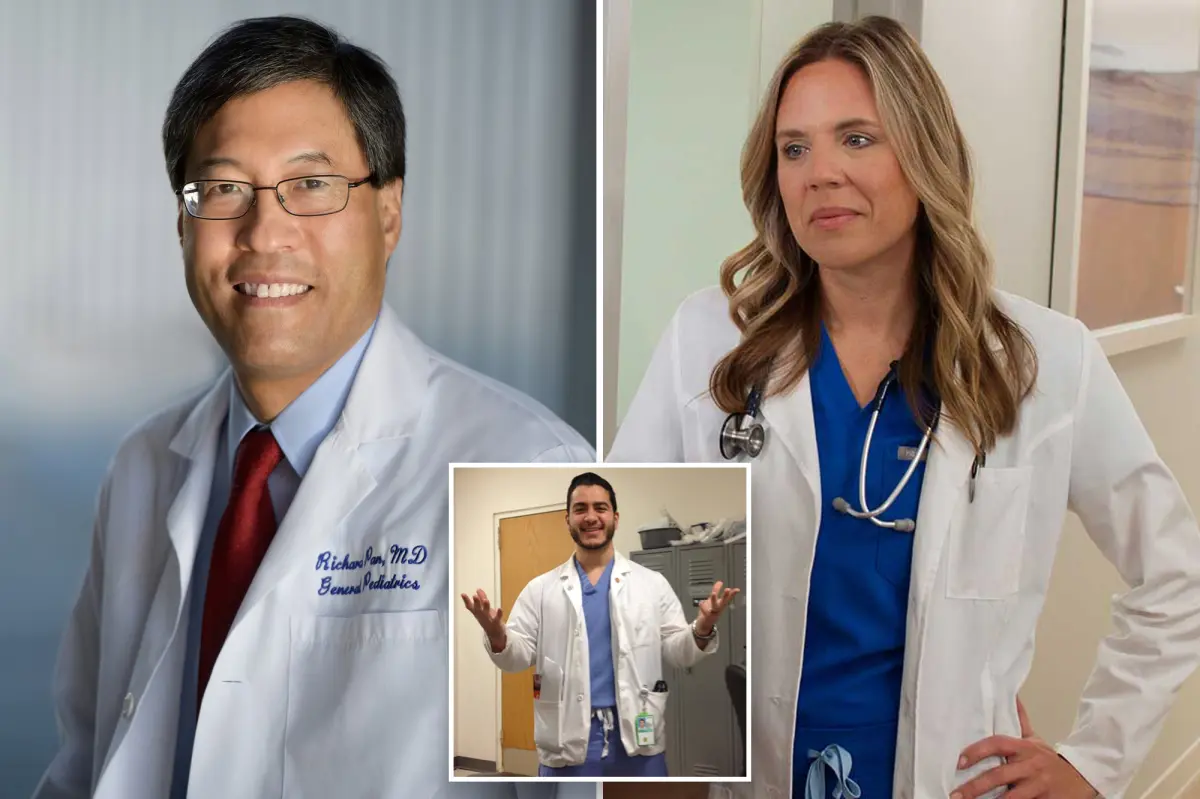
There has rarely been a clearer signal that the boundaries between medicine and politics are collapsing. In this midterm cycle, a record nineteen Democratic doctors and scientists won election to Congress, many of them backed by a dark-money network funded in large part by billionaire philanthropist George Soros and his son Alex. The organization behind the push is 3.14 Action, a political action committee whose stated mission is to find STEM leaders who share progressive values, recruit them to run for office, and then support them with training, staffing, polling, strategic guidance, and money. This year the group doubled its investment, pouring $23 million into candidates and producing more than 2,300 advertisements that aired hundreds of thousands of times in the final weeks of the campaign. Many of those ads highlighted the candidates’ medical backgrounds, reinforcing the message that the new arrivals were not ordinary politicians but healers coming to fix a broken system. Their legislative priorities are unmistakably progressive: abortion rights, climate change, gun violence prevention, vaccine access, and a broad commitment to what is often called gender-affirming care. To their supporters, these nineteen men and women represent a long-overdue opportunity to bring evidence, compassion, and science into a health-care debate that has too often been dominated by lobbyists and ideologues. To their critics, they are something darker: an ideological army that has figured out that wearing a white coat and using words like “public health” can launder left-wing politics into seeming neutrality. The phrase “woke” is now a familiar insult, and former Trump adviser Theo Wold has accused the left of trying to use scientific credentials to hoodwink voters. But behind the partisan slogans are real people with real stories—doctors who have sat beside dying children, scientists who have stared at data maps, activists who have filed lawsuits and written papers. The country is about to see what happens when those people stop advising and start governing.
Take Dr. Annie Andrews, a 46-year-old pediatrician from South Carolina who stunned everyone by winning a Senate seat that had long been considered safely Republican. Andrews had never run for office before. Her early career was centered on asthma, a condition that disproportionately affects poor and minority children, and her first research was largely clinical. But around 2020, something shifted. She began writing and publishing about gun violence, firearms storage, and the social determinants of health. Over time, her output grew to 63 research papers, and a significant portion of them have clear political themes. One study, titled “Pediatric Hospitalists at the Front Line of Gun Violence,” promoted responsible gun storage. Another, published in the Journal of Pediatrics in 2022, examined racial and ethnic disparities in tonsillectomy among Medicaid-insured children and called for culturally appropriate interventions. In 2024, she wrote an op-ed in JAMA with the headline “It Is Time to Get Political for Children,” in which she explained that she was making a hard pivot into politics because of the gun safety, gender-affirming care debates, and vaccine wars she saw in her clinic. She has been especially vocal in support of puberty blockers and cross-sex hormones for minors, telling audiences that “gender affirming care isn’t child abuse.” That position made her a target of conservative media, but it also made her a favorite of 3.14 Action, which saw in her a perfect messenger: a relatable mother-doctor with a soft voice and a steel spine. Since winning, Andrews has made clear that her first priority will be confronting Health Secretary Robert F. Kennedy Jr. She has called him her “professional archnemesis” and said she will work to impeach him. To her fans, she is a fearless advocate for children. To her critics, she is a pawn of dark money who has traded medical objectivity for a seat at the political table. What no one can deny is that she is no longer a long shot—she is now a United States senator with a national platform.
Richard Pan’s route to Congress was even more deliberate. A 61-year-old pediatrician from California, Pan built his reputation as a vaccine warrior. In 2015, he recruited Sacramento parents to launch Vaccinate California, a campaign that successfully pushed for a state law banning personal-belief exemptions for school vaccine requirements. The law made California one of the strictest vaccine states in the country, and it made Pan a hero to public-health officials and a villain to civil-liberties groups. His research portfolio extends beyond virology: he has written papers with titles like “Enhancing the Racial and Ethnic Diversity of the Pediatric Workforce” and “Nondiscrimination in Pediatric Health Care,” part of a broader academic project to weave social justice into medical education. When he decided to run for federal office, he did not hide his intention: he told reporters that one of his main motivations was to get Robert F. Kennedy Jr. under oath and force him to answer for the anti-vaccine message that Pan believes has cost lives. Then there is Jamie Ager, who flipped a House seat in North Carolina after campaigning as an environmental scientist. Ager’s scientific credentials are slim: he holds an undergraduate degree in environmental studies and history from Warren Wilson College, a small liberal arts school, but he has no graduate degree, no peer-reviewed research, and no professional licensing as a scientist. That did not stop 3.14 Action from promoting him as an expert on climate change. His victory suggests that in the new political landscape, the image of scientific authority matters more than the substance. Ager may not know how to model sea-level rise, but he knows how to tell a story, and that was enough. Together, Pan and Ager show the range of the new doctor-scientist bloc: one is a policy wonk with decades of clinical experience; the other is a messenger whose appeal depends on identity and narrative. Both are now in a position to influence the future of American health policy.
The new majority also includes Dr. Adam Hamawy, a 57-year-old Egyptian-born plastic surgeon from New Jersey who won a House seat after traveling to Gaza to treat patients. For Hamawy, the campaign was not simply about policy; it was about presenting himself as a moral alternative to the cynicism of Washington. But his past is full of shadows. The Investigative Project on Terrorism, an organization that tracks extremist activity, has accused him of lying under oath when he testified as a defense witness for the “Blind Sheikh,” Omar Abdel-Rahman, who was convicted for his role in the 1993 World Trade Center bombing. Hamawy accompanied the sheikh to an Islamic conference in Detroit in 1991, and while he was never charged with perjury, the incident has been a recurring topic of controversy. Even more troubling, he volunteered in Bosnia with a Chicago-based charity whose offices were raided by federal agents in 2002 after being determined to be a front for al-Qaeda. Hamawy has repeatedly refused to answer questions about those associations, and his campaign did not make things easier by trying to change the subject. His medical career has also raised warnings: some online reviews describe him as “creep,” and a 2017 lawsuit alleged that a botched neck lift left a patient permanently injured. It is worth noting that none of these accusations have resulted in criminal charges, and his defenders argue that he has devoted his life to healing people in some of the most dangerous places on earth. They also say that his work in Gaza demonstrated a commitment to human life that few critics can match. But the sheer volume of unanswered questions makes Hamawy a risky figure for a bloc that wants to claim the moral high ground of evidence and ethics. Voters will have to decide whether his humanitarian credentials outweigh the warning signs in his past.
No one embodies the strange intersection of medicine, identity politics, and power more than Abdul El-Sayed, the senator-elect from Michigan who calls himself a physician even though he never completed a medical residency and has never held a medical license. El-Sayed does hold a medical degree from Columbia University, and that degree was funded by a grant from the Soros family for new Americans, a detail that has become a favorite talking point for his enemies. In academia, he produced research that has been attacked by scholars across the political spectrum. One Columbia paper, widely criticized as an exercise in eugenics, suggested that Arab women should limit childbearing to partners from their own ethnic group in order to achieve better health outcomes. That paper follows a pattern, according to earlier reporting, in which El-Sayed used his identity as a Muslim American and son of immigrants to gain funding and visibility far beyond what his scientific record would normally merit. His campaign for the Senate was built on the same foundation: he did not run as a policy specialist with a detailed health-care plan, but as a progressive intellectual who would fight the establishment, especially RFK Jr. He has already promised to launch a probe into the Health Secretary’s Make America Healthy Again movement. Theo Wold, who served as a White House deputy assistant for domestic policy under Trump, offered a sharp critique of people like El-Sayed, calling it “just the left trying to capitalize on their complete occupation and control of higher education and academia.” Wold’s key argument is that figures such as El-Sayed “want to use scientific credentials to hoodwink voters into trusting so-called scientific expertise that is just leftist ideology with a veneer of STEM terminology.” There is no question that El-Sayed is intelligent and articulate; there is also no question that his path to power would have been far more difficult without the Soros money and the identity-based support he cultivated. In a profession that prizes evidence, he has made trust a matter of identity. The voters who sent him to Washington knew what they were getting, and now they will watch to see whether he can translate his personal narrative into actual policy.
All of these figures were not simply discovered; they were cultivated. 3.14 Action, the committee behind the push, has built a complete political machinery focused on grooming STEM professionals. Its website describes its mission as identifying scientists, doctors, engineers, and other technical experts who share a progressive worldview, recruiting them to run, and then supporting them all the way to Election Day. This cycle, it produced over 2,300 ads that aired hundreds of thousands of times in October alone, many of them carefully designed to highlight the candidates’ stethoscopes, white coats, and commitment to public health. The group’s issue agenda is explicit: abortion rights, climate change, and gun violence are the top three. It has also made no secret of its hostility to Health Secretary Robert F. Kennedy Jr., whom it calls its “number one villain.” With their new House majority, Democrats now possess the power to issue subpoenas in congressional investigations, and the newly elected doctors and scientists have made clear they intend to use that power. Pan has said he wants to question RFK Jr. under oath. El-Sayed has promised to investigate him. Andrews has gone even further, vowing to introduce articles of impeachment. The money trail behind this new bloc is complex but transparent enough: records show that George and Alex Soros’s Open Society Action Fund gave $34.4 million in 2024 to Our American Future Action, which donated $9 million to House Majority Forward, which in turn gave $2.5 million to 3.14 Action. RFK Jr. did not respond to requests for comment. What all of this means for ordinary Americans is still uncertain. It is possible that the nineteen newcomers will use their medical backgrounds to craft more thoughtful, humane policy. It is also possible that they will simply add another layer of polarization to an already fractured system, using their credentials as shields and their working-class childhoods as weapons. Either way, the message of this election is clear: doctors are no longer content to treat the symptoms of America’s dysfunction. They want to change the system itself, and with the help of dark money and sophisticated media, they now have the power to try.