


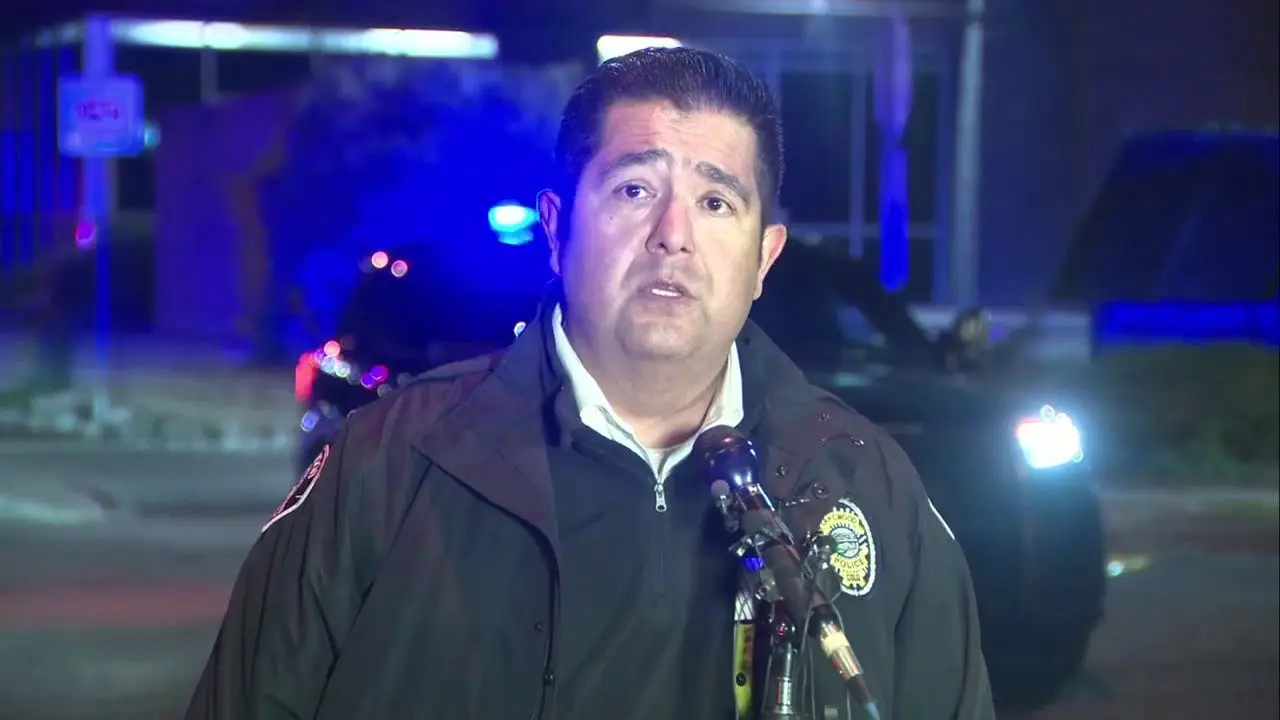
On an otherwise ordinary Thursday evening, the quiet streets of Lakewood, Colorado, became the site of a devastating act of violence that would leave a community shaken and a police department grieving. It was around 6:30 p.m. when officers responded to a report of a suspicious person near the busy intersection of Colfax Avenue and Wadsworth Boulevard—an area familiar to commuters and residents alike. What began as a routine check on a possible threat quickly spiraled into a nightmare. The officers encountered an individual who appeared to be attempting to board a Regional Transportation District (RTD) bus, and within seconds of their approach, the situation erupted into gunfire. According to Lakewood Police Public Information Officer John Romero, the suspect opened fire on the officers, striking four of them. The suddenness and brutality of the attack underscored the unpredictable dangers that law enforcement officers face every single day, often with little or no warning. As the initial reports came in, sirens filled the air, and the neighborhood was quickly cordoned off by emergency responders. For the families waiting at home, the news was agonizingly slow to arrive, and for the officers on the scene, the nightmare was only beginning.
The aftermath of the shooting brought both sorrow and uncertainty. Four Lakewood police officers had been hit by gunfire, and despite the best efforts of medics and hospital staff, one of them did not survive. Romero, visibly emotional, delivered the devastating news during a late-night press conference, his voice heavy with grief. “We are very sorry to report that one of those agents has been pronounced dead of their injuries,” he said. The loss was immediate and profound, and the department found itself thrust into a world of pain, mourning the death of a colleague who had gone to work that day expecting to protect and serve, not to make the ultimate sacrifice. The three other officers were rushed to area hospitals, their conditions still unknown in the hours after the shooting. A civilian, who happened to be in the wrong place at the wrong time, was also injured and taken to a local hospital for treatment. The suspect, who had initiated the violent exchange, was shot by police and pronounced dead at the scene. Yet the confirmation of the suspect’s death provided little comfort. The lives forever altered, the families who would never see their loved ones again, and the lingering question of why it all happened left a heavy cloud over the community. For the surviving officers, the road ahead would be long, filled with physical recovery and emotional scars that might never fully heal.
In times of tragedy, the true character of an institution often emerges, and the Lakewood Police Department responded not only with professionalism but with profound heart. Romero’s words during the press conference were not just a briefing; they were a heartfelt message to the fallen officer’s family, and to the entire department family. “We just want the family to know that we love them, that we’re here for them, and Lakewood Police Department is a family, and we will be here for each other,” he said. Those words, spoken through the haze of shock and sorrow, revealed the deep bonds that exist within law enforcement communities—bonds that are forged through shared danger, shared duty, and shared sacrifices. The fallen officer was not just a badge number or a public servant; they were a mother, father, son, daughter, or spouse, someone with dreams, laughter, and a life that was cut brutally short. In the days to come, the department would rally around the grieving family, providing support, solace, and the promise that their loved one’s sacrifice would never be forgotten. Meanwhile, the three injured officers fought for their recovery in hospitals, surrounded by comrades who stood vigil, their hearts heavy with gratitude and dread. The entire city of Lakewood, and indeed the broader Denver metro area, felt the shockwaves of the tragedy. Flags were lowered, moments of silence were held, and ordinary citizens found themselves grappling with the harsh reality that those who wear the badge are never truly safe.
Colorado Governor Jared Polis was among the many public officials to respond with condolences and resolve. In an official statement, he acknowledged the profound sacrifice made by the fallen officer and extended his heartfelt sympathy to their loved ones. “Law enforcement put their lives on the line for our safety everyday and I am heartbroken to learn that a Lakewood Police Agent was killed in the line of duty this evening,” Polis wrote. He went on to express his thoughts and prayers for the three additional officers still receiving care at area hospitals, as well as the civilian who had been wounded, wishing them a full and speedy recovery. The governor’s words carried the weight of shared grief, but they also spoke to a broader truth about the role law enforcement plays in society. Every day, officers leave their families and step into the unknown, never knowing whether they will return home at the end of their shift. They run toward danger so that others can flee from it, and they make split-second decisions that can have life-or-death consequences. Polis also noted that the Colorado State Patrol was assisting at the scene and participating in a procession from the hospital honoring the fallen officer. That procession, with its rows of flashing lights and saluting officers, became a powerful visual symbol of the respect and gratitude owed to a hero who made the ultimate sacrifice. It was a reminder that even in the darkest moments, the thin blue line stands strong, united in grief and solidarity.
As the investigation into the shooting began, the Jefferson County Critical Incident Response Team took the lead, with support from the Colorado Bureau of Investigation. The meticulous process of piecing together exactly what unfolded in those harrowing moments would take time, involving interviews, forensic evidence, ballistic analysis, and a thorough review of body-worn camera footage. It was a painstaking effort born out of the need for accountability, transparency, and a complete understanding of the events that led to the climax on that busy street corner. Meanwhile, the Regional Transportation District, whose bus had been at the center of the encounter, released a statement expressing its deep concern over the incident. “Our thoughts are with those affected directly by this incident,” the statement read. “The safety and well-being of our customers, employees, and partners remain our highest priority.” The mention of the bus was a stark reminder that this tragedy unfolded in a very public place, where ordinary members of the community might have been boarding or waiting nearby. The civilian who was wounded in the crossfire served as a sobering reminder that the consequences of such violence rarely remain contained. The investigative team would also work to understand the suspect’s background, motives, and mental state, searching for answers that might help prevent future tragedies. Yet in the immediate aftermath, all anyone could do was mourn, support the victims, and cling to the hope that the injured would somehow find their way back to health.
Beyond the official statements and investigative procedures lies the human core of this tragedy—a story of lives interrupted, families shattered, and a community left to pick up the pieces. The officer who lost their life did not intend to become a statistic. They had likely kissed loved ones goodbye that morning, made plans for the weekend, and carried the quiet pride that comes with a career dedicated to public service. The three wounded officers now face a long and uncertain journey, their bodies healing slowly while their minds replay the sudden explosion of violence that nearly ended their lives. Their courage, and the courage of every officer who answered the call that evening, is a testament to the enduring spirit of those who choose to protect the innocent. To the civilian injured in the chaos, we offer a wish for recovery, despite the trauma of being swept up in an event no one could have anticipated. And to the suspect—a person whose own demons or desperation led to such a catastrophic act—we are left with unresolved questions and a sense of profound loss for all involved. Violence solves nothing, but it leaves everything in ruins. In the days ahead, the city of Lakewood will hold vigils, share memories, and begin to heal. The fallen officer will be honored with a funeral marked by solemn ceremony and tearful tributes. The surviving officers will lean on each other, on their families, and on professional counselors who understand the weight of trauma. And the community will slowly return to their routines, forever changed but determined not to forget. In the end, what remains is a profound appreciation for those who wear the uniform, a renewed commitment to supporting law enforcement, and an enduring hope that such senseless tragedies may one day be no more. We are all connected by moments like these, and in remembering the fallen, we honor the best of what it means to protect and serve.