

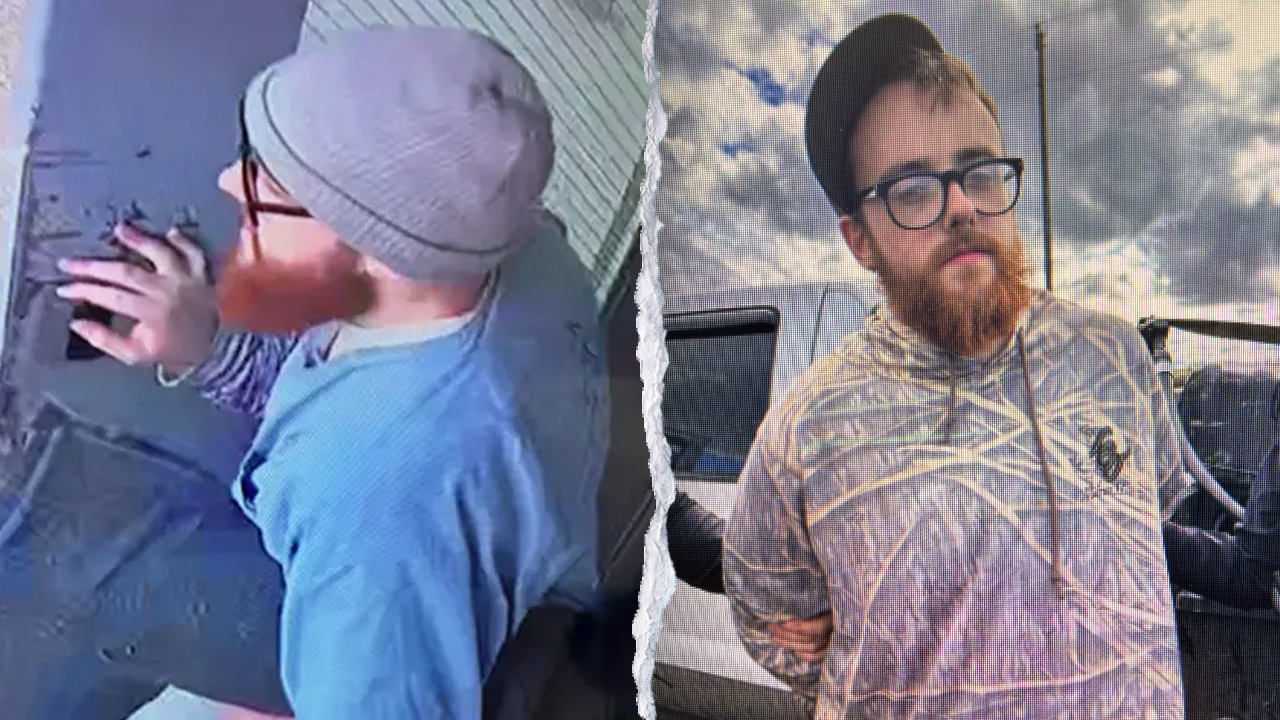
For nearly a week, a convicted murderer traded the gray concrete of a Tennessee prison for the dusty shadows of a hunter’s shed in southern Illinois, living on beer, garlic bread, and the thin hope that no one would find him. Jacob Allen Morley, a man already serving life for the brutal killing of Cody Birchfield, became the subject of a multi-state manhunt after walking away from the Northwest Correctional Complex in Tiptonville, Tennessee, on October 25. His capture on Tuesday was not the climax of a dramatic standoff or a desperate chase through the woods, but rather the quiet end of a strange and unsettling episode—one that ended with authorities finding him hiding in a small outbuilding roughly 127 miles from the prison he had escaped. The details that emerged afterward read less like a hardened criminal’s last stand and more like the baffling behavior of a man who seemed to be living out some bizarre, improvised version of freedom: drinking beer, making himself comfort food, and even writing a handwritten apology for stealing a farmer’s truck. It was a portrait that left investigators shaking their heads, and it reminded everyone that even the most dangerous fugitives can be undone by the strangest of human touches.
The escape itself unfolded with alarming simplicity. Morley slipped away from the Northwest Correctional Complex, a maximum-security facility in the far northwest corner of Tennessee, and quickly stole a pickup truck from a driveway on Keystone Drive, about two miles south of the prison, at roughly 1 a.m. on October 26. That truck was later found abandoned in Marion, Illinois, early the next morning, but Morley had vanished into the rural landscape. For days, law enforcement agencies across multiple states traded tips and tracked leads, with the Tennessee Bureau of Investigation leading the charge and the Missouri State Highway Patrol joining the hunt as the trail pushed westward. It was ultimately the eyes in the sky—the FLOCK cameras that read license plates and alert authorities to suspect vehicles—that made the difference. On the morning of his capture, the Missouri Information Analysis Center and Troop A Communications received a tip from the TBI that Morley might be traveling westbound on Interstate 70 near Independence, Missouri. Using the network of FLOCK cameras, undercover officers zeroed in on the suspect vehicle as it traveled south on Missouri 291 in Liberty. The arrest came without incident, bringing an end to a manhunt that had stretched from Tennessee through Illinois and into Missouri. The technology that some have questioned as an intrusion on privacy proved, in this case, to be a quiet and effective hunter.
But the strangest chapter of the story was not the chase; it was what investigators found when they retraced Morley’s steps. Williamson County Sheriff Jeff Diederich said evidence indicated that Morley had sheltered for a period in a shed near Marion, Illinois, a rough-hewn space used occasionally by hunters. It was there that the escaped killer apparently tried to make himself as comfortable as possible under the circumstances. He drank beer, prepared garlic bread, and helped himself to other food left in the shed. He also took clothes and three firearms from the property. In a move that struck investigators as almost surreal, Morley left behind a handwritten letter of apology for taking the truck from the farm. The apology did not mention the firearms or the clothes, and it certainly did not mention the life he had taken in 2022. It was a small, strange gesture—a man on the run, wanted for murder, pausing to say sorry for the inconvenience of stealing a vehicle. Sheriff Diederich admitted that the whole sequence was puzzling, noting that how Morley ended up in Marion “is kind of a mystery.” After leaving the shed, Morley apparently abandoned another truck and traveled roughly three miles on foot before linking up with the vehicle that would eventually carry him into Missouri and into the waiting arms of the law.
To understand the weight of Morley’s capture, one must look back at the crime that put him behind bars in the first place. Cody Birchfield disappeared in early February 2022, after being last seen in Elizabethton, Tennessee, a small city in the northeastern part of the state. Investigators with the Carter County Sheriff’s Office soon found indications that a violent crime had occurred inside Birchfield’s house, and the search for answers quickly centered on Morley. On March 2, 2022, Morley was arrested after a police chase that ended at the North Carolina state line. The investigation took a grim turn when Birchfield’s body was discovered underneath Morley’s home. The discovery transformed a missing-person case into a murder investigation and cemented Morley’s reputation as a dangerous man capable of extreme violence. He was subsequently convicted of first-degree murder, along with burglary, vandalism, tampering with evidence, and evading arrest. The murder conviction carried a life sentence, and Morley was sent to the Northwest Correctional Complex to serve out his days. That he managed to escape at all was a shocking failure of the system; that he used his freedom to hide in a shed, make garlic bread, and write apology notes only deepened the unsettling contrast between the brutality of his past and the almost mundane nature of his flight.
There is something deeply human, and deeply confusing, about the details of Morley’s time on the run. We like to imagine escaped convicts as cunning predators, always moving, always calculating, never stopping to enjoy a cold beer. But Morley’s behavior suggests something more complicated—a man who, despite his violent history, sought out the small comforts of domestic life even in the most precarious of circumstances. The garlic bread, the beer, the note of apology: these are the actions of someone trying to reclaim a sliver of normalcy, even as he knew the net was closing around him. It is easy to mock the absurdity of a murderer writing a polite note about a stolen truck, but it also speaks to a fractured psyche—a mind that can rationalize the killing of a man while still feeling the need to apologize for a minor theft. Psychologists might call it compartmentalization, the ability to separate one’s actions into different boxes, some monstrous, some almost banal. Sheriff Diederich’s bemused comments reflect the wider bewilderment of everyone who has followed the case. We want our villains to be consistent, to be evil in every fiber of their being, but real life is messier. Morley’s brief, strange interlude in that Illinois shed reminds us that human beings are capable of holding contradictions that seem impossible to reconcile.
In the end, Morley’s escape and recapture is a story about the thin line between order and chaos, and the many ways that ordinary life can intrude on even the most extraordinary circumstances. It is also a story about the dogged persistence of law enforcement and the quiet power of technology to restore order. The FLOCK cameras that helped track Morley were not glamorous; they did not involve helicopter chases or dramatic gunfire. They simply kept watch, feeding information to officers who methodically closed in on their target. For the community in Elizabethton, where Cody Birchfield’s family still grieves, Morley’s capture offers a measure of relief, even if it cannot undo the pain of the past. For the hunters who own the shed in Marion, the scene must have been surreal—a murderer making himself at home among their gear, leaving behind beer bottles and a half-eaten loaf of garlic bread as evidence of his strange passage. And for Morley himself, the brief taste of freedom likely now feels like a distant dream as he returns to the confines of a prison cell. The apology note he wrote for the stolen truck may have been an attempt to leave behind a sliver of decency, but it cannot erase the blood on his hands. In the end, he will spend the rest of his life behind bars, remembered not only for the man he killed but also for the strange, almost laughable details of his final days on the run—a reminder that even the darkest hearts are often full of surprising and uncomfortable contradictions.