

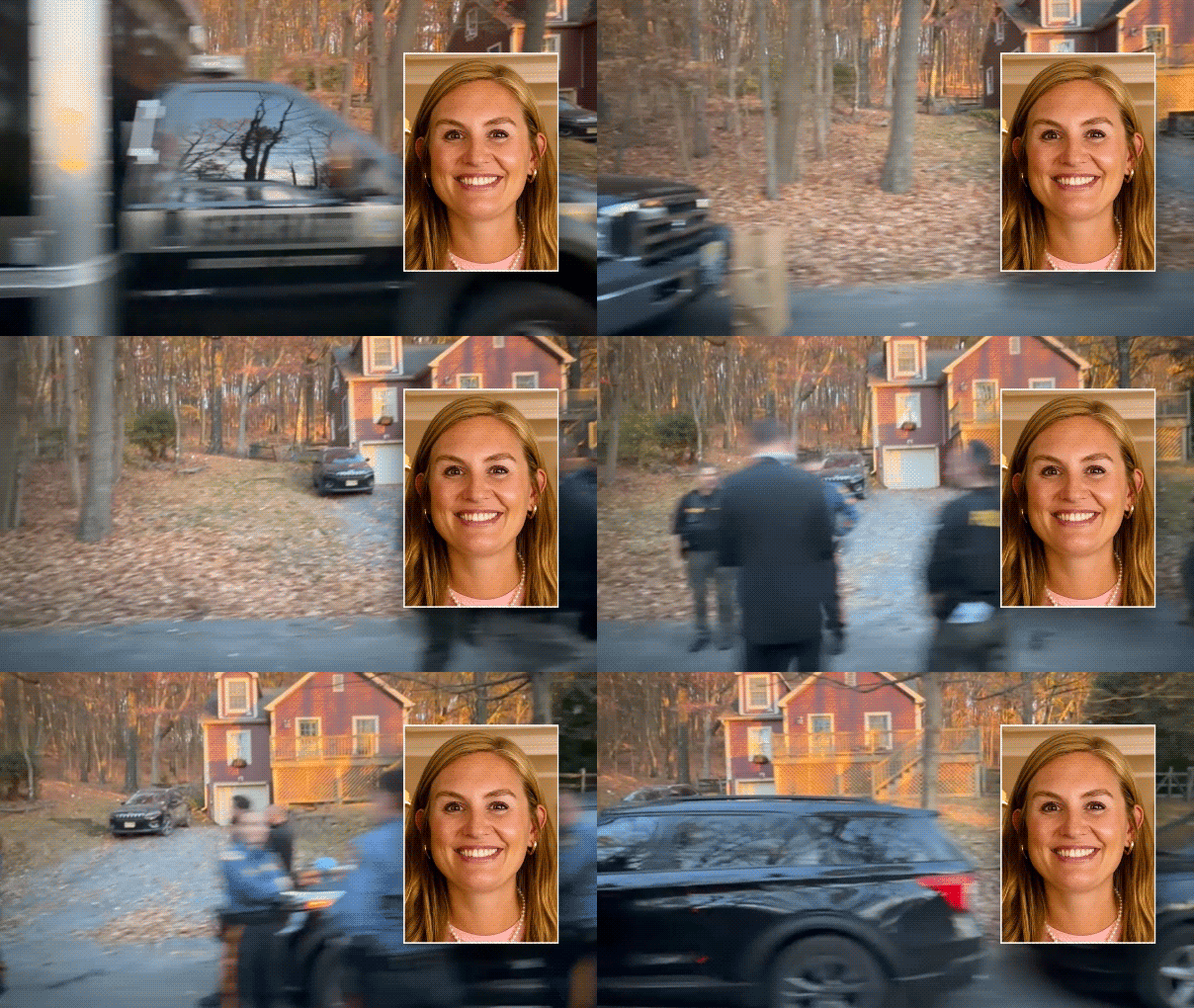
The quiet, tree-lined streets of Chester, New Jersey, were once the picture of suburban peace—the kind of place where neighbors wave as they pass, children play in front yards, and the biggest concern of the day is whether to water the lawn. But that peace has been fractured for nearly five months now, ever since the devastating morning when 31-year-old mother Brooke Hanlon was found stabbed to death inside her home on Pottersville Road. This week, the unease returned in a visible, unmistakable way. Police descended on the Hanlon home again, with neighbors telling Fox News Digital that at least 15 law-enforcement vehicles appeared on Wednesday and remained at the residence until around 11 p.m. The following day, they were back. The sight of so many officers, black SUVs, and forensic personnel moving in and out of the house sent a chill through the neighborhood, reopening wounds that had never truly begun to heal. What are they looking for? What do they know? These are the questions echoing through Chester—a town that does not usually find itself at the center of a homicide investigation. Brooke’s husband, Conor Hanlon, was seen speaking with police on Wednesday afternoon, his presence a reminder that the man who once shared her life remains entangled in the grim mystery of her death. He has denied any involvement, and no arrests have been made. But for the community, the investigation feels like a slowly turning wheel, one that keeps circling back to the house where a young mother took her last breath, leaving behind a one-year-old daughter and a circle of family and friends desperate for answers.
The case has been shrouded in an unusual and frustrating secrecy from the beginning. Weeks after the killing, the Morris County Prosecutor’s Office released Brooke’s autopsy report, confirming what authorities had already indicated in June: her death was a homicide caused by “sharp force injuries.” The term is clinical, sterile, and utterly insufficient to convey the horror of what happened. Brooke was a mother, a professional, a daughter, a friend—someone with a future that was violently cut short. The autopsy report was the first official confirmation of the manner of death, yet it raised more questions than it answered. No weapon has been disclosed. No motive has been offered. No suspect has been named. The investigation has remained maddeningly quiet, with prosecutors declining to share even the smallest updates with the public. One private investigator familiar with the case told Fox News Digital that he had “never seen anything like this,” describing the behind-closed-doors nature of the investigation as extraordinary. For those who knew Brooke, the silence is agonizing. They want justice, but they are left to piece together fragments of information from media reports, from police activity, from the occasional glimpse of Conor Hanlon returning to the home where his wife died. The return of investigators this week only deepens the sense that something significant is happening behind the scenes—something the public may not learn about for a long time.
Perhaps the most heart-wrenching piece of evidence released so far is the 911 call made on the morning Brooke was found dead. The audio, obtained by Fox News Digital, captures Conor Hanlon’s voice trembling with panic as he tells the dispatcher he has just discovered his wife unresponsive and needs instructions to perform CPR. “I just found my wife—CPR, I need CPR instructions,” he says, his words rushed and desperate. He describes a “laceration” on her body, trying to keep his composure even as his world disintegrates around him. “I need you here. I need you here immediately,” he pleads, the raw fear in his voice piercing through the static of the recording. It is the kind of call that stays with anyone who hears it—a snapshot of a man confronting the unthinkable, trying to save a life that has already slipped away. The dispatcher walks him through the motions, but it is clear from the start that nothing can be done. Brooke was already gone. For listeners, the call humanizes the tragedy in a way that police reports and autopsy results cannot. It is not a statistic or a case number; it is a man screaming into the void, begging for help that would arrive too late. It also raises unsettling questions: What happened in that house before the call? How did such violence occur in a family home? And why, months later, does Conor Hanlon still return to the scene of the crime in the eyes of many neighbors?
Neighbors have observed that Conor Hanlon has been making frequent trips back to the Pottersville Road home, sometimes spending the night there. The house, once a symbol of family life, has become a place of lingering shadows. In the months following Brooke’s death, he reportedly divided his time between Chester and the Boston area, where his own family is originally from. But the fact that he continues to stay in the home where his wife was killed is deeply unsettling to some, while others view it as a sign of grief or attachment to the life they shared. There is no indication that Conor has been named a suspect, and he has maintained his innocence throughout. Yet the optics are hard to ignore, especially as investigators keep returning to the property. Officials have not disclosed whether a murder weapon was ever found at the scene, and no clear narrative of the events leading to Brooke’s death has ever been presented to the public. The lack of information has allowed speculation to flourish, but it has also left Brooke’s family in a painful limbo. They know their daughter, their sister, their relative is gone. They know she was murdered. But they do not know why, or by whom, or how such a brutal act could be committed without leaving a trail of answers. It is a nightmare that does not end with a funeral; it continues with every unanswered question, every closed door at the prosecutor’s office, every day that someone walks free.
In their only public statement, Brooke Hanlon’s family expressed an unwavering trust in the investigation. “We have full and unwavering confidence in the investigative efforts of law enforcement,” they said, offering a steady hand of faith amid the chaos. It is a remarkable show of restraint and hope, especially for a family enduring what no family should ever have to endure. But even their confidence cannot fill the void left by Brooke’s absence. She was, by all accounts, a devoted mother to her one-year-old daughter—a child who will grow up without her mother’s arms around her, without hearing her voice, without knowing the woman who gave her life. That little girl is the silent victim of this tragedy, and she is perhaps the reason the family is so determined to let law enforcement do their work. They are not seeking retribution in the media; they are seeking truth. They want the person responsible to be held accountable, not only for Brooke’s sake but for her daughter’s sake, and for the sake of a community that now looks at Pottersville Road with a mixture of sorrow and suspicion. The investigation, though slow and guarded, is the only vehicle for that truth. Until it arrives, the family is left to grieve in private, to comfort one another, and to hold onto the belief that justice will eventually come.
As the weeks stretch into months, the Hanlon case remains a haunting presence in Chester, a reminder that violence can find its way into the most unlikely places. The return of police to the home this week suggests that the case is far from cold—that somewhere behind the silence, detectives are working, examining evidence, interviewing witnesses, and building a puzzle piece by piece. For the community, each police car that pulls onto Pottersville Road is a flicker of hope that answers may be near. For Brooke’s friends and loved ones, it is a painful reminder that she is still gone. And for the broader public, the case has become a cautionary tale about the limits of what we can know from the outside—how a tragedy can unfold in a seemingly ordinary home, leaving behind more questions than closure. Until the day comes when someone is arrested, charged, and brought before a court, Brooke Hanlon’s story will remain unfinished. Her daughter will grow up with a void that no investigation can fill. Her parents will carry a grief that no verdict can undo. But perhaps in time, the slow wheel of justice will turn far enough to give them the one thing they still hold out hope for: a name, a reason, and an accounting for the terrible night their beloved Brooke was taken from them. Until then, the house on Pottersville Road stands as a silent monument to a life cut short—and a community’s determination not to let her be forgotten.