


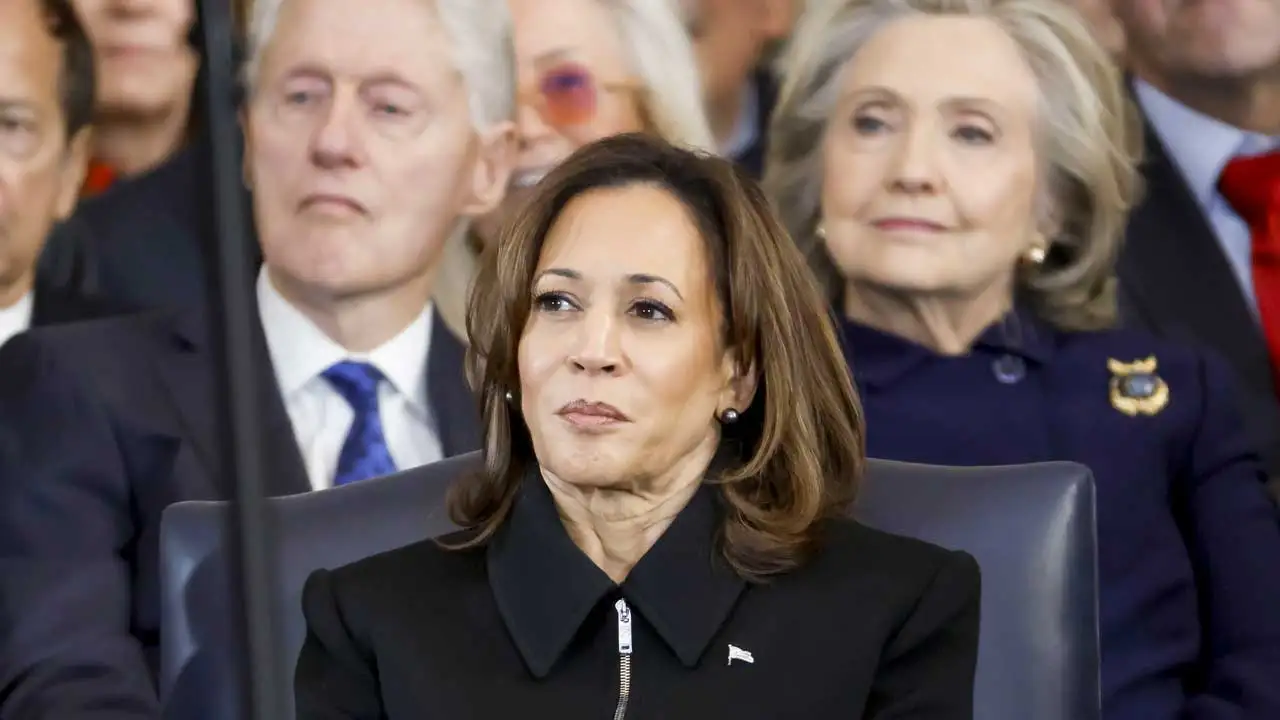
The morning after the 2026 midterm elections broke like a sudden sunrise over a landscape that had been scarred by political winter. For Democrats, the victory wasn’t just a win; it was a seismic correction, a taken breath after holding it for years. The blue wave that had swept through Texas and across the nation’s suburban battlegrounds had upended the Republican stronghold on Congress, and with it, the paralysis that had gripped the opposition. In the midst of this newfound power, three titans of the Democratic Party emerged to offer their competing visions for the road ahead. Former Vice President Kamala Harris, former Secretary of State Hillary Clinton, and former President Bill Clinton each stood on the precipice of this new era, their words not just policy prescriptions but emotional manifestos for a party that had been starved of power. The air was thick with a mix of vindication and dread, acknowledgment that the American people had finally spoken against the chaos of theTrump administration, but also a sobering understanding that holding power is often harder than winning it. The euphoria of the night before, where analysts had stayed up late tracking the historic turnout in the Rio Grande Valley and the suburbs of Philadelphia, gave way to the stark, gray light of governance. Harris, the party’s most formidable messenger, led the charge with a ferocity that was unmistakable. Her call for Democrats to be “ruthless” in wielding their power was not a casual turn of phrase; it was a direct challenge to every moderate instinct that had historically plagued the party in Washington. She framed the victory as a moral mandate, a clear verdict on the corruption she deemed “deep-seated” in the administration. Her words resonated with a base that had grown weary of procedural niceties and legalistic debates, craving instead a visceral, aggressive response to the perceived theft of their institutions.
Harris’s declaration was not made in a vacuum. It was a carefully calibrated response to the internal war she herself had waged with the party’s progressive flank. Just weeks before, she had publicly warned Democrats that impeachment was “not a good idea,” a controversial stance that had enraged the left’s most vocal activists, who saw it as a capitulation when the evidence of wrongdoing was piling up. Now, with power consolidated, she was walking a tightrope, trying to balance the fervent desire for retribution with the practicalities of governing. Her Wednesday post on X (formerly Twitter) was a masterclass in political tension. She invoked “economic relief for working families” as the immediate goal, but the emotional core of her message was the pronouncement of accountability. For Harris, the midterms were not merely about passing legislation but about restoring the public’s faith that the government could be a force for good against those who sought to dismantle it. Her language of being “ruthless” painted a picture of a prosecutor’s mindset, one she had before attempting to dismantle the Trump administration from the inside. The imagery was of a party unwilling to accept the status quo of the previous two years, where executive overreach had seemed unchecked. She was channeling the base’s hunger for a fight, for a law-and-order approach aimed not at the streets but at the highest echelons of power. Her statement was a promise that the weaponization of government that critics on the left had long claimed they were subjected to would now be turned back on its architects. It was a forward-looking call to arms, but it also contained a subtle warning to her own party: do not squander this opportunity by being timid.
Hillary Clinton, meanwhile, offered a more philosophical and historical lens to the moment. Her declaration that “The post-Trump era begins now” was both a chronological statement and a psychological one. For Clinton, her 2016 loss to Donald Trump was the foundational trauma of the modern Democratic Party, a wound that had never fully healed. Her message on Wednesday was part eulogy for that dark period and part resurrection of the ideals she had campaigned on a decade prior. She spoke of a “body politic” that “cannot recover until its harms have been treated and its wounds have been healed,” a profound metaphor that suggested the country – and her party – had been suffering from a collective PTSD. Her emotional plea for “crimes against our people and our Constitution” to be “answered for” was a direct echo of her 2016 concession speech, where she vowed to continue fighting. Now, with the midterm results in, she saw the first tangible fruits of that endurance. Her tone was unapologetically justice-oriented, though tempered by a motherly wisdom that acknowledged the need for healing, not just prosecution. She was the grandmother of the resistance, and her words were meant to give a name and a narrative to the era ahead. Where Harris called for ruthlessness, Clinton called for reckoning, but the underlying spirit of accountability was identical. She wove in the promise of the American Dream, not as a platitude, but as a material guarantee for every child to “live up to his or her full potential.” Her confidence that Democrats could “deliver both” was a testament to her belief that the policy solutions were not complex, but the political will to implement them had only just now been restored.
Yet, at the heart of the Democratic spectrum, Bill Clinton offered a radically different melody—a tune of conciliation and pragmatism that had defined his own presidency. His message was a stark counterpoint to the aggressive tones of his wife and Harris. Where they spoke of war, he spoke of “rebuilding trust.” The former president, who had famously coined the phrase “the era of big government is over,” seemed to be pulling the party back from the brink of maximalism. His statement, issued with the calm gravitas of an elder statesman, focused on the immediate pain points of the American voter: the cost of living, health care, ending “senseless wars and tariffs that drive up prices.” This was not the language of a revolutionary; it was the language of a technocrat who understood that the coalition that had just won the election was not purely a left-wing juggernaut but a loose union of disaffected moderates, suburban women, and minority voters who had been turned off by Trump’s chaos. Clinton’s inclusion of “getting our national debt under control” was a provocative addition, signaling that the party could not just be the party of free spending, especially with the specter of inflation still looming. But the true emotional weight of his message was in his closing lines: “We should do so with humility and determination, and an open hand, not a clenched fist, to those who didn’t vote for our candidates.” This was a direct rebuke to Harris and his own wife. It was a plea for national unity, or at least a recognition that governance requires a majority that must not alienate the more than 100 million people who voted for the other side. His invocation of humility was a stark contrast to the triumphalism of the others, suggesting that he understood the fragility of the new coalition and the danger of overreach.
The context of this ideological tug-of-war was the staggering reality of the election results themselves. The “historic wins in Texas” were not just a fluke but a demographic earthquake, a young and diverse electorate that had finally turned the Lone Star State purple, if not blue. The implications were enormous, not just for the upcoming legislative session but for the 2028 electoral compass. The Republican response, however, was a study in silence; the White House and the Republican National Committee’s refusal to comment on the Democrats’ statements was a strategic acknowledgment of the defeat. In the past, they would have issued a rapid-fire counterattack, but now they were left to lick their wounds and plan a defense against the coming subpoenas and investigations. Yet, for the Democrats, the silence was a double-edged sword. It gave them a moment to savor victory, but it also owed them nothing in terms of a response. The challenge lay in the execution of the vision. Harris’s “ruthless” approach risked a hyper-partisan backlash that could mobilize the Republican base for the next cycle, while Bill Clinton’s “open hand” risked looking weak to a base that had been promised retribution. Hillary Clinton’s “healing” risked being interpreted as a call for a truth and reconciliation commission that had no legal teeth. The political scientists will debate for decades whether the 2026 mandate was about economic anxiety or a referendum on Trump’s character, but the immediate problem for the Democratic leadership was synthesizing these three visions into a coherent legislative agenda.
Ultimately, the morning after the midterms was a human moment as much as a political one. For Kamala Harris, it was the culmination of her own journey from prosecutor to senator to vice president, a woman who had learned that power must be seized and held with both hands. For Hillary Clinton, it was a vindication of her stubbornness, a proof that she had been right about the dangers of the Trump presidency all along. For Bill Clinton, it was a return to the center of gravity, a reminder to his party that winning requires a mandate that is broader than just the progressive base. As they stood on the precipice of this new era, the three figures embodied the Democratic Party’s schizophrenic soul—one part that wants to burn it all down and one part that wants to build a bridge to the other side. The victory had given them the power, but it had not given them a single, unified heart. The first test of their leadership would not be the passage of a bill, but the ability to manage the internal tension between the clenched fist and the open hand. The American people had elected them to fix the economy and to heal the country, but the party itself had to decide if it was going to be a prosecutor or a pastor. The listening to come—the committee hearings, the budget negotiations, the constituent town halls—would ultimately reveal whether they could translate the euphoria of the night into the steady, arduous work of governance, or whether they would allow their own conflicts to derail them before the new legislative session even began. The post-Trump era had begun, but the question of what it would look like was still being written by the very leaders who had just secured the keys to the kingdom.