


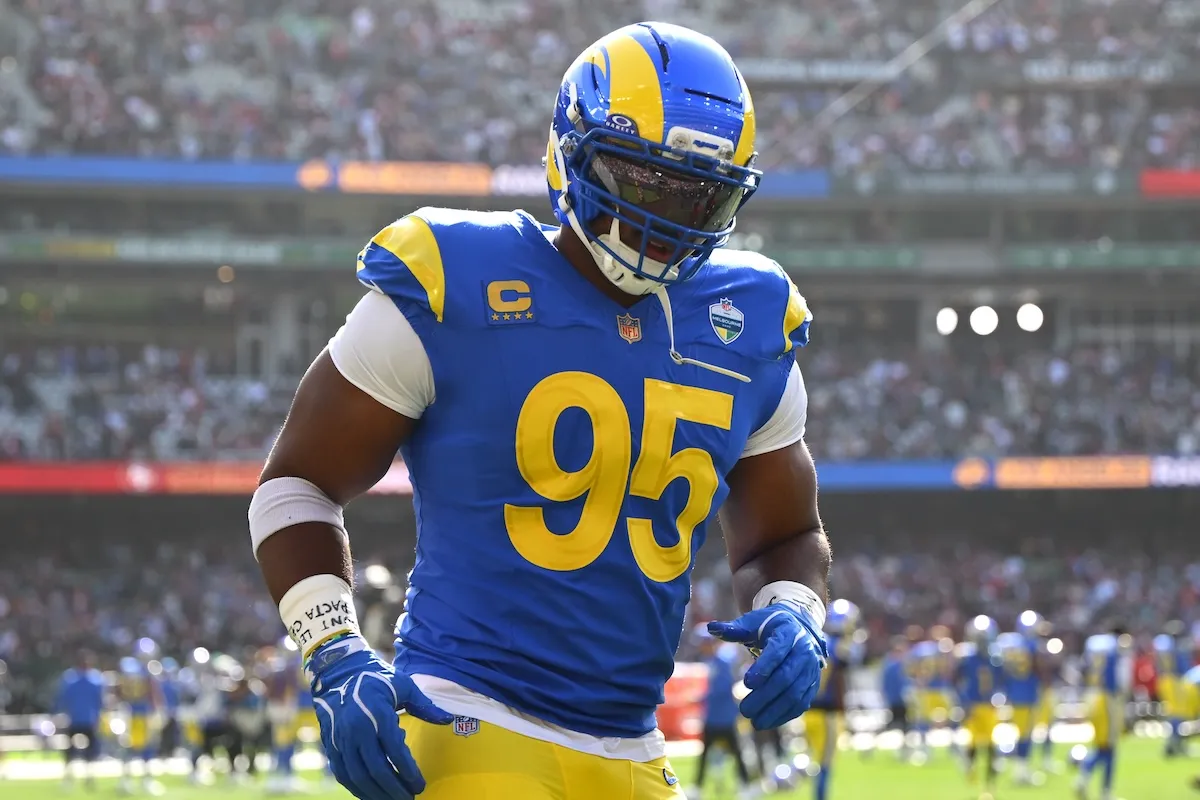
The crisp November air at the Rams’ training facility carried a different kind of electricity on Wednesday, a hum of cautious optimism that has been missing for nearly two months. There, amid the rhythmic thud of helmets and the sharp barks of coaches, stood Myles Garrett, the franchise’s marquee superstar, moving through individual pass-rushing drills with the fluidity of a man who had never been away. It was his first official return to the practice field since undergoing surgery on his left knee, a procedure that followed the team’s agonizing season-opening loss to the San Francisco 49ers in the far-flung setting of Australia. While his availability for Sunday’s pivotal clash against the Washington Commanders remains shrouded in uncertainty, the sheer sight of the reigning NFL Defensive Player of the Year back in uniform offered a desperately needed jolt of life to a defense that has been operating on fumes. He wasn’t a full participant, confined to roughly half the repetitions planned for him, but it was a monumental step—a psychological breakthrough that sent a silent wave of relief through the locker room and reignited the smoldering embers of a Super Bowl aspiration that had seemed to dim with each passing game.
The road back to this moment has been a grueling one, painted with the stark contrast of triumphant acquisition and crushing immediacy. When the Rams boldly traded for Garrett from the Cleveland Browns in June, the football world rightly hailed it as a seismic shift in the NFC’s power balance. He arrived bearing the credentials of a living legend, having just shattered the league’s single-season sack record with an absurd 23 quarterback takedowns in 2025, a feat that earned him the league’s most prestigious defensive honor. The expectation wasn’t just to win games; it was to terrorize offensive lines, to tilt every snap in Los Angeles’ favor, and to transform a good defense into a legendary one. Yet, football, in its cruelest irony, waits for no one. The opening game in Sydney, a glamorous, globally televised spectacle, ended in defeat, and the subsequent diagnosis of a knee injury requiring surgery felt like a devastating gut punch. Garrett was sidelined before he could truly begin, forced to watch seven games from the pristine but hollow perch of the sideline, a physical specimen reduced to a spectator, chewing at the bit while his teammates fought tooth and nail to keep their season afloat.
Head coach Sean McVay, known for his offensive genius and meticulous preparation, has approached Garrett’s rehabilitation with the patience of a master sculptor and the caution of a bomb disposal expert. His Wednesday comments to the press revealed a coach walking a razor-thin line between his desire to deploy his most dangerous weapon and his obligation to protect a generational investment. McVay’s plan is deliberately methodical—giving Garrett exactly half the practice snaps, a controlled environment designed to test the structural integrity of that surgically repaired knee without turning the session into a hostile battlefield. “A lot of it is going to be predicated on his communication and feedback to us,” McVay explained, his voice carrying the weight of a man who values data over impulse. The quote is telling: this isn’t just about medical imaging or range-of-motion tests; it’s about trust. It’s about Garrett’s own internal assessment, the whispered truth of how the joint feels when he plants and cuts. McVay emphasized that the staff has been “as diligent, as thorough” as possible, ensuring that every step is measured, every drill designed to build confidence rather than risk a setback. He’s not just coaching a player back; he’s rebuilding a foundation in real-time, evaluating daily whether the answer to Sunday will be a triumphant “yes” or a heartbreaking “not yet.”
What Garrett actually did in the portion of practice open to the media was a carefully curated preview of his recovery. He engaged in isolated pass-rush techniques, snapping off his signature speed rushes and bending around an imaginary tackle, his first-step explosion looking alarmingly close to his former self. Yet, the mental hurdles of a knee injury are often more daunting than the physical ones. The hesitation that clouds a player’s mind in the first game back, the subconscious fear of re-injury, is a ghost that can haunt even the most resilient athletes. McVay’s “day at a time” approach, where he hopes for a great Wednesday before seeing what Thursday brings, is a masterclass in managing those psychological demons. The evaluation process is not linear; it involves checking how the knee responds to the swelling of practice the following morning, how he feels climbing stairs, how he sleeps. Each box that gets checked brings the Rams closer to a reality where Garrett is not just practicing, but actually “rocking” as McVay hopes. But activating him also means putting him in the line of fire against a Washington offensive line that has seen its own struggles, and risking that explosive return carrying the weight of seven games of missed time and a recuperating joint.
The perspective from the quarterback room adds a profound layer of humanity to the strategic calculus. Matthew Stafford, the battle-tested veteran who has seen it all in his storied career, offered a simple yet resonant sentiment when asked about the defensive star’s progress. “Just happy that he’s feeling good enough to be out there,” Stafford said, “and feels like he can start to think about contributing to us on Sundays, which is the ultimate goal.” Stafford’s words cut through the technical jargon and highlight the pure, unvarnished truth of the sport: practices are necessary, but Sundays are sacrosanct. They are the arena where legacies are forged and wins are harvested. For Stafford, seeing Garrett suit up isn’t just about adding a pass-rusher; it’s about restoring a sense of balance to a team that has weathered a storm. The Rams have managed to string together two consecutive victories, clawing their way back to a .500 record at 4-4, a testament to their grit. Yet, those wins have lacked a certain finality, a sense that the defense can impose its will late in games. Garrett’s presence changes that geometry entirely. He is the gravitational force that collapses pockets, forces hurried throws, and creates turnovers. His return promises to re-categorize the identity of this defense, transforming it from a resilient unit into a predatory one.
Looking ahead to Sunday afternoon at Northwest Stadium, the matchup against the Commanders could not be better scripted for a triumphant return. Washington, sitting at a mediocre 2-4-1, represents a winnable game that Los Angeles desperately needs to secure before a brutal second-half stretch. But more than the tactical advantages, Garrett’s potential return on Sunday is a narrative about resilience, both for the player and the team. It mirrors the Rams’ own season—a rocky start marked by a devastating loss and a key injury, followed by a slow, grinding recovery, and now the tantalizing glimmer of a complete, dangerous roster. If Garrett can take the field, even in a limited rotational role, the emotional impact on his teammates would be immeasurable. It would signal that the cavalry has arrived, that the waiting is over, and that the full arsenal is finally prepared for war. The decision remains a daily dance of medical reports and player feedback, but for the first time in weeks, the Los Angeles Rams can look at their schedule with genuine, unfiltered optimism. The lion is being unchained, and whether he roars this Sunday or waits one more week, his presence on the sideline and the promise of his return have already rekindled a belief that was dangerously close to being extinguished.