


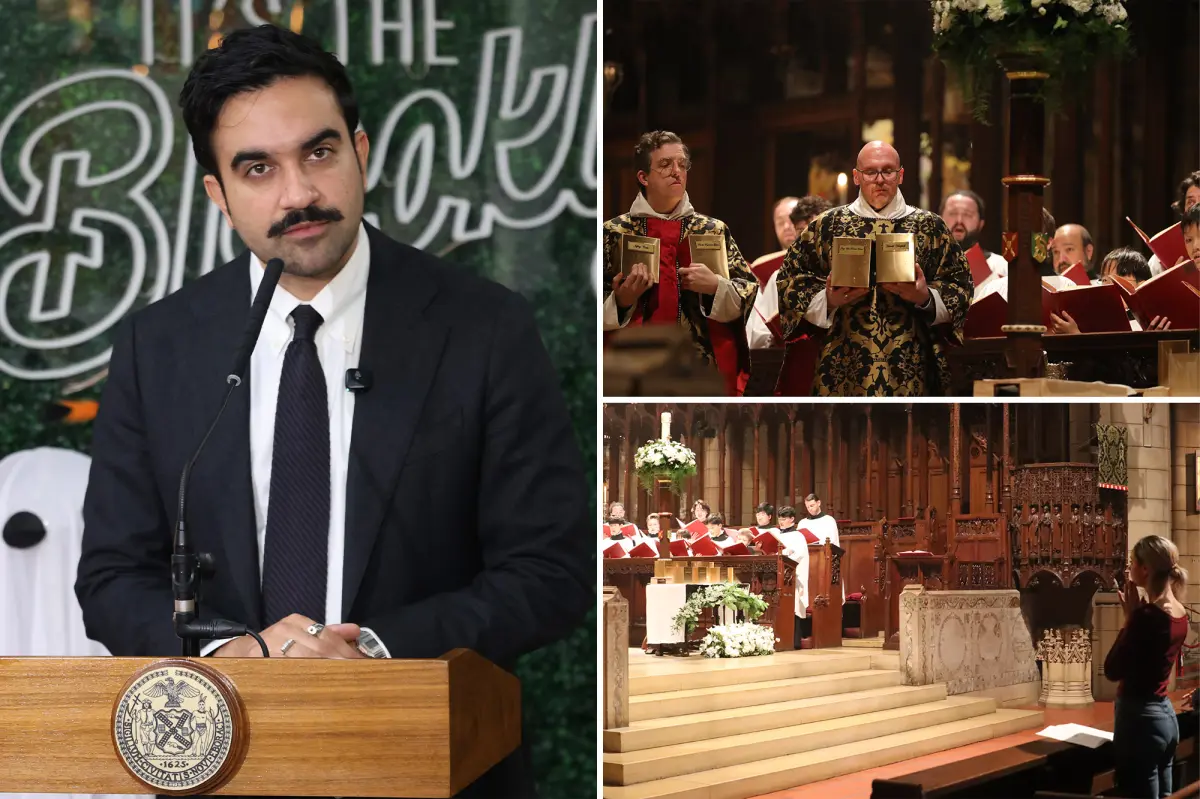
On a gray Monday morning, inside the soaring stone walls of St. Thomas Church on Fifth Avenue, a small gathering of mourners sat in the kind of silence that feels heavier than any hymn. It was All Souls’ Day, a day when the living remember the dead, and these were the dead most New Yorkers had walked past without ever truly seeing. The service was for nine homeless New Yorkers who had died during last winter’s deep freeze, the brutal cold snap that became Mayor Zohran Mamdani’s first great test at City Hall. There were no limousines outside, no motorcade, no rows of officials offering prepared remarks. The pews were filled with ordinary people: neighbors, advocates, volunteers, and the few who had known the deceased in passing. They came because no one else would. The Reverend Mark Schultz stood before them and spoke plainly, refusing to let the moment be reduced to statistics. “Now we know little of these nine neighbors, but we do know this – they are beloved,” he said. He did not pretend to know their favorite songs or their childhood dreams. He did not pretend they had lived easy lives. But he insisted on the one truth that mattered: these were human beings, made in the image of God, worthy of grief. “We speak the truth of their dignity,” he said. The words were both an elegy and a rebuke. Because the mayor of New York City was not there to hear them. Mamdani was noticeably absent, a no-show at a funeral for nine people who froze to death on the streets of the city he was elected to protect. His absence was not just a scheduling gap. It was a symbol of a much deeper failure, one that had begun long before the bodies were found and would continue long after the last candle was extinguished.
To understand why that empty chair mattered, you have to remember the winter that killed these nine people. It was a stretch of bone-crushing cold that descended on New York City like a warning. Temperatures plunged, winds howled, and the city’s most vulnerable residents had nowhere to go. For Mayor Mamdani, newly tested in office, the crisis demanded leadership. Instead, what unfolded was a response that critics described as hesitant, uncoordinated, and tragically inadequate. Over the course of the season, eighteen homeless people were found dead outside. Monday’s service honored nine of them, the unclaimed bodies that would otherwise have vanished into the city’s anonymous burial ground. The mayor’s public response was to plead with New Yorkers to “come inside.” He went on television, looked into the camera, and urged anyone living on the streets to seek shelter. But he stopped short of the one thing that many advocates, city council members, and even some of his own supporters said was necessary: involuntary removal. He called forced removal a “last resort.” For people who are freezing to death, last resort is a luxury they do not have. When the temperature drops below freezing, the street is not a matter of choice; it is a death sentence. Mamdani’s reluctance to compel people indoors may have been rooted in a genuine respect for autonomy, a desire not to treat homeless New Yorkers like prisoners. But critics saw it differently. They saw a mayor who was more concerned with his own political positioning than with saving lives. They saw a leader who confused compassion with passivity, and whose unwillingness to act had consequences that could be measured in frozen bodies found in doorways and under bridges.
The funeral itself was not organized by the city. It was cobbled together by a handful of good Samaritans, the kind of people who believe that no one should die unnoticed. Rhonda Roland Shearer, a nonprofit founder who helped plan the service, said she hoped the funeral would “make everybody alert to prevent this again.” Her team did more than plan a service. They tracked down the remains of the nine dead, rescuing them from Hart Island, the city’s potter’s field off the coast of the Bronx, where the unclaimed dead are buried in mass graves. For generations, Hart Island has been the final stop for New Yorkers too poor, too forgotten, or too alone to get a headstone. The volunteers wanted more for these nine. They wanted a church. They wanted candles. They wanted someone to say their names out loud, even if the names were not all known. They wanted the city to see their faces, not as statistics but as people. The service at St. Thomas was an act of resistance against indifference. It was a reminder that the opposite of love is not hate; it is neglect. And it was a rebuke to the idea that because these nine people were homeless, their deaths were somehow inevitable. They were not inevitable. They were the result of a chain of decisions: decisions about shelter capacity, about outreach, about where warming centers are placed, about whether a mayor is willing to make politically unpopular choices to save lives. The good Samaritans who organized the funeral did not have the power of the mayor’s office. They had something else: the conviction that every person matters. They gave the nine a proper goodbye, not because it would undo the tragedy, but because it honored the truth that they had lived.
Mayor Mamdani’s absence at that service was not just a missed appointment. It was the final image of a failed response. Throughout the winter, his administration struggled to get its emergency plans off the ground. The city had promised mobile warming centers, vans that could bring warmth to neighborhoods where homeless people gathered. But the rollout was a mess. The centers were difficult to track down, their locations changed without warning, and often they were not where they were supposed to be. Imagine being unhoused, exhausted, and cold, having finally decided to accept help, only to discover that the van isn’t there. Imagine having to explain that to a city that barely sees you. The failure was not one of intention; it was one of execution. And for the people who died, execution was everything. The mayor’s office did not immediately respond to requests for comment when asked about the funeral and the policy failures. That silence was telling. In the face of death, the administration seemed to have nothing to say. Meanwhile, the advocates who had begged the city to do more were left to clean up the aftermath. They were the ones who identified the bodies, who contacted the funeral home, who found a priest, who filled the pews. The city, which has a legal and moral obligation to protect its most vulnerable residents, was absent. It is one thing to miss a funeral. It is another to miss the opportunities to prevent the deaths that made the funeral necessary.
Experts and advocates had seen this coming. Nicole Gellas Gelinas of the Manhattan Institute told the New York Post at the time, “He knows this is coming and more deaths are coming unless he changes his approach.” That was not a partisan attack. It was a warning. Winter is not a surprise in New York City. The cold comes every year, and every year people die because they are outside. The only question is whether the city will treat those deaths as unavoidable tragedies or as failures of policy. Mamdani’s approach seemed to prioritize the rights of homeless individuals to refuse services over the urgency of saving their lives. That is a difficult ethical line. Forcing someone into a shelter can be traumatic, especially for people who have been victims of violence, who suffer from severe mental illness, or who have been mistreated by institutions. But letting someone freeze to death is not a form of respect. It is a form of abandonment. There are middle paths: low-barrier shelters, safe haven programs, drop-in centers, 24/7 access, outreach workers who build relationships over time, and enough beds for everyone who needs one. The city did not have to choose between coercion and neglect. It could have chosen competence. Instead, it chose a slogan. “Come inside.” Words cannot warm anyone. Words cannot find the person behind a dumpster at 3 a.m. Words cannot pay for a mental health crisis team or fix a broken referral line. Only action can do that. And action was missing.
In the end, the funeral at St. Thomas was not just about nine dead New Yorkers. It was about what kind of city New York wants to be. The Reverend Mark Schultz said, “We speak the truth of their dignity.” That truth is not limited to those nine. It applies to every person sleeping on a subway grate tonight, every person asking for change on a street corner, every person who has been told that their life is less important than the comfort of the people walking past them. The good Samaritans who organized the service understood this. They did not ask whether the dead had earned the right to be mourned. They did not ask whether they had voted, or worked, or paid taxes. They simply said: these are our neighbors, and we will not let them disappear. The mayor should have been there. But more than that, the city should have been there before they died. It should have been there with warm shelters that did not turn people away. It should have been there with outreach workers who knew the names of the people they served. It should have been there with a leader willing to make difficult choices, even when those choices are unpopular. The nine people remembered at St. Thomas are gone. But the winter will come again. The streets will fill again with people who have nowhere to go. The question is whether New York will learn from this loss or repeat it. The funeral was a call to action, a plea for a city that sees its most vulnerable residents not as problems to be managed but as people to be loved. Until that happens, every empty pew is a warning. Every unclaimed body is a judgment. And every mayor who skips the funeral of a homeless New Yorker should remember: they are not absent. They are accountable.