



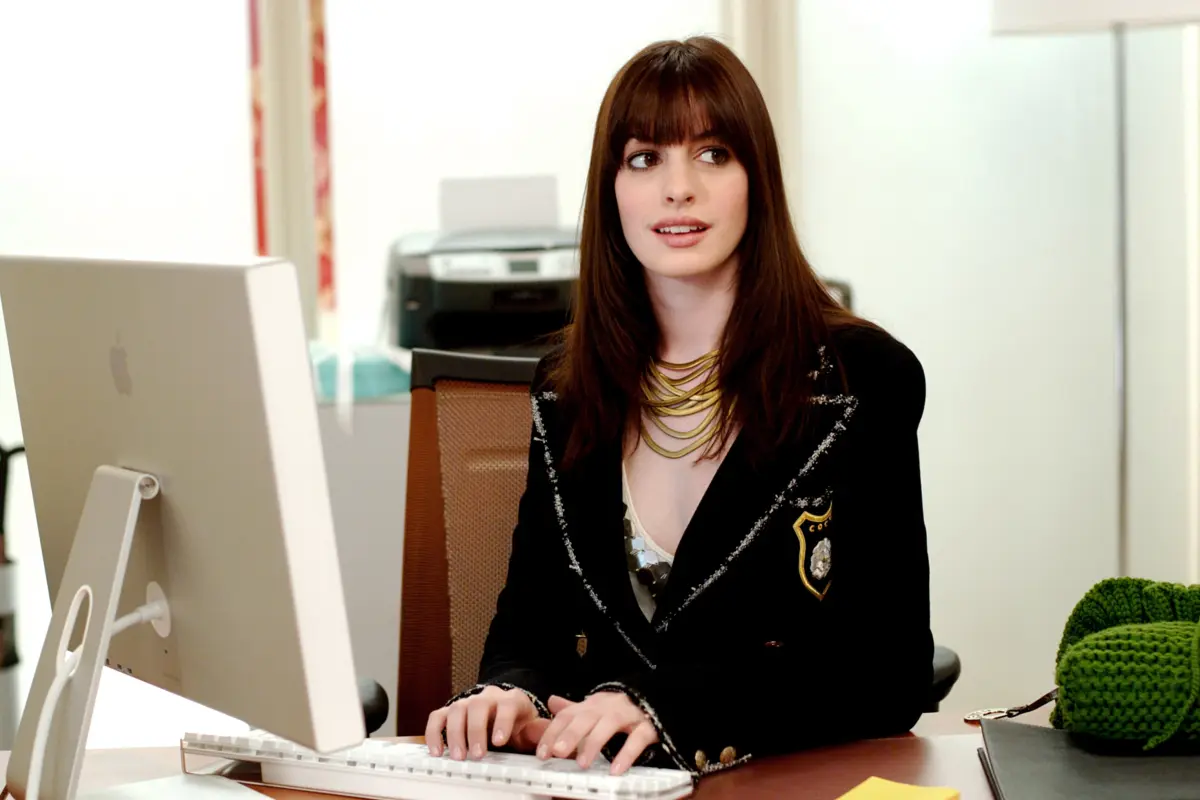
Someone must have fallen down and smacked their little head on the pavement. That is genuinely the only reasonable explanation for parting with a Chanel jacket from 2005 — the very same design that Anne Hathaway wore in the greatest fashion-rom-com ever made, 2006’s The Devil Wears Prada. This isn’t just any old vintage blazer. This is a piece of cinematic history, a garment that carries the weight of a cultural moment, a fairy tale about ambition, a career-defining glow-up, and the unmistakable thumbprint of Karl Lagerfeld, the late, legendary creative director of Chanel. It was also styled by Patricia Field, the woman who dressed Carrie Bradshaw for Sex and the City and knew exactly how to make a costume say what words couldn’t. And this week, there it was, sitting on TheRealReal, the popular resale site, like a forgotten gem in a digital thrift bin. The price? Just over $10,000. For some, that might seem outrageous. For the right fashion obsessive, it’s practically a bargain. It’s the kind of purchase you don’t make with your head; you make it with your heart, your memory, and your unshakeable love for one of the most quoted, meme-ified, and lovingly dissected movies of the twenty-first century. You don’t buy this jacket to wear it. You buy it to remember what it felt like the first time you watched Andy Sachs walk into that office and prove she belonged.
The story behind the jacket is almost as dramatic as the movie itself. The Devil Wears Prada was based on the best-selling novel that everyone knew was inspired by Vogue’s fearsome editor-in-chief, Anna Wintour. That made the production a delicate political tightrope. Many European designers and their notoriously protective publicists refused to lend clothes to the film, terrified of offending Wintour and being blacklisted from the pages of Vogue forever. They thought it was a sensitive political issue, Field said at the time. The fashion world was holding its breath, trying to figure out whether this movie would be a love letter to the industry or a brutal evisceration of it. But Patricia Field didn’t have time for all that anxiety. She had a movie to make and a wardrobe to build. And she had Anne Hathaway, who was already such a rising star that designers were willing to take a chance. Lagerfeld, in particular, sensed that the film would be good for everyone. He was right. The jacket he created — made from French-milled cotton and piped with threads of silver and gold — became part of one of the most iconic makeover sequences in movie history. When Hathaway’s Andy Sachs steps out in that nautical-style blazer, layered over a flirty skirt and boots, she stops the entire office. Meryl Streep’s Miranda Priestly looks up. Emily Blunt’s Emily looks horrified. And even supermodel Gisele Bündchen gives her a once-over. It’s the moment Andy realizes that clothes can be armor, and the audience realizes they’re watching something special. Even Wintour eventually came around, wearing her own Prada dress to the film’s New York premiere. The movie became a massive hit, earning $326.6 million worldwide and launching both Hathaway and Blunt firmly into Hollywood’s A-list. It also taught an entire generation how to spell “Gabanna” — wrong, but with confidence, just like Andy.
But the jacket isn’t just a costume. It’s a symbol of everything The Devil Wears Prada taught us about transformation, identity, and the complicated power of fashion. At the beginning of the film, Andy is a clueless newcomer in a chunky sweater and sensible shoes, convinced that style is superficial. By the time she puts on that Chanel blazer, she’s learned that what you wear isn’t just a frivolous game — it’s a language, a signal, a way of declaring who you are without saying a word. The makeover montage, set to a remixed pop song, is practically a genre unto itself, and this blazer is the crown jewel of it. It represents the moment when Andy stops aping the fashion world and starts inhabiting it. It’s also a testament to the craft of costume design. Patricia Field and her team had to scramble for runway-worthy pieces, mixing high fashion with accessible pieces, pulling from archives and showrooms, and creating looks that would hold up on screen for decades. Today, that level of fashion access seems impossible. Designers now brand-camp their clothes in every project, sending endless freebies and paying for placement. Back then, it was a struggle to get anyone to lend a single garment. That makes this jacket even more special. It was fought for, chased down, and carefully styled. It has a behind-the-scenes résumé that includes Karl Lagerfeld’s approval, Patricia Field’s desperate genius, and Anne Hathaway’s star-making performance. It’s not just a piece of clothing. It’s a piece of the movie’s soul.
So what exactly are you getting for your $10,000? The available piece on TheRealReal is a slim size 36, which translates to a very trim American size 2. That’s the version that screams “high-fashion sample size,” the kind of fit that makes a blazer look like it was sewn directly onto the wearer. But for those who don’t fit into that narrow standard, hope is not lost. The site is also listing two larger versions: a size 42, priced just over $8,400, and a size 48, at roughly $9,500. That’s a welcome and refreshing move for a luxury market that often leaves curvier buyers out of the nostalgia. If you’re a size 14 or 16, you can still channel Andy Sachs’s fantasy wardrobe. And that’s the kind of inclusivity that makes this story genuinely heartwarming. Each jacket features Chanel’s signature gold-stamped buttons, the iconic woven wool fabric that has become a house staple, and those lovely little logo badges that bear Chanel’s lucky number, cinq — the number five, which has been synonymous with the brand since Coco Chanel first launched her legendary perfume. The details are exacting, luxurious, and unmistakably Chanel. It’s the kind of quality that doesn’t really exist anymore in the fast-fashion world, where clothes are disposable and style is fleeting. These jackets were made to last, and they have. They’ve survived nearly two decades, traveled from fashion houses to film sets to resale racks, and they still look like they could walk into Miranda Priestly’s office and command the room. And yes, all three jackets come in black. Not cerulean. Phew. The fashion gods are smiling.
There’s something deeper going on here, too. The rise of resale platforms like TheRealReal has turned vintage fashion into a secondhand treasure hunt, but screen-worn pieces like this Chanel jacket hold a special place in the market. They’re not just clothing; they’re artifacts. They carry a story. When you buy a jacket like this, you’re not buying fabric and buttons. You’re buying the memory of a movie that made you laugh, cry, and maybe reconsider your entire wardrobe. You’re buying the moment the film’s fictional fashion assistant finally found her footing, and the real-life thrill of watching a young actress become a star in real time. In an era when everything is fast, digital, and disposable, owning a physical piece of that history feels almost rebellious. It’s a way of holding onto a story that continues to resonate. And given the film’s continued relevance — with a hotly anticipated sequel arriving in May and raking in over $693 million at the global box office, which is roughly 105,000 Prada bags for those keeping score — the appetite for Devil Wears Prada memorabilia is only growing. People want to connect with the film in a tangible way. They want to wear a little piece of that world, or at least hang it in a closet and know it’s theirs. The fact that these jackets are available at all is a small miracle. It means that somewhere, someone had the nerve to let go. And it means that someone else has the chance to pick up a piece of cinema history and make it their own.
In the end, this Chanel blazer is so much more than a resale listing. It’s a time machine. It takes us back to 2006, when Anne Hathaway was just becoming a household name, when Emily Blunt was still a relative newcomer, when Meryl Streep was doing the kind of work that reminded everyone why she is the greatest actress of her generation, and when Patricia Field was stitching together a visual language that would define a decade of style. It reminds us of the moment we first fell in love with these characters, their sharp one-liners, their impossible heels, and their complicated relationships with fashion, power, and each other. It whispers to us about the frantic mornings on set, the steaming and pinning and last-minute alterations, the anxiety of asking designers for clothes they were afraid to lend, and the triumphant thrill when Lagerfeld said yes. If this jacket could talk, it would tell us about the cameras rolling, the lights blazing, the hush that fell over the set when Hathaway stepped into frame in that exact blazer. It would tell us about the people who made the movie, the dreams they poured into every seam, and the millions of viewers who watched and thought, I want to be her. For $10,000, you’re not just buying a jacket. You’re buying that feeling — the one that says, with the right clothes and the right attitude, you can walk into any room and own it. You’re buying the power of a woman who learned to say “gimme those boots” and meant it. And honestly? That might be worth every penny.