



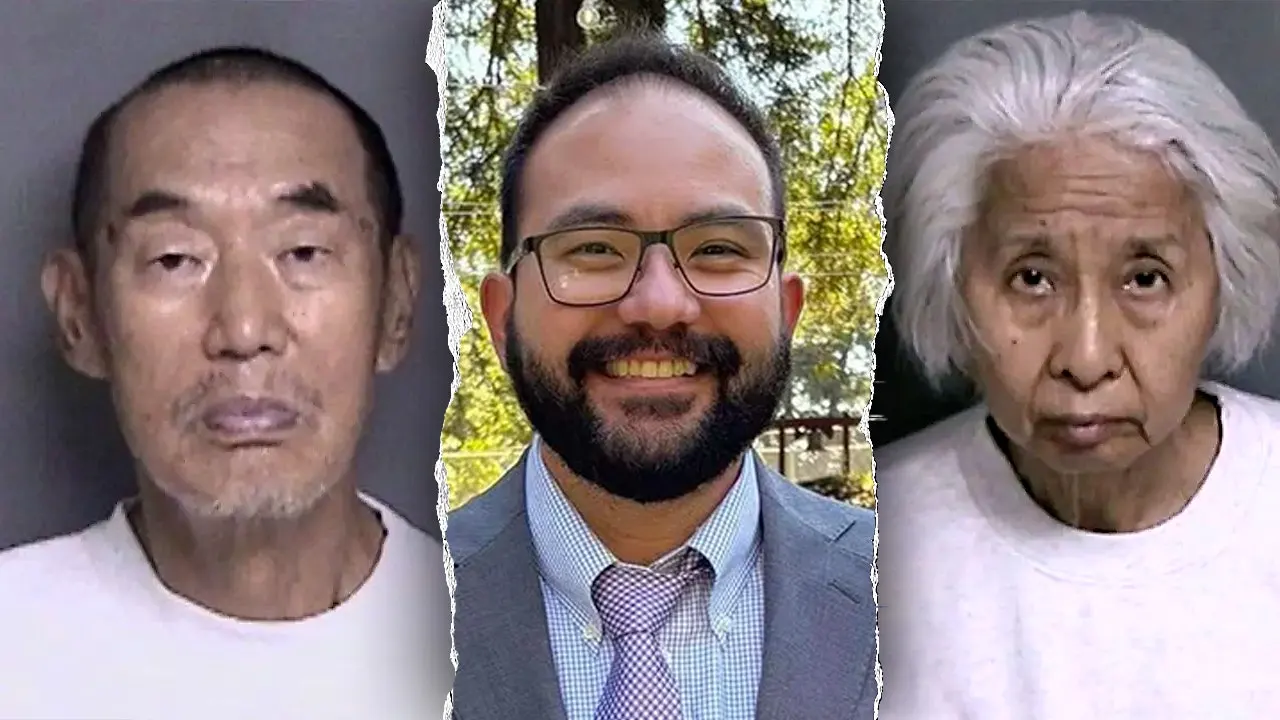
It is a story that reads less like a headline and more like a family tragedy that spilled out into a public park with deadly consequences. One month after Shili Chen, 77, and her husband, Shouyong Zhang, were arrested in connection with the fatal shooting of their son-in-law, Jonathan McKinsey, Chen is now making a startling claim in court documents: her husband acted alone in planning the killing, and she was left in the dark. McKinsey, a 40-year-old transgender man who worked as an executive at The New York Times, was shot and killed in a crowded park in Dublin, California, on a day that should have been unremarkable. According to a new bail filing reported by the San Francisco Chronicle, Chen’s lawyers say she was sitting inside her car at the Dublin Sports Grounds when she watched her husband fire the fatal shots at McKinsey. Her attorney, Curtis Briggs, argues that Chen only got out of the vehicle afterward, not to participate in a murder, but to protect her husband from what she feared was an assault by McKinsey. The image is one of confusion and fear, but prosecutors tell a very different story—one of a couple working together, lying in wait, and opening fire in a place where children were present.
The legal battle over Chen’s freedom hinges on how much she knew and what she did in those final, violent moments. Her lawyers insist that she was kept “in the dark” while Zhang planned McKinsey’s murder, and that she had no idea why he had asked her to drive to the park that day. Zhang, for his part, allegedly admitted to the fatal shooting just days after his arrest, but only after investigators showed him video footage of the attack. He told police that he had asked his wife to drive him to the park but did not explain his purpose. That admission, however, did not exonerate Chen in the eyes of prosecutors. Surveillance video allegedly shows Chen firing a gun at McKinsey after Zhang had already fired the shots that killed him. Chen’s lawyers have tried to minimize this by arguing that she was not the “actual killer” because McKinsey was already dead by the time she fired. It is a grim and technical argument, one that attempts to draw a line between a fatal bullet and a bullet fired into a lifeless body. But prosecutors are not convinced. They have accused the couple of “lying in wait” for McKinsey at the park, a special circumstance that has been used to hold both of them without bail. For Chen, the question is whether she was a horrified witness who made a terrible decision in the chaos of the moment, or a willing participant in a premeditated execution.
The prosecution’s case paints a far more coordinated picture. According to court documents, several 911 callers reported gunfire at the Dublin Sports Grounds before a Dublin Police Services sergeant arrived and found McKinsey lying face up with multiple gunshot wounds. He was pronounced dead at the scene. Witnesses pointed police toward a black Honda Civic that was leaving the parking lot, and officers conducted a high-risk traffic stop nearby. Chen was driving, and she allegedly had a firearm in her possession when she was detained. Zhang was in the passenger seat. Three witnesses identified both Chen and Zhang as the shooters, and surveillance video allegedly captured the couple opening fire “in concert” on McKinsey. Police said the couple started shooting in a crowded park’s parking lot with “blatant disregard for public safety,” even as several children were nearby. After searching the Honda, police recovered a second firearm that Zhang allegedly admitted using in the shooting. The complaint alleges that the killing involved “great violence” and acts showing a “high degree of cruelty, viciousness, or callousness.” Prosecutors also allege that both defendants were armed or used a weapon during the killing. These are not the words of a case built on a misunderstanding. They describe a deliberate, dangerous act carried out in a public space, with no apparent concern for who else might be hurt.
To understand how a family could reach such a point, one has to look at the bitter and tangled history that preceded the shooting. McKinsey’s killing came amid a divorce and custody battle with Chen and Zhang’s daughter, Candice Jang. The couple was locked in multiple legal fights at the time of his death, including competing domestic violence restraining order cases, a child custody dispute, and a pending divorce. The court dockets reviewed by Fox News Digital show that Jang sought a domestic violence restraining order against McKinsey in October 2025, and McKinsey filed his own request two months later. The competing domestic violence matters were heading toward a three-day hearing in December. The allegations between them were serious and painful. McKinsey accused Chen of directing anti-LGBTQ slurs at him and one of his children, and he alleged that Zhang struck him in the chest while he was recovering from double mastectomy surgery. Jang, meanwhile, made competing allegations of domestic violence and child abuse against McKinsey, which he disputed. This was not a simple divorce. It was a war fought in courtrooms, with accusations of abuse, fear for children’s safety, and deep family wounds. Somewhere in that storm of anger and pain, the conflict moved from legal filings to bullets.
Now, both Chen and Zhang are asking for pretrial release, and their defenses are as different as their roles in the shooting. Chen’s lawyers argue that she should not be held without bail because she was not the “actual killer” and because there is not enough evidence to prove she was lying in wait. They describe her as an elderly woman who was caught up in a situation she did not fully understand, and who acted only out of a misplaced instinct to protect her husband. Zhang’s public defender, in a separate filing, argues that he does not pose a threat to the community because of his age and health, and because the shooting was an isolated family incident. That argument is likely to face fierce opposition from prosecutors, who see the couple as a unit that planned and carried out a killing together. But there is something deeply human in these pleas for freedom. These are not young criminals with long records; they are a married couple in their late seventies, facing the possibility of dying in prison. Their lawyers are trying to remind the court that they are people with health problems, with histories, with fears of their own. Yet the image of McKinsey lying face up in a park, with gunshot wounds and children nearby, is not easily erased. The court will have to weigh the severity of the alleged crime against the defendants’ age and circumstances, and decide whether they can be trusted to appear for trial.
In the end, this case is a haunting reminder of how family conflict can escalate beyond all reason, especially when identity, custody, and cultural tensions collide. McKinsey was a transgender man who had built a successful career at one of the most prominent newspapers in the world, but his personal life was marked by a painful divorce and accusations that his in-laws despised him for who he was. The allegations of anti-LGBTQ slurs and physical violence suggest a family that had become deeply fractured, with each side believing they were protecting themselves or their children. Whatever the truth, the result is a tragedy that has left two children without a father, a daughter without a husband, and a couple in their late seventies facing murder charges. The legal system will now have to untangle the events of that day in Dublin, determine who planned the killing, who pulled the trigger, and who is truly responsible. Chen’s claim that her husband is to blame may be a last-ditch effort to save herself, or it may be the desperate truth of a woman who followed her husband into a nightmare. Either way, the case is far from over. The competing restraining orders, the custody disputes, and the allegations of abuse will all become part of the story, a story that ended in gunfire but began long before, in the quiet bitterness of a family falling apart.