



ICE and TradeXYZ Plan Perpetual Futures for Traditional Assets and Crypto: A Game-Changing Alliance
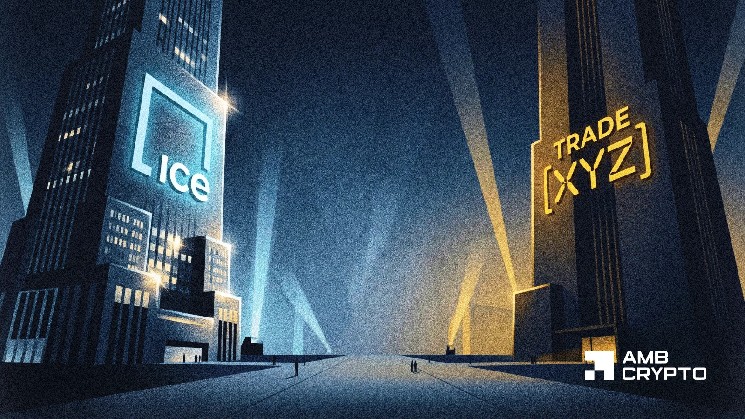
Intercontinental Exchange, the financial infrastructure giant that owns the New York Stock Exchange, has made a decisive move into the world of digital-asset derivatives. The company has entered a strategic agreement with TradeXYZ, a crypto-native derivatives platform known for its deep presence on Hyperliquid, to launch perpetual futures spanning equities, stock market indices, commodities, foreign exchange, and cryptocurrencies. The ICE-TradeXYZ agreement is not a small experiment. It is a plan to bring a broad new family of derivative contracts into the U.S. market, with access provided through participating brokers and trading platforms. For years, perpetual futures have been a dominant product in crypto trading, offering speculators and institutional investors a way to hold positions without worrying about contract expiration. Now, a company that powers the heart of global finance is signaling that those products have a future beyond the often loosely regulated digital-asset world. The move adds new weight to the argument that crypto derivatives are evolving from a niche activity into a mainstream component of the global trading ecosystem.
Under the planned framework, the ICE-TradeXYZ agreement is much more than a simple product listing. The infrastructure being discussed includes clearing systems, customer identification through know-your-customer procedures, and anti-money-laundering controls. Clearing, in particular, is the back-end system that makes modern markets safe enough for institutions to participate. It helps manage counterparty risk, ensures that trades are processed correctly, and guarantees that settlement follows the applicable rules. For many traditional finance veterans, the appeal of a product like a perpetual future has often been undermined by the lack of strong clearing arrangements in the crypto ecosystem. By pairing the speed and flexibility of blockchain-based markets with the regulatory and operational safeguards of traditional clearing, ICE and TradeXYZ are attempting to resolve one of the central concerns holding back institutional adoption. At the same time, ICE will make a strategic equity investment in TradeXYZ, although the financial terms of that stake have not been disclosed. That detail matters. It signals that ICE is not merely entering a commercial partnership for fees or volume; it is placing a direct financial bet on the future of TradeXYZ and its technology platform.
Why does TradeXYZ stand out as the right partner for a project of this magnitude? The platform’s track record on Hyperliquid offers a powerful answer. TradeXYZ has reported more than $650 billion in trading volume in just over a year, a figure that places it among the most active players in the growing Hyperliquid ecosystem. Even more striking is its influence within that ecosystem: builder-deployed markets tied to TradeXYZ account for roughly half of Hyperliquid’s trading activity. That is not a marginal footprint. It reflects a platform that has become central to how users engage with on-chain derivatives. TradeXYZ has also begun moving beyond purely crypto-native assets. In March, it secured a license for an S&P 500 perpetual contract, a major step toward bridging the gap between digital-asset markets and traditional finance. In addition, it has introduced products linked to crude oil and equity benchmarks, showing that it understands how to structure contracts around conventional financial instruments. For a firm like ICE, which prizes technical sophistication and market credibility, these achievements make TradeXYZ a logical choice. The Hyperliquid builder has proven it can generate substantial volume, manage complex product launches, and operate in the demanding world of on-chain trading.
Taken together, the partnership represents one of the most serious attempts yet to bridge traditional financial markets and blockchain-based derivatives trading. ICE brings decades of experience in exchange operations, clearing, market structure, and regulatory compliance. TradeXYZ brings deep knowledge of decentralized markets, Hyperliquid’s infrastructure, and the unique mechanics of perpetual futures. On a practical level, the collaboration could give U.S. investors a way to trade perpetual futures tied to a wide range of assets, from blue-chip equities to global indices, oil, currencies, and digital tokens. Perpetual futures are a distinctive type of derivative: they allow traders to maintain leveraged positions without needing to roll contracts from month to month. In crypto markets, they have become a cornerstone of liquidity and price discovery. But they have also raised concerns about volatility, leverage, and inadequate risk controls. By combining TradeXYZ’s experience with ICE’s clearing and compliance backbone, the two companies are aiming to offer a version of the product that meets the expectations of institutional investors and regulators. The agreement is not just about adding another token contract; it is about creating a model for how regulated market infrastructure can absorb blockchain-native trading without sacrificing oversight.
Interestingly, ICE and TradeXYZ are not alone in recognizing this opportunity. Payward, the parent company of Kraken, has also announced plans to introduce on-chain perpetual futures for eligible U.S. traders through Hyperliquid, subject to regulatory approval. That announcement suggests that Hyperliquid’s infrastructure is becoming a common foundation for major players looking to enter the U.S. market. Meanwhile, Crypto.com CEO Kris Marszalek revealed that the company has received authorization from the U.S. Securities and Exchange Commission to offer tokenized stock perpetual futures in the United States through its new futures exchange, OG.com. That approval reportedly followed extensive discussions with both the SEC and the Commodity Futures Trading Commission, underscoring how seriously regulators are beginning to take these products. The broader race to offer crypto-linked perpetual futures in the U.S. is clearly accelerating. But not everyone is convinced that Hyperliquid and its associated platforms can become the “everything exchange” that some envision. Ark Invest has questioned the ambition, pointing to limited decentralization, an anonymous development team, and negligible spot trading as major challenges. That skepticism is worth noting. High derivatives volume can be impressive, but it does not automatically translate into a well-rounded exchange that can handle the full complexity of traditional financial services. The criticism serves as a reminder that while the momentum behind perpetual futures is undeniable, the road to widespread adoption still requires answers to difficult questions about governance, transparency, and reliability.
In the end, the agreement between ICE and TradeXYZ represents a clear signal of where the next phase of financial market evolution may be heading. ICE plans to use the collaboration to bring perpetual futures trading for both traditional financial assets and cryptocurrencies into the U.S. market. TradeXYZ, for its part, has demonstrated its staying power on Hyperliquid by amassing more than $650 billion in trading volume in just over a year and driving a substantial share of the entire ecosystem’s activity. Those are not small numbers, and they explain why an established exchange group would take notice. The final shape of this partnership is still being built, and regulatory approvals, technical execution, and market demand will determine its ultimate impact. But the direction is unmistakable: the boundaries between centralized finance and decentralized markets are beginning to blur. If the ICE-TradeXYZ venture succeeds, it could provide a template for the next generation of trading platforms, where traditional clearing and compliance meet the speed and accessibility of blockchain. If it fails, it will still stand as a defining moment in the effort to legitimate crypto derivatives in mainstream finance. For now, the exchanges, regulators, and traders of the world are watching closely as one of Wall Street’s most influential names places its first major bet on the expanding universe of perpetual futures.