

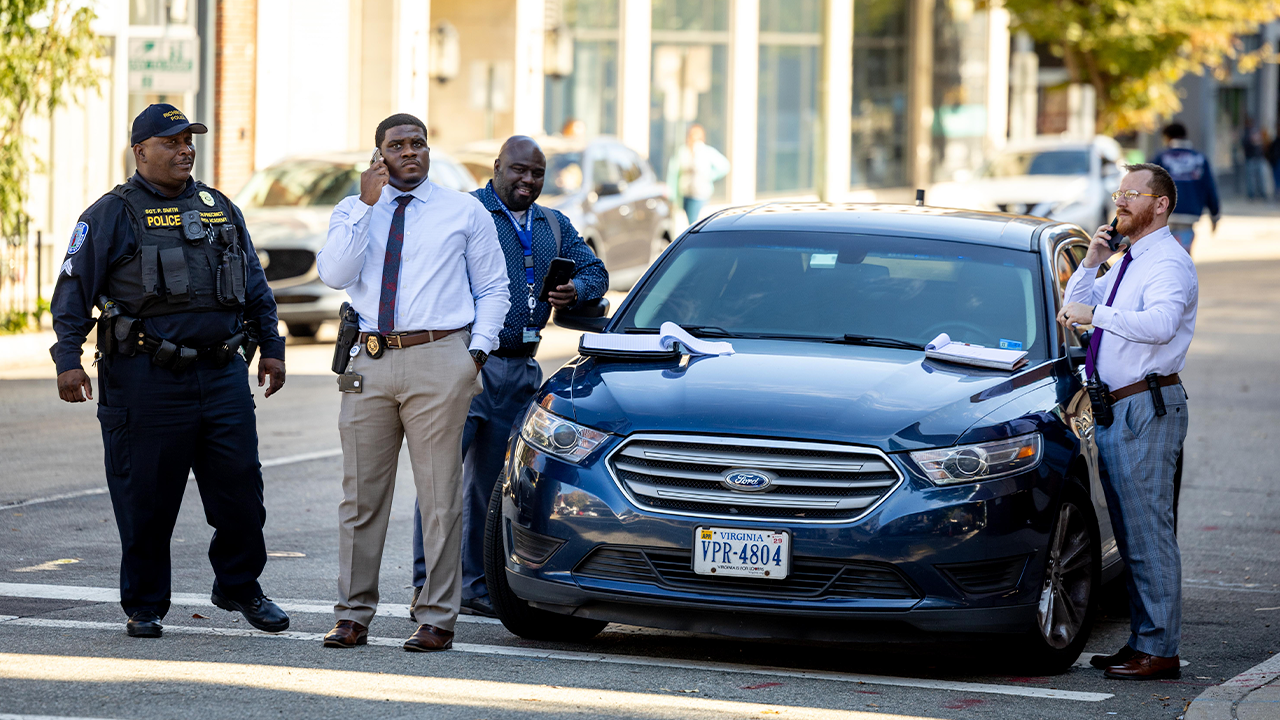
On an ordinary Thursday afternoon in downtown Richmond, the familiar rhythms of city life were interrupted in the most jarring way possible. It was just after 1:45 p.m., and the 100 block of East Grace Street was home to the usual bustle of people heading to lunch, running errands, or settling back into their desks after a busy morning. In front of the Obenshain Center, a modest but significant building that houses the Republican Party of Virginia’s headquarters, those rhythms were shattered by the unmistakable sound of a gunshot. A woman was shot immediately in front of the building, according to the state GOP and local reports. The news traveled fast, first through the anxious whispers of nearby witnesses, then through official statements and news alerts, and finally across social media, where the party’s own account confirmed what had happened. The details were sparse and terrifying in their simplicity: a woman had been wounded, first responders were rushing to the scene, and no one yet knew exactly why or how this had happened. For a few harrowing minutes, all that anyone could do was wait, watch, and hope.
The Republican Party of Virginia took to the platform X to share what they knew, and their statement reflected both urgency and relief. “Around 1:45 p.m. today, a woman was shot immediately in front of The Obenshain Center, the offices of the Republican Party of Virginia. City of Richmond first responders were at the scene within minutes. All Republican Party of Virginia staff are safe,” the post read. Those are the words of an organization holding its breath. The phrase “all Republican Party of Virginia staff are safe” is a quiet but powerful affirmation of what must have been swirling through the building in the moments after the gunfire. Political offices are not just ideological battlegrounds; they are workplaces filled with real people who answer phones, send emails, coordinate volunteers, and go home to their families at night. The staff inside that building likely heard the same sounds that alarmed the street, and they must have felt the cold wave of fear that comes when violence happens at your own front door. Relief, gratitude, and disbelief were all probably tangled together in that office, as the party leaders sought to reassure the public while also trying to comprehend what had just happened outside their windows. In that sense, their statement was not political spin; it was a human exhalation of anxiety and hope.
The shooting occurred at a moment of extraordinary sensitivity, less than a week before voters across Virginia and the rest of the country were preparing to head to the polls for the midterm elections. Every political office in America becomes a symbol during election season, a visible beacon of the democratic process and the sharply divided loyalties that surround it. When violence strikes at the doorstep of a political party’s headquarters, the first question that leaps to mind is always the same: was this a political act? The Virginia GOP was clearly aware of that instinct, and their statement sought to address it directly. “The proximity of this event notwithstanding, we have no indication that the shooting was related to the operations of the Republican Party of Virginia,” the X post continued. Those words are carefully chosen to acknowledge the obvious—that the location is impossible to ignore—while also refusing to leap to conclusions that the facts do not yet support. The party’s measured tone is admirable in an era when political tensions are so high that every incident can feel like powder and spark. But even with that caution, the emotional impact remains: an election season already fraught with anger, fear, and division now has a new image burned into the public consciousness, one of emergency lights reflecting off the walls of a political headquarters, and a woman injured on pavement.
And yet, amid the political implications and the symbolic weight of the location, it is essential to remember the person at the center of this story. The victim was a woman, though her name, her age, and her condition have not yet been made public. She is, at this moment, someone’s daughter, perhaps someone’s mother, sister, partner, or friend. She went about her day that Thursday—maybe she worked nearby, maybe she was visiting the neighborhood, maybe she was on her way to somewhere entirely unrelated—and in a fraction of a second, her life was irrevocably altered. The Richmond Police Department did not immediately respond to requests for comment, and the circumstances surrounding the shooting, including what led to the gunfire, remained unclear. That lack of information leaves a void, and in that void, the community must fill the space not with assumptions but with compassion. Every hour that passes without an update is a long, agonizing wait for those who love her. The cliché says that violence is senseless, but the truth is even more unsettling: the sense, or the senselessness, can often only be understood after the investigation reveals the facts. Until then, all anyone can offer is the fragile hope that she will survive and that the trauma of this day will not completely define her future.
This incident also lands at a time when the safety of political workers and the public alike has become a subject of growing concern. In recent years, the landscape of politics in America has been marked by heated rhetoric, threats, and occasional acts of violence that have left communities shaken. Offices that were once seen as mundane workplaces have become potential targets for anger, and the people who staff them know this all too well. The Obenshain Center is not just a building; it is a place where volunteers gather to knock on doors, where strategists plot campaigns, and where ordinary citizens come to engage with the political process. When something like this happens, even if it turns out to be entirely disconnected from politics, it sends a shudder through the entire democratic system. It reminds us that democracy is not abstract. It is carried out by flesh-and-blood individuals who deserve to do their work without looking over their shoulders. The party’s statement, reassuring as it was, does not erase that underlying unease. For the staff who were inside the building, for the party workers across the state who will now check their surroundings a little more carefully, and for citizens who believe in the right to assemble and advocate, Thursday’s shooting is a sober reminder that normal life can be upended in an instant.
As the sun begins to set on this disturbing day, the situation remains fluid. Fox News and other outlets are following the developing story, urging readers to check back for updates, but there are no new answers yet. We do not know whether the woman will recover, whether a suspect will be apprehended, or whether the shooting was precipitated by something deeply personal, entirely random, or maybe even politically motivated despite the party’s early assessment. What we do know is that a community is holding its breath, that first responders rushed to help with professionalism and speed, and that the people inside the Virginia GOP headquarters are safe but certainly shaken. In moments like this, the political labels that divide us seem to matter a little less. The Republican Party of Virginia may be the institution whose address was stained by the event, but the fear and the sadness are not partisan. A woman is fighting for her life. A neighborhood is reeling. A country on the verge of an election is once again reminded of how quickly life can change. We can hold onto the hope that the investigation will bring clarity, that the woman will pull through, and that this incident will end up being an isolated tragedy rather than a sign of something darker. But for now, all we can do is pause, reflect, and remember that behind every headline, every official statement, and every political reaction, there are human beings—some in offices, some on stretchers, and many more watching from home with heavy hearts, hoping that the next update brings better news.