


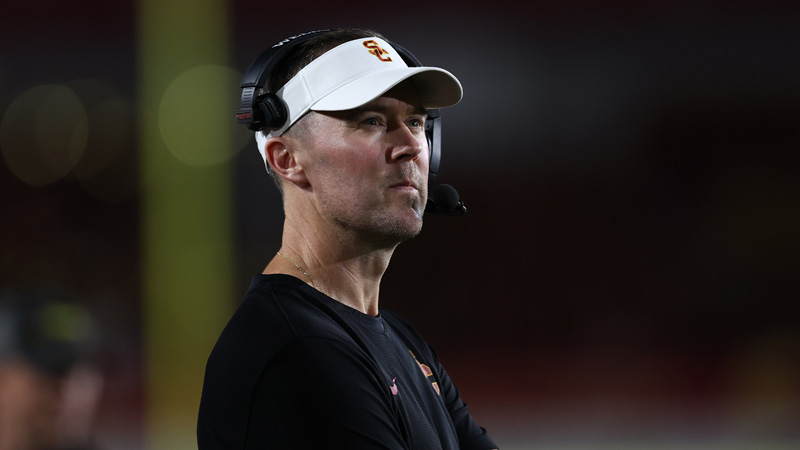
Los Angeles is a city built on sunshine, second chances, and the relentless pursuit of glory. But right now, the sunshine feels a little dim around USC, and a cloud of uncertainty hovers over the Trojans. Frustration is mounting, not just in the stands but in the program itself, and the man at the center of it all, head coach Lincoln Riley, knows exactly what everyone is asking. Is he thinking about leaving? Is the shine of that famous USC brand no longer enough? Is the pressure of a fanbase that once expected national championships every single year starting to feel like too much? Riley faced those questions head-on during a press conference Wednesday, and he did not give the kind of smooth, coach-speak answer that leaves people guessing. He looked into the cameras, let the question hang in the air, and answered with a clarity that felt both honest and necessary. “If I didn’t want to be at this place, I wouldn’t have come here in the first place,” he said. “If I didn’t want to be at this place, I’ve had plenty of opportunities to leave, and this is where I want to be. This is the right place for me. I’m the right person to be here. That’s as honest and transparent as I can be with you.” There is something almost defiant in that statement, a coach who feels the outside noise growing louder and wants to remind everyone that he made this choice. But in a city that loves drama almost as much as it loves winners, words only carry so much weight. The real answer will be written on the field, game by game, in the closing weeks of a season that has tested everyone’s faith.
The Trojans are sitting at 6-2, which on paper still sounds respectable, but anybody who has watched this season knows the records are hiding a much messier reality. This is a season of confusion, one where every victory feels like a near-miss and every defeat feels like a warning sign. USC’s Big Ten wins have come against teams that are struggling in conference play, and in at least two cases, Rutgers and Penn State, those opponents have losing records on the season altogether. Those are the kinds of wins that are supposed to build confidence, but they’ve instead left fans feeling like the team is merely surviving, not soaring. The losses, meanwhile, have been even more concerning. At home against Oregon, the Trojans watched Ducks quarterback Dante Moore leave the game with a head injury, and still somehow couldn’t take advantage, suffering a painful defeat in front of their own faithful. Then came the trip to Wisconsin, a game that was supposed to be a statement, a chance to prove that USC belonged in the Big Ten conversation. Instead, the Trojans were held to just seven points and lost on the road to a Badgers team that was hardly a juggernaut. That loss knocked USC out of the national rankings entirely. The unranked status feels like a punch to the gut for a program that still sees itself as a blue blood, a place where greatness is not just a hope but an expectation. And the confusion is not just about results; it’s about identity. This is a team that doesn’t quite know what it wants to be. It has moments of brilliance, flashes of explosive offense, and then lapses of discipline, execution, and energy that are baffling for a roster coached by someone of Riley’s reputation. Every week brings more questions than answers, and the frustration is no longer simmering quietly. It’s out in the open now.
To understand the weight of this moment, you have to look at the whole arc of Riley’s career and the enormous expectations that followed him to Southern California. At Oklahoma, he was seen as one of the brightest offensive minds in football, a young head coach who guided the Sooners to the College Football Playoff in three straight seasons from 2017 through 2019 and won at least ten games in four of his five years in Norman. He was the coach everyone wanted, the one who could turn quarterbacks into superstars and programs into contenders. When he left for USC after the 2021 regular season, it was treated as a seismic shift in the college football landscape. The Trojans weren’t just landing a great coach; they were landing their guy, the one who could restore the magic of the John McKay and Pete Carroll eras. But five years later, the results are decidedly mixed. USC is 41-20 under Riley, which is not a bad record by most standards, but it’s nowhere near the standard that was set. The Trojans have not made the College Football Playoff in his tenure. They came painfully close in 2022, but a loss to Utah in the Pac-12 Championship Game dashed those dreams in heartbreaking fashion. Since then, USC has seemed to be searching for the same rhythm that made Riley’s early Oklahoma teams so formidable. The move to the Big Ten only added another layer of challenge and another layer of scrutiny. In five seasons, the only double-digit win total Riley has produced at USC was that 11-win 2022 campaign. There is still time to rewrite the narrative, but the clock is ticking, and in college football, that clock moves faster than almost anything else. Riley is no longer just a young coach with limitless upside; he is a coach being measured against the very ceiling he once seemed destined to break through.
If there were ever a possibility that USC would decide to move on, the price tag alone would make anyone stop and think. Riley originally signed a reported 10-year, $110 million contract when he arrived, a deal that was supposed to provide stability and patience. But if the Trojans ever reached a point where they felt a change was necessary, firing Riley would involve an estimated $70 million buyout. That astronomical number is not just about money; it is about commitment. It is about the reality that a school doesn’t pay that kind of figure lightly, and that any decision to part ways would be a monumental statement, perhaps the largest financial commitment to a coaching change in college football history. The thought of that buyout is both a shield and a weighing anchor. For Riley, it means the school has invested too much to abandon him easily. For the fanbase, it can feel like being trapped in a relationship that isn’t working but is too expensive to end. Meanwhile, the coaching carousel around the country is starting to spin. Maryland, Baylor, and NC State are currently the Power Four schools with head-coaching vacancies, and every day that passes brings new speculation and new rumors. That doesn’t mean Riley is connected to any of those jobs, but it’s another reminder that the coaching world is unpredictable. A season like this can change careers, and even the most secure-looking coach can suddenly find himself at the center of a firestorm. Riley has said repeatedly that he wants to be at USC, but the uncertainty in the air is not going to disappear because of one press conference. It will only disappear through wins, consistency, and proof that the program is heading in the right direction. And that proof has been extremely hard to come by this season.
If there was any hope that the Trojans could ease their way through the final stretch of the regular season and regain some confidence, that hope vanishes the moment you look at the schedule. This is not a soft landing. This is a minefield. Up first: a home game on Saturday night against the Ohio State Buckeyes, the No. 2-ranked team in the country. Ohio State is exactly the kind of opponent that can make a struggling team look completely lost, and they are coming to the Coliseum with their own championship ambitions. After a much-needed bye week, the Trojans face a road game against the No. 4-ranked Indiana Hoosiers, a team that has been one of the surprise stories of the season and will be playing with nothing to lose. Then comes Maryland, which might be the only look at a more manageable opponent, but even that game carries danger because nothing has been comfortable for USC this year. And to close out the regular season, the Trojans travel to face their archrival, the No. 7-ranked UCLA Bruins, in a game that means everything to both sides of the rivalry and will be played in an atmosphere charged with emotion and pride. There is no way to sugarcoat it: this is a brutal road ahead. A 6-2 record could very quickly become 6-5 or 7-4, and with it, any remaining hope of a special season would disappear. The good news for Riley is that his teams have shown resilience in the past. The bad news is that the margin for error is essentially zero now. Every snap, every decision, every drive matters. The season is approaching its critical moment, and within those final games lies the verdict on whether USC is truly making progress or just treading water in an ocean of high expectations.
So where does that leave Lincoln Riley and USC? It leaves them at a crossroads, with the road ahead looking far steeper than anyone anticipated. Riley has said all the right things. He has reminded everyone that he chose this place, that he believes in this place, and that he believes he is the right person to lead this program back to greatness. There is genuine emotion in that statement, and anyone who has ever felt misunderstood or doubted can understand the frustration behind it. But in Los Angeles, where performance is everything and yesterday’s promise means nothing, the only thing that truly matters is what happens next. The fans are restless, the critics are loud, and the pressure is immense. Riley’s words offer a glimpse of his internal resolve, but they cannot block out the noise. They cannot stop the questions from coming if the Trojans stumble against Ohio State. They cannot erase the pain of a season that was supposed to look much more like triumph and much less like survival. What makes this story so human is that it is not just about X’s and O’s, buyouts, or rankings. It’s about a coach who left a secure, successful situation to chase something bigger, who took a chance on a place he loved, and who now finds himself fighting not only other teams but also the weight of expectation. It’s about a fanbase that has been waiting for a return to glory, and a city that worships winners. It’s about the exhausting, emotional, sometimes unfair nature of high-level sports, where a person can do everything the right way and still end up in the middle of a storm. Lincoln Riley isn’t going anywhere, at least not according to him. But the season will be the final word. And as the Trojans prepare for the most difficult stretch of their schedule, the only thing certain is that the next few weeks will reveal not only what kind of team USC is, but what kind of coach Lincoln Riley is. In a place like Los Angeles, under the bright lights, that kind of truth always finds its way out.