




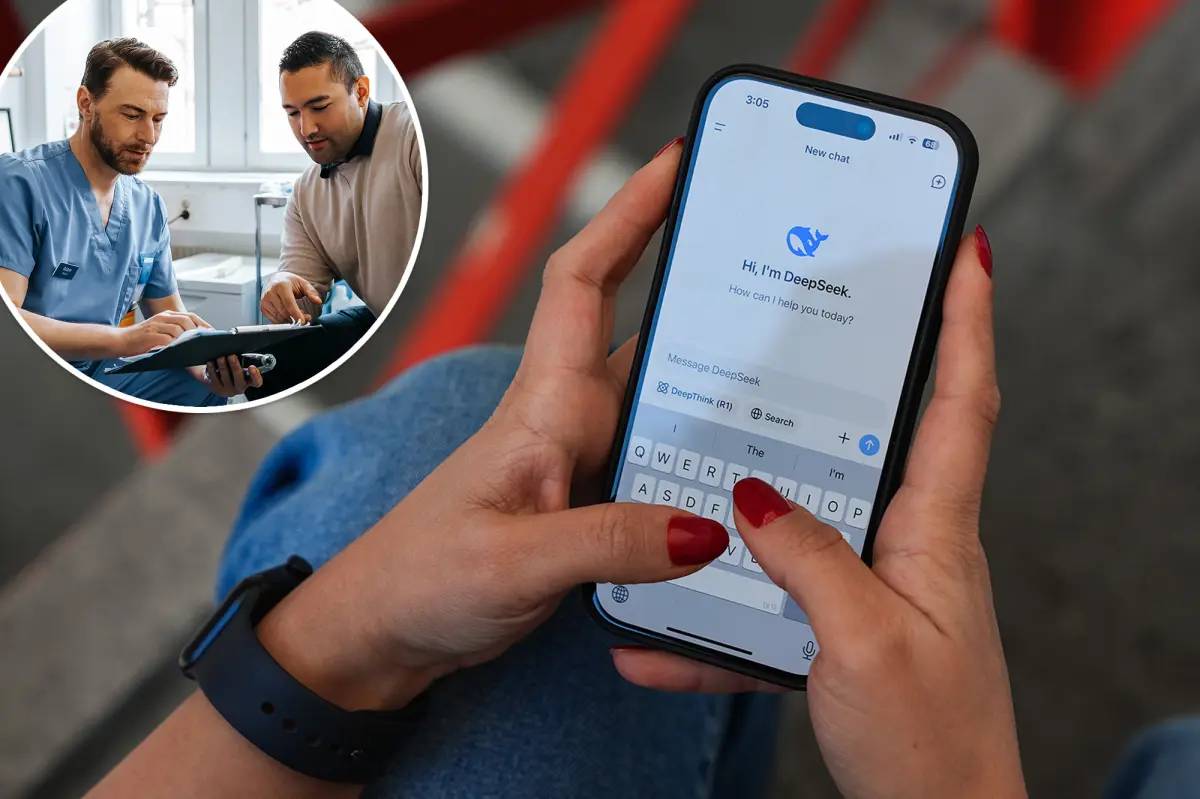
It’s 2 a.m., your child has a fever, and your mind is racing. You don’t want to wake the pediatrician, and the internet feels like a swamp of worst-case scenarios. So you type a question into an AI chatbot instead, and within seconds, you have an answer. That scene is becoming incredibly common, and it’s reshaping how Americans think about their health. According to new research from Talker Research for MD Live by Evernorth, one in seven Americans now trust AI chatbots as much as they trust a doctor. That’s a stunning number, but it becomes even more striking when you look at people who have actually used AI for health advice. Among those users, trust in AI as much as a doctor nearly quintuples compared to people who don’t use AI, and 60 percent say they would believe AI-generated health advice even if it directly contradicted what their healthcare provider told them. The survey, which included 1,000 millennial parents and 1,000 Americans from the general population, paints a picture of a society that is eagerly embracing artificial intelligence as a health companion—often without pausing to question its limits, its blind spots, or the ways their own behavior shapes the answers they get.
The most eye-opening finding is how often people act on AI advice without any medical backup. Nearly two-thirds of AI users, 63 percent, admit they have followed health advice from an AI chatbot without first confirming it with a doctor or other healthcare provider. That confidence seems to be fueled by the way AI delivers information. Half of respondents say that when AI gives them a clear or reassuring response about their health, they are likely to accept it without questioning it. It’s easy to understand why. AI is always awake, never rushes you, never judges your late-night panic, and answers instantly. For health-focused AI users, that convenience is the biggest draw: 37 percent say they rely on AI because it’s available at any time, 31 percent say it’s faster than seeing a doctor, and 30 percent say it provides reassurance about their health worries. These users are not just dipping their toes in; they are asking an average of nine health-related questions every week. That is a lot of medical guidance being absorbed from a system that many people don’t fully understand. Even more concerning, 28 percent of respondents admit they verify the AI’s answer less than half the time. So for a significant share of people, the chatbot’s word simply becomes the final word, no second opinion required.
Nowhere is this trend more visible than among millennial parents, who are using AI to make decisions about their children’s health with remarkable frequency. Among millennial parents who use AI for health purposes, 58 percent admit they have acted on AI-generated advice for their children without first checking with a healthcare provider. Many of these parents say they would be comfortable relying solely on AI for a range of important decisions involving their kids: 80 percent would trust it to evaluate minor symptoms, 71 percent would trust it to determine what type of care is needed, and 71 percent would trust it for medication guidance. On the surface, that sounds like engaged, proactive parenting. But there’s a hidden danger. When you ask a chatbot whether your child’s cough is just allergies or something more serious, you are getting a pattern-based guess, not a diagnosis grounded in an exam, a medical history, or a relationship with a clinician. Parents in the survey seem to treat AI as a wise, always-available pediatrician who never needs sleep. Yet unlike a real doctor, AI doesn’t look at your child, doesn’t listen to their lungs, doesn’t know their vaccination history, and doesn’t ask the follow-up questions that often make all the difference. The result is a generation of parents making high-stakes health decisions with a digital assistant that has never met their child.
Part of the problem is that Americans misunderstand how AI actually works, and they unconsciously sabotage its accuracy. Nearly eight in ten respondents, 78 percent, did not recognize that the way a question is worded influences the answer AI provides. People tend to think of AI as an objective oracle that simply pulls truth from the web. In reality, the output is heavily shaped by the input. More than half of respondents, 53 percent, admitted they have reworded or adjusted their health question when they didn’t like the first answer they received, including 27 percent who say they always do so. This is a form of leading the witness. Many AI users ask questions that nudge the chatbot toward a desired response: 38 percent describe symptoms and ask what could be wrong, 34 percent ask whether a symptom could be connected to a condition they already suspect they have, and 32 percent ask whether a specific diagnosis could explain what they’re experiencing. Dr. Maggie Williams, medical director of virtual primary care at MD Live by Evernorth, put it perfectly: “The survey indicates that people are often going to AI already hoping for a certain answer, whether that’s reassurance or confirmation of a fear. That’s very different from how a doctor works through a symptom with a patient, asking questions, gathering context and ruling possibilities in or out before reaching a conclusion.” In other words, when people approach AI with an agenda, they aren’t getting a medical opinion; they’re getting their own biases handed back to them in polished sentences.
The gaps in understanding don’t stop there. Many Americans have wildly inflated ideas about AI’s capabilities and sources. One in five respondents believe that AI only pulls information from trusted medical sources, and the same share of regular users believe AI factors in their personal medical history—even when that information has never been provided. This is a dangerous illusion. A chatbot cannot take your unique health background into account unless you tell it everything, and even then, it won’t truly understand it the way a doctor would. At the same time, many respondents actively withhold information from the AI while expecting it to give personalized advice. Forty-two percent admit they have lied about who they are submitting a health question about, often for privacy reasons. More than three-quarters of regular users leave out their medical history, demographics, and personal information due to privacy concerns—76 percent omit each of the first two, and 81 percent withhold personal details. It’s completely reasonable to want privacy from a machine, but it is not reasonable to expect precise, individually tailored medical advice from a machine you’ve deliberately kept in the dark. The consequences are already showing up. Nearly six in ten AI users, 59 percent, said they later realized that health information they received from AI didn’t fully apply to their situation. And almost half, 49 percent, say they acted on that information anyway before discovering it wasn’t the right fit. That’s a massive red flag: people are not just reading AI responses; they are changing their behavior, giving their children medicine, or avoiding care based on incomplete, inaccurate, or irrelevant advice.
Despite all of these problems, the survey suggests that the shift toward AI in healthcare is only going to accelerate. Americans do have some misgivings: 34 percent worry about receiving incorrect advice and 31 percent worry about the lack of human oversight. One in four people say they plan to use AI for even more healthcare decisions in 2027, and 27 percent say they would trust AI-generated information more if it were reviewed by a doctor. That last number is a hopeful sign. It suggests that people don’t really want to replace doctors with machines; they want the convenience of AI combined with the safety net of a human expert. Dr. Williams sees this as an opportunity rather than a threat. “The results show people will continue to turn to AI for their health care questions—and having people more engaged in their health is a good thing,” she said. “But healthcare providers add important clinical guidance by catching details a patient may not consider relevant, asking follow-up questions, and putting the information into the context of that person’s health history. As we consider a patient’s full care journey, it’s important to understand how AI and physicians can come together to provide the clearest picture to patients while ensuring appropriate safeguards and clinical oversight.” In an ideal future, AI isn’t a substitute for a doctor; it’s a starting point, a triage tool, a 2 a.m. comfort that helps you ask better questions and seek help sooner. But the survey is a powerful reminder that trust without understanding is dangerous. People need to remember that AI can be wrong, that it cannot see you, and that no chatbot will ever care for you the way a human doctor will. The best health decisions will come not from choosing between AI and a doctor, but from using AI to become more informed, more curious, and more prepared to have a real conversation with the human who ultimately holds the prescription pad.