


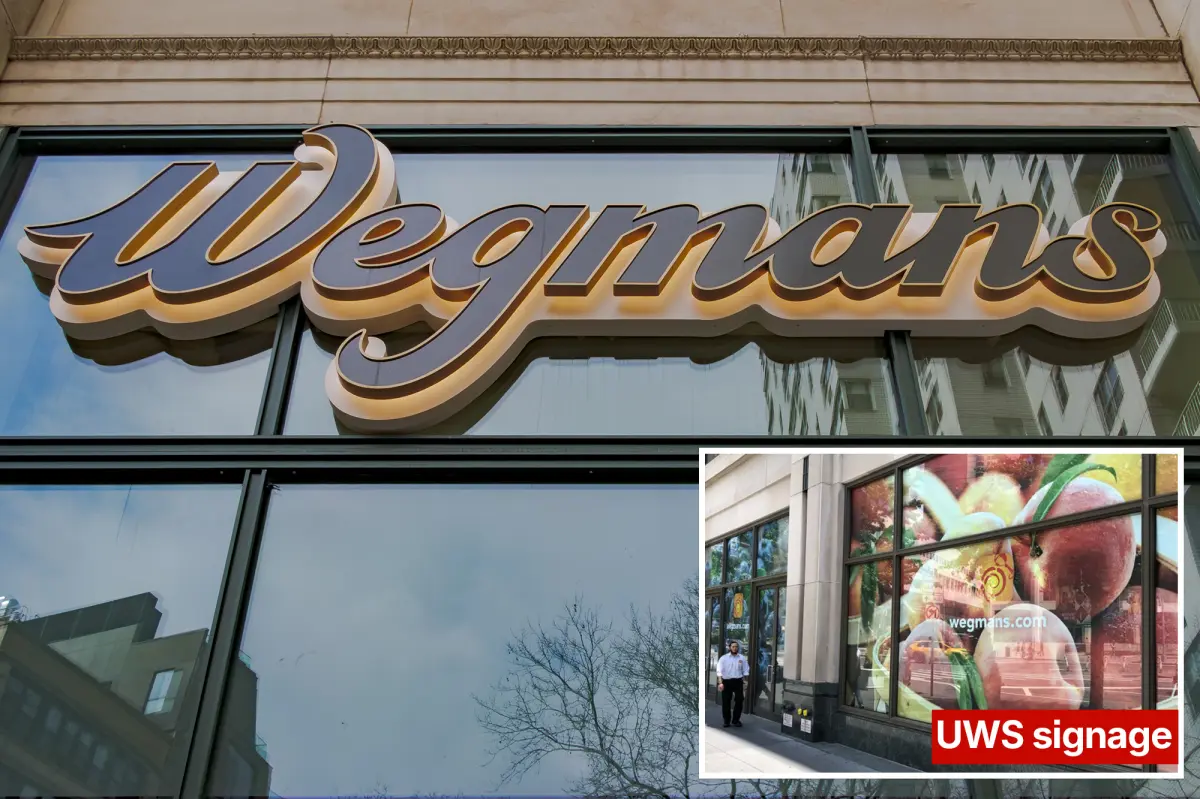
There’s a particular kind of Manhattan magic that happens when a big, beloved suburban grocery store decides to squeeze itself into the middle of the city’s concrete grid. It’s a promise of impossibly wide aisles, mountains of vibrant produce, and prepared-food counters that feel less like a daily errand and more like a tiny vacation from New York’s relentless pace. For Upper West Siders, that promise has been hanging in the air—literally—for more than two years, in the form of a blue Wegmans sign taped up on a dark, empty storefront that used to be a Bed Bath & Beyond. But this week, the dream took another wobbly, tentative step toward reality. Wegmans confirmed it is bringing its beloved aisles to 1932 Broadway, between West 64th and 65th Streets. The news came from company spokesperson Mandee Puleo, who revealed to West Side Rag that the premium grocer will take over the sprawling space in a prime location where teaser signage has hung since June 2024. For the uninitiated, Wegmans is not just a grocery store; it is a cultural touchstone, a place where families go to hang out, where high school students work their first jobs, where people drive across state lines just to lose themselves in a labyrinth of specialty cheeses and heat-and-eat meals. The idea that this sort of suburban grocery heaven could plant roots in the heart of Manhattan has always felt both thrilling and slightly impossible. And now, according to an official spokesperson, it’s actually happening. But the announcement came with a deliciously frustrating caveat: yes, the store is coming, but there is no timeline yet. Which, for anyone who has followed this saga, feels less like a breakthrough and more like another delicious test of patience.
Let’s rewind and trace how we got here, because the path has been anything but straightforward. The space at 1932 Broadway spent years serving a very different purpose. It was a massive Bed Bath & Beyond, a destination for fluffier towels, space-saving kitchen gadgets, and the kind of organized chaos that felt unmistakably American. But the retail apocalypse eventually caught up with the brand, and in early 2023, the Upper West Side location shuttered its doors for good during a wave of companywide closures and bankruptcy proceedings. The building didn’t stay quiet for long, at least symbolically. In June 2024, Wegmans signage went up, and the neighborhood collectively allowed itself a spark of hope. The storefront, however, remained stubbornly empty. Months dragged by. The sign stayed, the doors stayed locked, and no opening date ever appeared. According to company representatives, real estate negotiations with landlord Glenwood initially stalled at 1932 Broadway, forcing Wegmans to pivot its attention downtown. They focused on launching their massive 87,000-square-foot location at 770 Broadway in Astor Place, which debuted in 2023 to long lines, curious shoppers, and the kind of grand-opening energy that most grocery stores only dream of. It was a smart strategic move: establish a foothold in Manhattan first, figure out the logistics, and then circle back to the Upper West Side. Now that the downtown store is running smoothly, the company says it’s shifting its attention back uptown to finalize the UWS site. Spokesperson Puleo confirmed that the grocer is actively designing the layout and securing municipal permits. That sounds official. That sounds promising. But when West Side Rag asked directly whether this means the Upper West Side store is expected to open, Puleo reportedly answered with three small words that perfectly captured the uncertainty: “Yes. Just no timeline yet.” So the answer is yes, but the answer is also, technically, maybe. In Manhattan, that’s practically a commitment.
And yet, the internet has responded with the kind of collective skepticism that can only be forged through years of open-ended subway construction projects, last-minute concert cancellations, and endless “coming soon” signs that never come. Social media is practically a group therapy session for Upper West Siders who have been teased too many times. One cynical Redditor dismissed the announcement as “a plan for a plan.” Another darkly predicted that the opening date won’t arrive until 2030. An Instagram commenter, dripping with theatrical exhaustion, snarked, “The second coming of Christ has had fewer delays than this one.” Someone else laid out a painfully plausible timeline: “Let me get this straight. June 2024: signs are posted. It’s happening. Oct 2026: spokesperson confirms it’s happening. Feb 2029: do we get a date on when it’s happening?” These comments are funny, but underneath the humor is an honest, exhausted truth. New Yorkers have learned not to trust corporate announcements until they can physically walk through the revolving doors. The Upper West Side is a neighborhood that remembers the rise and fall of beloved institutions, the slow disappearance of independent bookstores, the endless rotation of banks and pharmacies and luxury condos that replace everything with character. It has watched storefronts sit dark for years, the way 1932 Broadway has, and it has learned that real estate deals in this city are fragile, messy, and often delayed by forces far beyond any spokesperson’s control. That’s not cynicism for its own sake. It’s a survival mechanism. People want to be pleasantly surprised, not repeatedly disappointed. At the same time, underneath all that snark, there’s a quieter, sweeter strain of hope. More than a few residents have already mentally planned their first shopping trip, drawing imaginary maps in their heads of where the bakery section will be, whether they’ll be able to grab a fresh pizza slice, and how many bags of their famous chocolate chunk cookies they can justify buying after a long day.
Because the Upper West Side is not just dense—it is fiercely local, opinionated, and protective of its sidewalks. The skepticism about timing is matched only by a deeper concern about what a Wegmans will actually do to the neighborhood’s fragile equilibrium. 1932 Broadway sits in a high-traffic zone, sandwiched between West 64th and 65th Streets, just steps from Lincoln Center, the Time Warner Center, and some of the most valuable residential real estate in the country. The idea of a suburban-style mega-grocery store opening in that space feels, to some locals, like a beautiful but chaotic invasion. One alarmed commenter voiced it plainly: “Noooo not this franchise on the West Side! It’ll definitely attract too many people and cause so much chaos and traffic! This isn’t the East Side! I hope people boycott.” It sounds a little dramatic, but there’s a real worry buried in there. The area is already choked with deliveries, ride-shares, buses, bikes, and strollers. A Wegmans would almost certainly pull shoppers from across the city, people who would flock there on weekends, block the bike lanes, double-park with hazard lights blinking, and crowd the checkout lines with carts the size of small bathtubs. There’s also the question of what it would do to the grocery ecosystem that already exists nearby—the smaller markets, the beloved local grocers, the corner bodegas that understand the neighborhood’s rhythms and greet regulars by name. Could a Wegmans undercut them? Could it turn the Broadway and 64th intersection into a circus? Absolutely. But there’s another side to that coin. Wegmans has a reputation for being more than a supermarket; it’s a civic gathering spot, a place where people linger, snack, and run into neighbors. It brings jobs, affordable everyday staples, and a level of prepared food that could genuinely make life easier for exhausted families and elderly residents who don’t fall into the “too cool for a chain” crowd. In a city that simultaneously loves to complain about big chains and mourns the loss of convenient shopping, a Wegmans might actually be exactly what the Upper West Side needs—if it doesn’t tear the corner apart first.
Then there’s the quieter, more uncomfortable issue hanging over the whole celebration: privacy. Wegmans’ existing Manhattan location at Astor Place has faced criticism over its use of facial recognition technology to identify customers. Store notices reportedly explain that Wegmans “collects, retains, converts, stores or shares customers’ biometric identifier information which may include facial recognition, eye scans, voiceprints.” That kind of language is enough to make anyone pause mid-checkout. In a city already saturated with surveillance cameras, subway scanners, and always-listening smart speakers, the idea of a friendly, family-oriented grocery store quietly scanning your face as you browse the olive bar feels invasive, even a little unsettling. What makes it stranger is that Wegmans has built its entire brand on being warm, approachable, and genuinely kind—the kind of place where employees are called “employees-owners,” and, theoretically, customers are treated like neighbors. The revelation of facial recognition technology seems to cut against all of that, turning the cozy shopping experience into something more clinical and watchful. The Astor Place store has absorbed the criticism, but so far, there’s been no clear answer about whether the Upper West Side location will adopt the same system. Wegmans hasn’t said a word on the subject, and for a neighborhood as socially conscious and politically engaged as the Upper West Side, silence is not likely to be accepted gracefully. There may be petition drives, angry community board meetings, or at the very least, a lot of grumbling at nearby cafés. On the other hand, the Upper West Side also loves a good grocery store, and convenience has a way of dulling even the sharpest political instincts. The question remains: will residents walk past a sign warning them about biometric data collection, or will they simply shrug and reach for their loyalty cards? It’s too early to say. But the privacy conversation isn’t going away, and Wegmans will eventually have to address it head-on if it wants to maintain the halo of wholesomeness that makes people fall in love with its stores in the first place.
So what should we believe on this ordinary Tuesday of an otherwise forgettable week? The most honest answer is that Wegmans is coming to the Upper West Side—or at least, Wegmans says it is coming. The company is actively designing the store, navigating municipal permits, and inching forward behind the scenes. That is real progress, even if the public only sees a lonely blue sign and an empty window. There is no official opening date, and in Manhattan, no date means no certainty. The space at 1932 Broadway remains, for now, a shell of potential, a monument to Bloomberg’s decade of construction delays, to red tape, to the slow grinding of real estate machinery that New Yorkers have watched a thousand times before. But the process is moving. That counts for something. Perhaps the most honest summary came from the West Side Rag itself, which asked the obvious question and got the obvious answer: yes, but no timeline. This is the point where the neighborhood divides into two camps: the optimists who already know exactly which shelf the peanut butter will be on, and the skeptics who mutter “I’ll believe it when I see it” every time the subject comes up at dinner parties. Both camps are valid. Both camps have a little bit of history on their side. But if New Yorkers are good at anything, it’s waiting. We wait for trains that never arrive. We wait for apartment renovations that take twice as long as promised. We wait for the seasons to change, and the weather to cooperate, and the line at the post office to evaporate. Waiting for Wegmans just becomes another item on the list, another shared story to roll our eyes about over brunch. And when—not if, but when—the doors finally swing open, there will be triumphant Instagram posts, long security lines around the block, and the unmistakable smell of fresh bread wafting out onto Broadway. People will crowd in like it’s the hottest club in town, which, in a way, it will be. But until that day, the sign stays up, the store stays quiet, and the Upper West Side holds its collective breath, one giant grocery cart away from the suburban grocery heaven it’s been promised for far too long.