

New York City is a place where the past and the present live in the same breath. On any given morning, commuters pour across the Brooklyn Bridge, tourists stand quiet in the shadow of One World Trade Center, and locals move through a city that has learned to absorb shock. But this week, that uneasy balance broke into the open. Two separate acts of rage left their mark on the city: a group of anti-ICE demonstrators deliberately blocked the Brooklyn Bridge during the middle of the workday, and a man was arrested for spray-painting a political slogan over the engraved names of victims at the 9/11 Memorial. Both acts broke the law, both disrupted the lives of ordinary people, and both unfolded while city leaders remained noticeably silent. It was a grim reminder that in a city already raw with political division, the anger of a few can cripple the routines of many—and even stain the most sacred spaces.
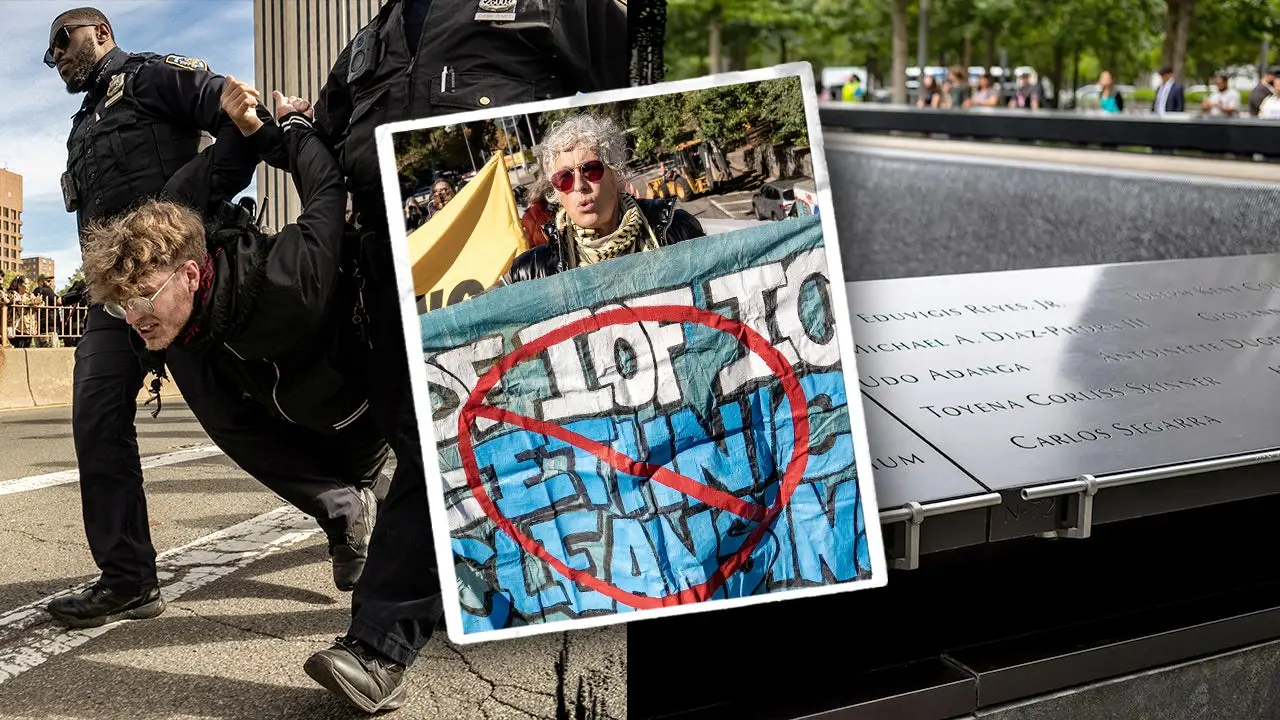
The Brooklyn Bridge blockade was not a subtle protest. Around 12:30 in the afternoon, a group of demonstrators opposed to Immigration and Customs Enforcement stationed themselves at the entrances to the historic bridge, turning a landmark of American engineering into a wall of bodies. Traffic backed up bumper-to-bumper as drivers honked, shouted, and pleaded for a way through. One frustrated driver was caught on video saying simply, “I just want to get to work!” It was a human moment in the middle of a chaotic scene—a reminder that for most people, the bridge is not a stage for political theater but a route to a paycheck, a doctor’s appointment, a school pickup, or a job that cannot wait. The demonstrators, though, were not interested in compromise. Through a megaphone, they chanted, “NYPD, KKK, ICE, they’re all the same!” The comparison was as inflammatory as it was inaccurate to many who heard it, and it deepened the sense that this was not an attempt to persuade, but to punish. The protesters also shouted “Free Oscar Bergal!”—a reference to a recent ICE arrest of a Dominican national in Manhattan’s Marble Hill neighborhood that ended with the man being shot during the operation. That case has become a flashpoint for activists, and the bridge protest was clearly meant to keep that fire burning. For about an hour, the demonstrators held their ground, snarling traffic and testing the patience of an entire city. Police eventually arrived, and by 1:30 the bridge was clear. The NYPD confirmed that fourteen people were arrested and that no injuries were reported. But the damage had already been done—not to the bridge itself, but to the trust that New Yorkers place in the idea that public spaces can remain open and safe for everyone.
Behind the chants and the blocked lanes was a larger story of anger, fear, and a political battle that has drifted far beyond policy debate. The arrest of Oscar Bergal, referenced in the protest chants, has become a rallying cry for those who see ICE as a brutal force targeting defenseless immigrants. In the weeks since the shooting, protesters have erupted in the Bronx, demanding answers and calling for the release of the man who, despite being in the country illegally, has become a symbol for activists opposed to aggressive deportation tactics. A federal judge has even intervened in the case, temporarily blocking his deportation, while local leaders have weighed in with their own demands. One official, whose name was invoked by gun-control activists in connection with the events, has pressured the Trump administration to release Bergal entirely. The result is a complicated emotional landscape: some see a man shot by federal agents in a residential neighborhood; others see an illegal immigrant who resisted arrest and endangered officers. The anti-ICE demonstrators who took over the Brooklyn Bridge clearly see themselves on the side of mercy, calling for an end to what they view as state violence. But in their rush to make that point, they wrapped themselves in tactics that only created more division. They blocked nurses, teachers, construction workers, and parents—people who had no say in the policy debate that has erupted around them. They screamed slogans that compared police officers to the Ku Klux Klan, a slur that does nothing to build bridges. And by turning a commute into a hostage situation, they guaranteed that their message would be heard not as a cry for justice but as an act of cruelty. Even those who sympathize with the concern over ICE tactics could recognize that the protest did more to breed resentment than to build solidarity.
The second incident was quieter but arguably even more painful. On Monday, a man later identified as Johnathan Tijerina, 31, was taken into custody after allegedly vandalizing the 9/11 Memorial with red spray paint. The message scrawled across several engraved names read “just stop killing kids”—a gun-control slogan, but one that cut deeply against the grain of the place where it appeared. The 9/11 Memorial is not just a tourist attraction; it is a sacred space, a field of names honoring the nearly three thousand people killed in the September 11, 2001 attacks and the February 26, 1993 World Trade Center bombing. Among those names are children, parents, firefighters, office workers, and ordinary people who went to work one morning and never came home. To cover those names with paint is to vandalize more than stone—it is to stomp on the memory of the dead and the grief of their families. Tijerina, according to officials, recorded himself committing the act and his organization, which called itself “Just Stop Killing Kids,” shared the video online. In a post, the group claimed that Tijerina had been arrested for spraying red paint on “Freedom Tower” and demanded that both President Trump and Mamdani, a New York official, enact what the group called “common-sense, highly popular demands” such as universal background checks and a national gun registry. The message itself speaks to a very real frustration over gun violence in America. But the method—desecrating a memorial to terrorism victims—reveals a profound failure of empathy. The people whose names were covered did not die from gun policy debates; they died because they were targeted by terrorists in one of the most devastating attacks in American history. Using their graves as a canvas for a protest sign is not activism. It is vandalism, and worse, it is a violation of the shared grief that binds the city to that hallowed ground.
The 9/11 Memorial & Museum responded quickly, with a spokesperson saying that security personnel and law enforcement had addressed the incident and restored the affected area to its commemorative state. “The 9/11 Memorial is a sacred place of reflection at the heart of a rebuilt World Trade Center that honors the 2,983 victims killed in the September 11, 2001 and February 26, 1993 terrorist attacks,” the spokesperson said. That statement was more than a press release—it was a reminder that some places are supposed to stand above politics. But the incident left a stain that could not be washed away as easily as paint. It prompted a melancholy question: How did a country become so fractured that even the names of the dead are no longer off-limits? There is a special irony in the slogan “just stop killing kids” appearing on a memorial that includes the names of young victims of terrorism. If the goal is to protect children, then respect for the sanctity of life should begin with the survivors and the memories of the fallen. Instead, the act turned a message of healing into an instrument of harm. It gave critics of the gun-control movement ammunition to dismiss their cause as reckless and disrespectful. And it made the families of 9/11 victims feel, once again, that the world has not gotten any safer or more decent. In a single spray-paint can, the perpetrator managed to alienate the very people who should have been his allies—anyone who believes that children should be allowed to grow up in a world free from violence. The ends may have been noble, but the means were a betrayal of the message itself.
Taken together, these two events reveal a troubling pattern in modern American protest. In trying to demand justice, some activists have abandoned the very principles that make justice possible: respect for others, respect for public space, and respect for the shared symbols that hold a community together. The bridge protest and the memorial vandalism were not isolated incidents; they were expressions of a wider impatience that has convinced some people that the normal rules of decency no longer apply. But the cost of that impatience is paid by the people caught in the middle—the commuter who just wants to get to work, the family visiting the memorial to honor a loved one, the police officers and security personnel who have to clean up the aftermath. City leaders, meanwhile, have remained quiet on both matters, leaving New Yorkers to wonder whether the silence is born of indifference or of fear. What happened this week should not be accepted as the new normal. A city that has endured the worst of human cruelty and rebuilt itself in the name of resilience deserves better than political slogans spray-painted over the names of its dead. It deserves better than bridge closures in the name of a cause that could be championed through honest, open, lawful debate. The anger underneath these acts is real, and it will not simply disappear. But the way forward cannot be through more pain imposed on innocent people. It has to be through dialogue, through lawful demonstration, and through a refusal to let the worst instincts win. New York has always been a city that fights, but it has also always been a city that remembers. This week reminded everyone just how deep that memory goes—and how fragile it can be when people lose sight of each other’s humanity.