


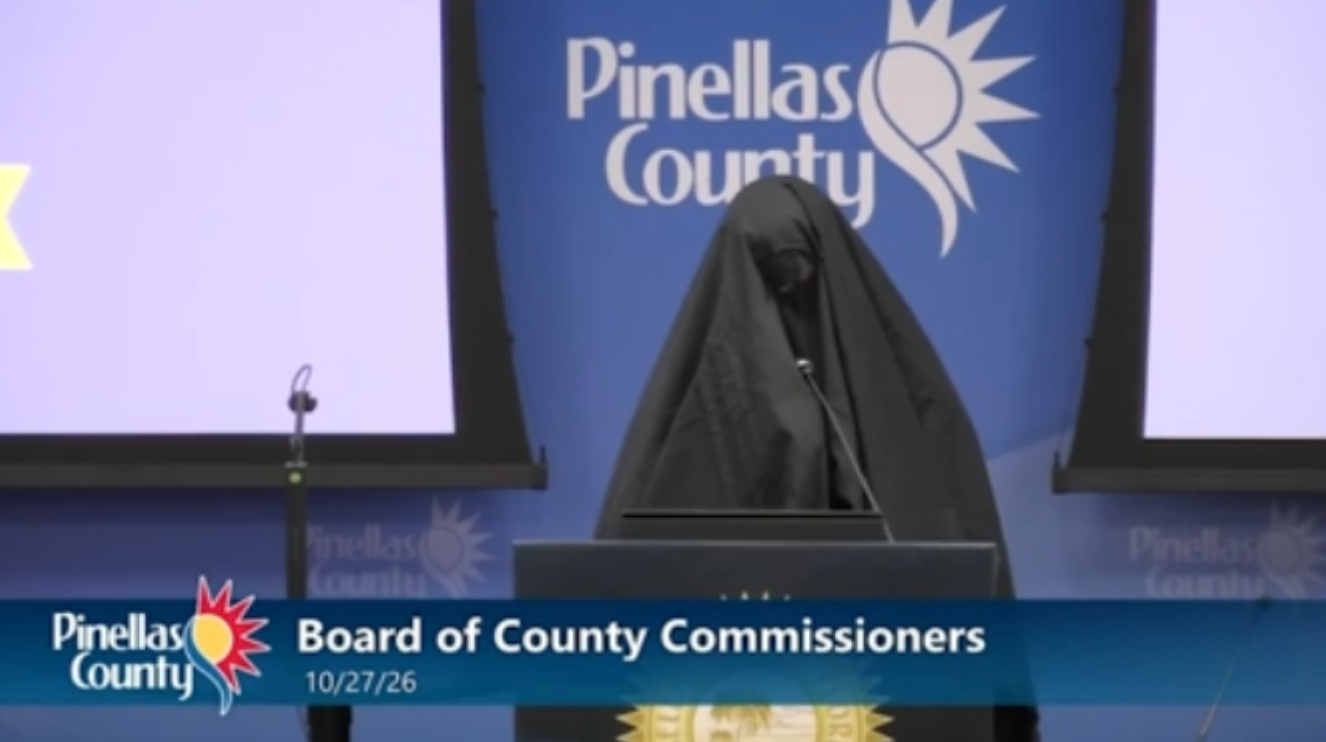
On an otherwise routine Wednesday in Pinellas County, Florida, the sort of afternoon where citizens file into the county commissioners’ meeting to talk about zoning, budgets, and local services, something unexpected unfolded. The room was filled with the familiar hum of public business—papers shuffling, chairs creaking, voices rising and falling as residents took their turn at the microphone. Then a woman stepped forward, dressed from head to toe in a black burka, with only her left eye visible. She approached the podium with a quiet, deliberate presence, and instead of speaking, she pressed play on a device. The ancient, haunting melody of the Islamic call to prayer, the adhan, filled the chamber. For nearly a minute, the sound—normally heard from minarets across the world—echoed through the government room, surprising some, stirring others. No one knew whether this was a solemn act of religious expression, a protest, or a provocation. But in that moment, the meeting stopped being routine, and the room became a stage for a modern American conflict over speech, faith, and the rules that hold public spaces together.
The chairman of the board, Dave Eggers, reacted quickly and firmly. Public comment time, he reminded the room, has rules. Residents are invited to come forward and speak their minds, but they are not permitted to play recordings. “Ma’am, you’re going to have to stop … stop the music, stop the tape,” Eggers said, interrupting the audio mid-stream. The woman remained at the podium, refusing to comply, and the sound continued to play. What happened next was swift: a deputy from the Pinellas County Sheriff’s Office approached the woman, guided her away from the microphone, and escorted her out of the meeting room and out of the building. It was a brief, almost mechanical enforcement of a local rule—no amplified recordings during public comments. No criminal charges were filed, and the sheriff’s office later confirmed that the woman was simply removed without further incident. For the officials in the room, the decision was likely straightforward: rules are rules. But for many watching, the image of a woman in a burka being led away by a deputy, her only visible eye fixed ahead as the call to prayer was silenced, felt like far more than a procedural footnote.
The atmosphere after her removal grew tense and volatile. No sooner had the deputy guided the woman out the door than voices erupted from the audience. Some shouted at Eggers, questioning his decision and the fairness of the removal. Others demanded to know why a religious expression—one sacred to millions of Muslims worldwide—could not be shared during a public meeting. The chairman raised his hands, trying to calm the room. “Please. Just please exercise some decorum and kindness of your own,” he said over the rising noise. “We’re all people living together here.” The words hung in the air, a plea for grace in a moment that was already becoming contentious. Eggers then took care to explain the board’s position, clarifying that the issue was not the content of the woman’s message but its form. “We don’t allow taped things,” he said. “You can record the meeting, but we don’t allow taped activity like that. We ask you to come here and make comments, and that was not a comment. That’s why she was asked to step out.” His explanation was calm, but the crowd’s frustration did not dissipate quickly. The scene reflected a deeper truth: public meetings are not just about agendas and votes. They are places where people bring their identities, their beliefs, and their grievances—and when those collide with rigid rules, the result is often raw emotion.
This incident in Pinellas County does not exist in a vacuum. Across the country, local government meetings have increasingly become arenas for intense cultural and religious confrontation. In Dearborn, Michigan, tensions have flared over Islamic displays in public spaces, with lawsuits accusing the city of being hostile to Christians and Jews. In other communities, religious figures have clashed with city councils over prayer, symbols, and the limits of free expression. A pastor in Dearborn recently unleashed a fiery speech at a city council meeting, declaring “enough is enough” amid escalating religious tensions. Meanwhile, in Texas, officers have had to walk back comments about the First Amendment after a preacher was cited at a pride event. These moments share a common thread: they ask us how to balance individual expression with the practical rules that keep civic institutions functioning. The First Amendment protects the right to speak, but it does not guarantee the right to play an audio recording at a public comment podium. Yet the rule is not the whole story. For many, the woman’s act was not simply a violation of procedure—it was a cry for recognition, a way of saying “I am here” in a country where religious minorities often feel invisible. When that cry is answered with a security escort rather than a conversation, it leaves wounds that no procedural explanation can fully heal.
To understand what the woman was trying to do, one must understand the sound she chose to play. The adhan is not music; it is a deeply spiritual summons, an Arabic call that begins with the words “Allahu Akbar”—God is great—and continues with affirmations of faith and an invitation to prayer. For Muslims, it is the voice of community, of daily rhythm, of devotion made audible. Hearing it in a county commission chamber, far from a mosque, would be jarring and powerful. It might have been meant as an act of worship, a protest against Islamophobia, or simply a provocation designed to expose the limits of tolerance. The woman gave no verbal explanation, and she wore a burka that concealed all but one eye, making it impossible to read her intent. She may have known exactly what she was doing—testing the board’s patience, demonstrating how quickly a sacred sound can be treated as a disruption. Or she may have sincerely believed that public comment time, that most democratic of spaces, was the right place to share something holy with her neighbors. The ambiguity is part of the tragedy. In a society that often asks outsiders to assimilate and follow unwritten codes, her silence left the room with no bridge. Rules were enforced, but no understanding was reached.
What remains is a lingering question: how do we live together when our expressions of faith and identity feel like noise to one another and like life itself to those who offer them? The woman did not face criminal charges—she was simply escorted out, asked to return another day. But the incident leaves a mark on the community. It speaks to the difficulty of public life in a pluralistic democracy, where everyone wants the right to be heard, but no one wants to be silenced, and where decorum often feels like a weapon used against the powerless. Chairman Eggers’ words—“we’re all people living together here”—were sincere, but they also revealed how fragile that living together can be. A single audio recording, a single refusal, a single deputy’s hand on a sleeve, and the trust that holds a room together collapses into shouting. Perhaps the most human response is to take the moment not as a victory for order or for expression, but as a lesson in the limits of both. The call to prayer was cut short, the meeting resumed, and life in Pinellas County went on. But the image of that woman—one visible eye, a sound of faith in her hands, and a community unable or unwilling to hear her—lingers. It asks us to consider what we sacrifice when we enforce the rules without the softening of compassion, and what we might gain if, after the tape is stopped and the podiums are cleared, we actually listened to one another’s hearts instead of turning away from the unfamiliar.