



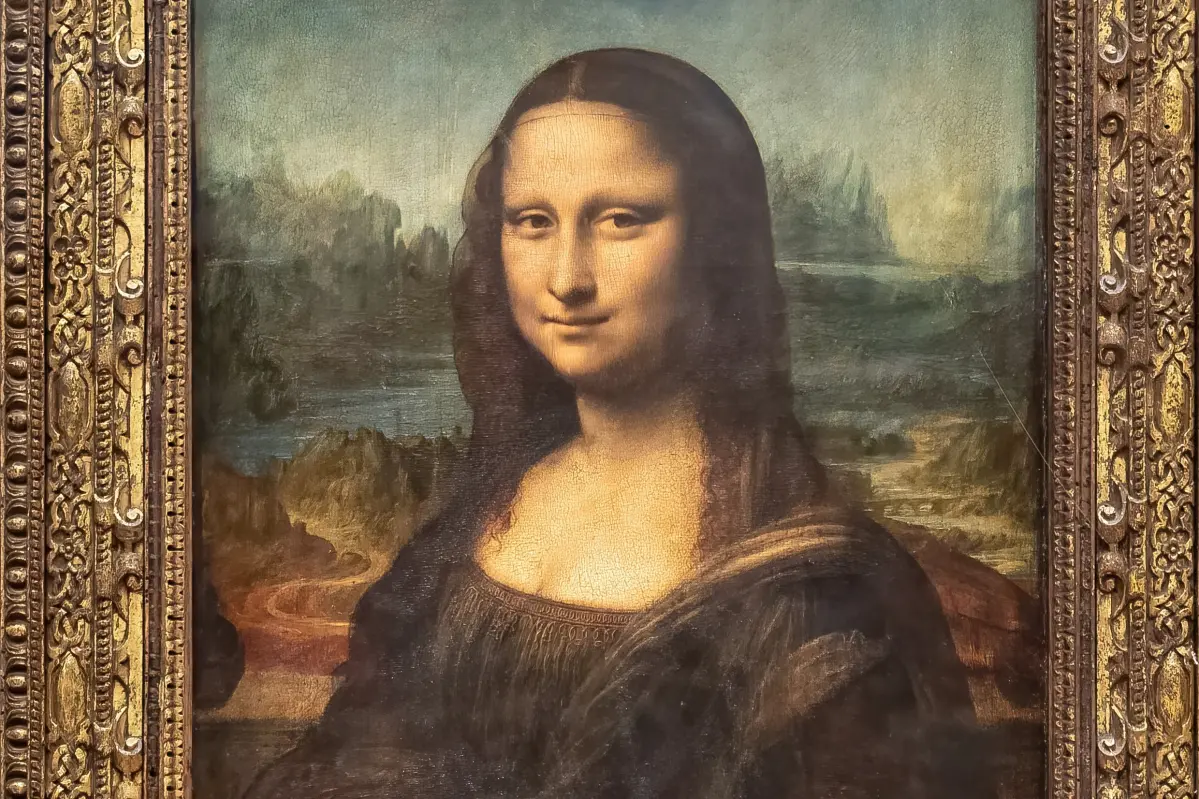
For five hundred years, the Mona Lisa has held the world in a quiet, half-smiling trance. She is the most examined, reproduced, and adored face in Western art, yet she has never seemed entirely reachable. That mysterious grin has inspired novels, songs, conspiracy theories, and countless hours of gallery contemplation. But this week, an Italian dermatologist has added a startling new layer to her story: the Mona Lisa, he argues, was probably not just smiling through a secret. She was living with alopecia areata universalis, an advanced autoimmune form of hair loss that would have left her without eyebrows, without eyelashes, and with a distinctive, receding hairline. Dr. Luigi Laino, a dermatologist in Rome, published his theory in the medical journal Clinics in Dermatology, and he points to four specific details visible on her face: the complete absence of eyebrows on both sides, the complete absence of eyelashes, a frontal hairline that stops abruptly without the usual soft transition of tiny hairs, and smooth, unblemished skin where hair should be. To him, these four clues are not random features of Renaissance beauty or artistic license. They are clinical signs. And once you see them, it is almost impossible to unsee them. The woman in the portrait, who has spent centuries as an object of aesthetic wonder, may have been quietly showing us a medical condition every time we looked at her. Her bare face was not a style or a mystery; it was a body telling the truth.
Understanding Laino’s diagnosis requires understanding what alopecia areata actually is. It is not the same as ordinary balding or the hair thinning that comes with age. Alopecia areata is an autoimmune disorder, meaning the body’s own immune system, for reasons that are still not fully understood, begins to attack its own hair follicles. In some cases, the attack produces small, coin-sized patches of hair loss. In more severe forms, it can advance to the point where all scalp hair disappears, and in even rarer cases, it becomes universalis, a form in which every hair on the body is lost, including eyelashes and eyebrows. The condition is often triggered or intensified by major stress, illness, grief, or hormonal changes. In the Mona Lisa, Laino sees all the hallmarks. The absent brows and lashes are not subtle; they are total and bilateral, affecting both sides of her face. Her hairline shows no gradual progression of fine, vellus hairs that normally blur the boundary between forehead and scalp; instead, it just stops. And crucially, her skin is not scarred, which helps distinguish alopecia areata from other conditions that can destroy follicles and leave permanent marks. Laino also points to something uncovered by multispectral imaging of the painting: a single fine hair above her right eye, a solitary supraciliary hair. Far from ruling out alopecia, he argues, that one surviving hair actually makes the diagnosis more convincing. Alopecia areata is often patchy; it can allow a single follicle to stubbornly cling on while everything around it falls away. For people who live with alopecia, the condition is never just an aesthetic issue. It changes the way they see themselves, the way they move through the world, and the way other people look at them. Eyebrows and lashes frame the face, and their absence can feel like a constant, public erasure of identity. To imagine the Mona Lisa as someone who experienced that reality is to imagine her not as an ethereal icon, but as a woman whose body was engaged in a quiet, private battle.
Laino believes the historical record makes that battle even more poignant. The real woman behind the portrait is widely believed to be Lisa Gherardini, a young Florentine who married a cloth merchant named Francesco del Giocondo. She was still a teenager when she became a wife and mother, and by the time she was in her early thirties, she had given birth to at least six children. Four of them died before reaching adulthood. In an era before modern medicine, losing children was devastatingly common, but the grief would not have been any easier to bear. At the same time, Lisa lived through a period of intense political instability in Florence, as well as religious upheaval and the recurring threat of plague. Her life, in other words, was a long sequence of pressures, and her body, like every body, would have registered those pressures in physical ways. For someone genetically predisposed to alopecia, one catastrophic stressor can be enough to trigger a major hair-shedding episode. Lisa Gherardini did not have just one stressor. She had a constellation of them: postpartum hormonal disruptions, the grief of losing four children, the ambient terror of war, political turbulence, and disease. Laino argues that it would have been almost impossible for her to keep a full, robust hairline under those conditions. The portrait Leonardo da Vinci painted around 1503 may therefore be more than a Renaissance showpiece. It may be one of the most intimate medical portraits ever made, a record of a woman whose hair loss was written on her face in plain sight, perhaps because, in the world of the sixteenth century, no one understood what they were seeing. The Mona Lisa may not only be lovely; she may also be a survivor, and her smile may be the smile of someone who knew more sorrow than any single expression could ever contain.
If Laino is right, the Mona Lisa would become the most famous person in history with alopecia, but she would be far from alone. In recent years, a number of prominent women have shared their own alopecia diagnoses, helping to demystify the condition and show the world that hairless beauty is still beauty. Jada Pinkett Smith made global headlines in 2022 when her alopecia-related hair loss became the subject of an Academy Awards moment, but she has spoken about the condition for years with remarkable candor. Viola Davis has also opened up about her struggle with hair loss, describing how she has learned to live with it and how it shaped her relationship with her own image. Lili Reinhart, best known for her role in Riverdale, revealed that she has alopecia and has used her platform to encourage others to embrace their changing bodies. And on the Netflix documentary series America’s Sweethearts, Dallas Cowboys Cheerleader Armani Latimer bravely shared her own alopecia journey, showing that even the polished, high-glamour world of professional cheerleading is not immune to this condition. The statistics are humbling: according to Pfizer, approximately 6.7 million Americans live with alopecia, and the condition crosses gender, age, race, and class lines. Meanwhile, somewhere between eight and ten million people visit the Louvre every year to stand in front of the Mona Lisa. There is something deeply moving in that juxtaposition. A face that draws millions of viewers may very well be a face with alopecia, which means that millions of people with the condition have been looking at an idealized symbol of beauty that may have looked a little more like them than anyone ever guessed. Recognition matters. To see yourself in a masterpiece is to understand that you were never as invisible as you feared.
Of course, interpreting a five-hundred-year-old painting is never a completely settled project, and not every art historian is likely to embrace Laino’s diagnosis without hesitation. Renaissance culture had its own beauty standards, and women sometimes plucked or shaved their hairlines to achieve a high, fashionably bare forehead. Eyebrows, too, were not always considered essential, and some artists intentionally omitted them in female portraits to create a sense of elegance or ethereality. In fact, people often point out that da Vinci’s Mona Lisa lacks eyebrows and wonder whether that was a deliberate artistic choice rather than a literal representation. Laino, however, pushes back against that explanation. He insists that the combination of total bilateral eyebrow and eyelash loss, the abrupt and unnatural frontal hairline, and the perfectly intact, non-scarred skin cannot be accounted for by fashion alone. Nor, he says, does the solitary hair revealed by multispectral imaging fit neatly with the idea of an artist merely painting a stylized face. In alopecia areata universalis, isolated hairs are a known clinical feature, and their presence actually reinforces the diagnosis rather than disproving it. It is possible that Leonardo, a famously meticulous observer of nature and human anatomy, simply painted what he saw. He may have been too honest, too devoted to the truth of the human form, to erase the marks of Lisa Gherardini’s condition. If so, the painting is not just a work of genius; it is also an act of respect. It preserves a woman as she really was, not as an idealized fantasy. Even if Laino’s medical conclusion is never accepted by every scholar, the debate itself is a reminder that the Mona Lisa remains a living document of the human body, and that art and medicine are not separate worlds. Both are ways of looking closely at a face and wondering what lies beneath the surface.
In the end, the most powerful result of Laino’s theory is not that it turns the Mona Lisa into a patient with a chart and a diagnosis. It is that it makes her more human, more reachable, more real. The smile that has haunted us for centuries no longer has to be an impossible, unreadable riddle. It can be read as the smile of a woman who had been through grief, stress, loss, and the daily struggle of a body that would not behave the way she might have wished. She still dressed well, sat for one of the greatest painters who ever lived, and faced the world with an expression of calm composure. In that light, her hairless brows and absent lashes are not imperfections. They are evidence of endurance. Laino closes his paper with a proposal that the most contemplated face in the history of art finally be recognized for what it has always clinically shown: a young woman with alopecia areata. That recognition does not diminish her. It deepens her. It transforms her from a mysterious object into a real person, someone who, like millions of people today, lived with something that made her look different and still refused to disappear from history. The next time you see the Mona Lisa, in person or in a photograph, let yourself notice her forehead, her eyes, the faint remnants of a hairline, the single stubborn hair above her brow. She was never a blank canvas of perfection. She was a woman who lost more than we can know, and still she smiled. That is perhaps the most human thing about her.