


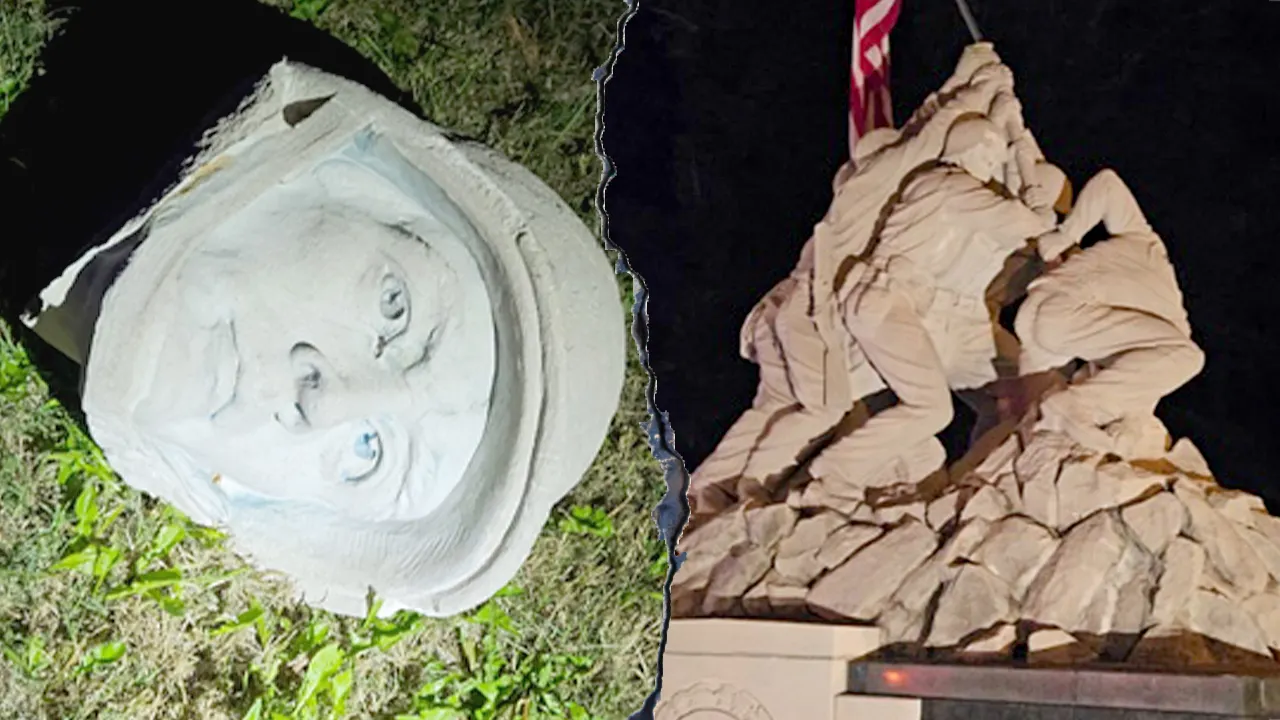
It was shortly after ten o’clock on the night of October 21 when Prince William County police officers arrived near the grounds of Marine Corps Base Quantico to confront a scene that would leave an entire community shaken. The quiet darkness of the Virginia evening had been broken by the unmistakable sound of metal striking stone. When officers reached the monument, they found a man standing over a nine-foot limestone sculpture, sledgehammer still in hand, the damage already done. The man, later identified as Miguel Alonso Maldonado Soriano, 27, had allegedly used that sledgehammer to attack the iconic Iwo Jima statue, smashing off the head of one of the Marines depicted in the sculpture and leaving serious damage to several other figures. For those who know the monument well—service members, veterans, local residents, and travelers who have paused before its silent tribute—the act was not simply vandalism. It felt like a violent blow against memory itself. On Monday morning, Maldonado Soriano appeared in Prince William County Circuit Court, where a judge granted him bond as he awaits further proceedings. He now faces multiple felony charges, including felony destruction of property, trespass with intent to damage property, and felony injury to a monument. His next court date has not yet been scheduled, but the case has already generated grief, anger, and a complicated conversation that extends far beyond the courthouse walls.
The attack targeted a sculpture that held deep meaning for many people, not just because it was old or valuable, but because of what it represented. The damaged work was a limestone depiction of the famous flag-raising on Mount Suribachi during the Battle of Iwo Jima in 1945. According to the Prince William County Police Department, Maldonado Soriano was found actively striking the monument with a sledgehammer in the moments before officers intervened. The resulting damage was extensive: one Marine figure’s head was completely removed, and other figures in the sculpted group were also struck, leaving the scene of triumph and sacrifice forever altered. Police estimated that the cost of repairing the monument would reach into the hundreds of thousands of dollars, a figure that speaks to both the physical intricacy of the sculpture and the profound care required to restore it. But for many who live in the shadow of Quantico, the cost is not just financial. The monument stood as a piece of public memory, a place where people could reflect on the courage of the Marines who fought on that Pacific island, the lives that were lost, and the bond between military service and the nation’s identity. To see it defaced in a sudden, violent act was to witness something more than the destruction of stone. It was as though a piece of history had been torn down, leaving an injury that cannot be measured in dollars alone.
The sculpture itself was created by Felix de Weldon, the same artist who would later sculpt the much larger Marine Corps War Memorial in Arlington, Virginia. That larger memorial, sometimes simply called the Iwo Jima Memorial, has become one of the most recognizable symbols of American military service. But the smaller limestone statue near Quantico had its own power, rooted in the same iconic photograph that captured six men struggling to raise the American flag on the desolate volcanic slopes of Mount Suribachi. That image, frozen in time, has come to represent not only the spirit of the Marines who fought in the Battle of Iwo Jima, but also the broader idea of endurance, brotherhood, and the willingness to stand together in the face of overwhelming odds. The battle itself was among the bloodiest of the Second World War, with roughly twenty-six thousand American casualties, including nearly seven thousand killed. The men who raised that flag, and the thousands of others who fought alongside them, did so without knowing whether they would ever return home. The monument along the road near Quantico was a way of honoring that sacrifice, a public reminder of a moment that helped define a generation. When the sledgehammer came down, it did more than break limestone. It struck a nerve, reopening a wound in the collective memory of a community that has lived with the legacy of the Marine Corps at its center for generations.
Now the legal process will determine what happens next. Maldonado Soriano has been charged with multiple felonies, and the judge’s decision to grant bond does not diminish the seriousness of the allegations against him. In Virginia, charges involving damage to a monument carry significant consequences, and prosecutors have made clear that they intend to treat this case with the gravity it deserves. The accused man remains entitled to the presumption of innocence, and the court will weigh facts, evidence, and testimony in the weeks and months ahead. But for the community, the road to healing will likely take far longer than the legal case. The damaged statue has become a symbol of local pride and military history, and its restoration will require not only money, but careful craftsmanship and a deep respect for the original work. Many will be watching to see how the case unfolds, what sentence might follow a conviction, and whether the legal system can deliver a measure of justice for an act that felt so personal to the men and women who have served, and to the families who have lost loved ones in service to their country. Whatever the outcome, the image of a man wielding a sledgehammer against a memorial to fallen Marines is one that will not quickly fade from memory.
The background of the accused man has added another layer of complexity to an already painful story. Federal sources told Fox News that Maldonado Soriano is a Mexican national who was in the United States illegally, and that he was at one point a recipient of Deferred Action for Childhood Arrivals, or DACA, under the Obama administration. According to those sources, he crossed into the United States illegally in December 1999—when he was only a small child, too young to make decisions about borders, paperwork, or the law. He was granted DACA in 2014, and his status was extended under the Biden administration in 2024 before it was not renewed under the Trump administration, with his protections set to expire in August 2026. The details of his immigration history have become part of the public conversation around the case, and they raise difficult questions that go far beyond the vandalism itself. Supporters of strict immigration enforcement see the incident as evidence of a broken system, while others caution against using the actions of one individual to characterize an entire community. The man accused of the attack is, in many ways, a complicated figure: someone who grew up in the United States, attended school, and lived under the protections of DACA, but who now stands accused of desecrating a monument to the very country that offered him a measure of stability. That contradiction has made the case even more painful, as it touches on issues of identity, citizenship, loyalty, and belonging.
Ultimately, the story of the damaged Iwo Jima monument is a story about what a community chooses to honor, and what it means when that honor is broken. The statue near Quantico was never just a piece of art; it was an invitation to remember, to pause, and to thank the men who gave everything for something larger than themselves. In the days since the attack, local residents have expressed shock and sadness, and efforts are already underway to assess the full extent of the damage and begin the slow, careful process of repair. But stone can be mended, heads can be recarved, and surfaces can be restored. What is harder to restore is the sense of safety and reverence that was shattered along with the sculpture. The incident has sparked discussions about the treatment of military monuments, the obligations of a nation to its veterans, and the ways in which political debates over immigration can spill over into real lives and real places. For the people near Quantico, however, the politics will always be secondary to the memory. They will look at the restored statue and remember what it stands for. And they will hope that out of this act of violence, something meaningful can be reclaimed: a renewed commitment to honoring the past, a deeper understanding of the complexities of the present, and a quiet determination to ensure that no sledgehammer, whether physical or metaphorical, can erase the sacrifice that the monument was built to celebrate.